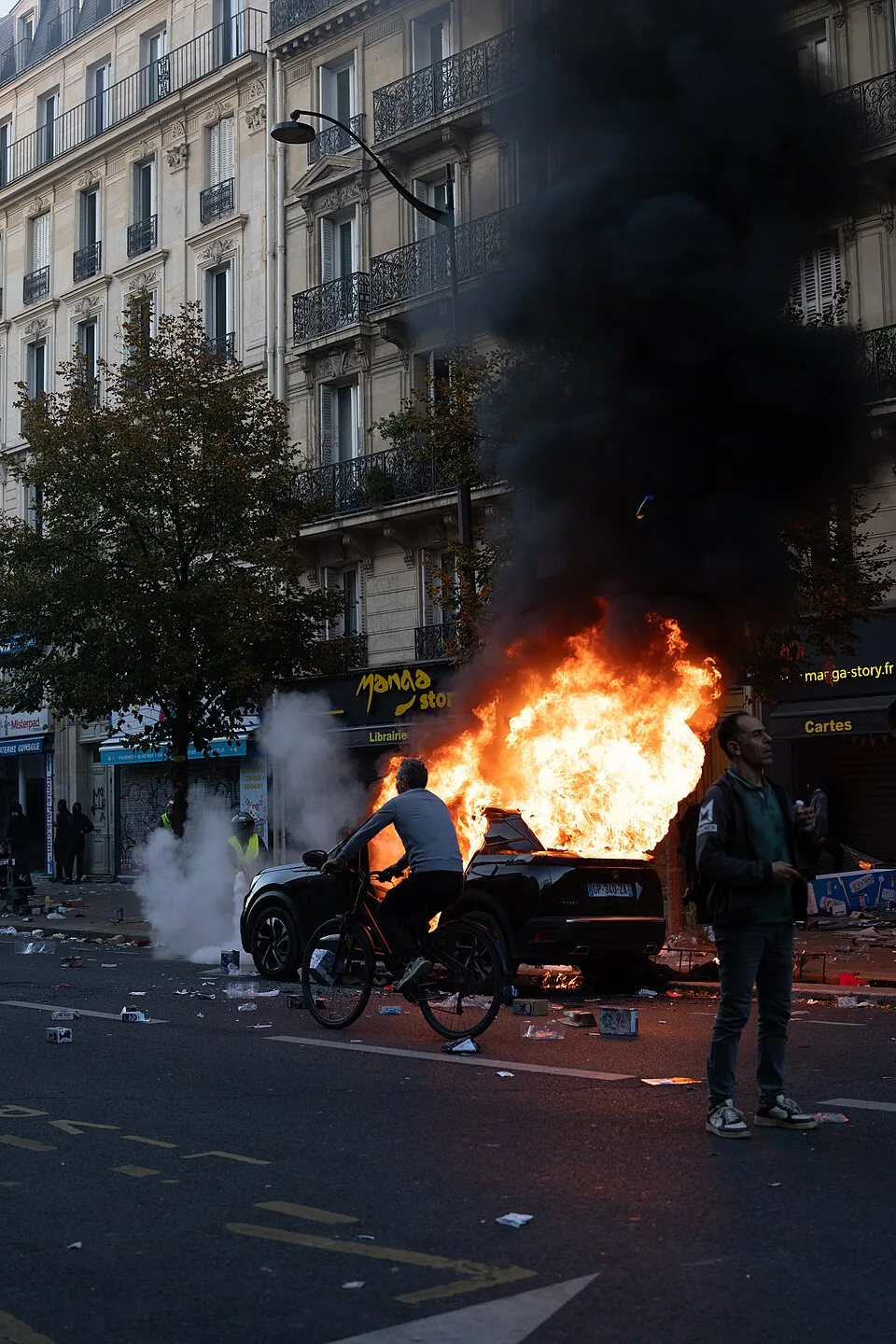
France has closed the Louvre, the Orsay, the Picasso Museum, and the Grand Palais. It has put up to 70,000 officers on the streets, backed by helicopters, armored vehicles, and water cannons. All of this started because one high school southeast of Paris did not have enough staff.
From One Understaffed School to a National Uprising
Let's start with how small this began. Last month, students at a single high school southeast of Paris protested staff shortages. That's it. Not a coup, not a manifesto, just teenagers saying the school needs more adults in it.
According to reporting from The Associated Press, via NBC News, that grievance has now swelled into a national movement. Students demanding better schools have been joined by workers demanding higher wages and pensions. More than half a million people took to the streets last Saturday. Some 3,000 shops across France were damaged or looted over the weekend.
This is what happens when a government treats a small, solvable problem as someone else's job. The problem does not stay small. It collects friends.
The Math Behind the Anger
If you want to understand why this spread so fast, look at the grocery bill and the heating bill. Energy prices in France were 21.3% higher in September than a year earlier. Overall inflation hit 3.1%, according to INSEE, the national statistics agency.
That is the kind of number that turns a staff shortage into a referendum on how a country treats the people who live in it. A school with too few teachers is a problem. A school with too few teachers during a winter when you can barely afford to heat your apartment is a cause.
And all of this is landing in the final months of Emmanuel Macron's presidency, which is a rough time to discover that your approach to governing has a ceiling.
Seventy Thousand Officers and a Very Short Route
Interior Minister Laurent Nuñez said up to 70,000 officers would be deployed nationwide, with helicopters, armored vehicles, and water cannons in support. The stated goal was to prevent another weekend of looting, burned cars, and attacks on public buildings.
The Paris march itself was confined to the city's southeastern edge, far from the center. Police changed the route on Friday, scrapping the planned Bastille-to-Nation march in favor of a stretch between Porte d'Italie and Porte de Vincennes. At Bastille, officers used a megaphone to tell people to leave or face a 135-euro fine.
Soumaya Abed, a 58-year-old nurse in a red CGT union vest, said she has joined protests for more than 30 years and had never seen a march start at Porte d'Italie. Thirty years of experience, and the authorities still found a new way to say please go protest somewhere nobody can see you.
Tear Gas in Lyon, Stun Grenades in Clermont-Ferrand
Not every city got the memo about staying calm. Police used tear gas in Lyon, where the rally had been banned. In Clermont-Ferrand, officers used tear gas and stun grenades to push back demonstrators trying to reach the city center, French media reported.
The Paris crowd, for what it's worth, was smaller than a week earlier. Several thousand people marched behind trade unions, followed by protesters in raincoats carrying flags and handmade placards. Raincoats and handmade placards. That's the intimidating enemy that requires helicopters.
Meanwhile, thousands also marched in Orléans in a separate, peaceful protest against the far right, as Marine Le Pen's National Rally held a two-day congress in the city. France is currently protesting on at least two fronts at once, and one of them is about the people waiting to profit from the first.
Boarded Windows and Empty Museums
The most telling images are the quiet ones. Gendarmes stood guard beneath the Arc de Triomphe while shopkeepers boarded up storefronts across Paris. Near the Saint-Lazare station, a 34-year-old contractor named Akram Ahmed was boarding up an optician's shop. "I got the call last night," he said. "The owner seemed desperate. He said I was saving his life."
The Louvre, the Orsay, the Picasso Museum, and the Grand Palais were all shuttered, the last of which has a major Cézanne exhibit on display. Art Basel opened to the public Friday for a single day, then organizers canceled the weekend program over the threat of unrest.
When the world's most famous museum locks its doors as a precaution, a government has stopped managing a crisis and started waiting one out.
Macron Offers a Meeting, Students Offer a Deadline
Macron did meet high school representatives on Friday. They said he promised to overhaul university admissions. They also called for the protests to continue until concrete measures are actually announced.
That's a reasonable position. A promise in a meeting is a promise in a meeting. These are students who started this over a staffing shortage, and they have now watched a president respond to it with a promise about a different part of the education system.
The movement has grown from one school to a national force because the people in it keep getting offered sympathy instead of solutions. They've noticed the difference.
The Dingo Take
In 1788, Louis XVI's government spent its energy managing the optics of unrest while the bread price kept climbing. Nobody in Versailles thought the thing in the street was serious until it was the only thing in the street. Macron is not Louis XVI, and this is not 1789, but the instinct is the same: move the crowd, close the monuments, and hope the anger is a weather system instead of a verdict.
Look at what the state chose to do this week. It did not fund the school. It did not touch the energy bills. It rerouted a march to the edge of town, closed the museums, and put 70,000 officers on duty. That is a government with an enormous budget for crowd control and a very small one for the reason the crowd exists. A staff shortage at one high school is a rounding error next to what this deployment costs.
The students have it right. Don't stop until there are concrete measures, because a meeting is not a measure, and a promise about university admissions does not put a teacher in an understaffed classroom. Boarding up the optician's window is easy. Fixing the thing that made people want to throw a brick at it is the actual job.



Comments