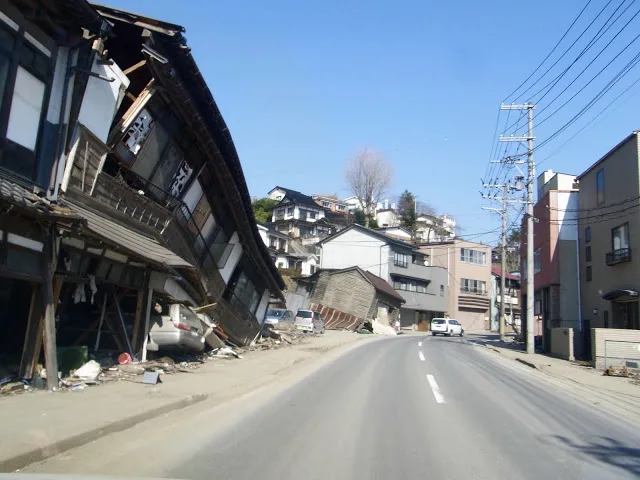
A magnitude-7.1 earthquake tore through Japan's Kumamoto prefecture on Tuesday afternoon, killing at least 13 people, partially collapsing a shopping mall, and knocking a freight train clean off its rails. Rescuers are still digging through rubble looking for survivors. Japan's meteorological agency is now warning that more quakes of similar intensity could hit within the next few days.
What Happened and Where
The quake struck Tuesday afternoon at a shallow depth of just 6 miles, with its epicenter roughly 12 miles south of Kumamoto city, a metropolitan area of about 700,000 people. NBC News reports that Prime Minister Sanae Takaichi confirmed the death toll at 13 and described the situation in stark terms: "Even now, there are people waiting to be rescued, and this is a race against time."
Tsunami warnings went out immediately after the quake and coastal residents were evacuated. The warnings were lifted shortly after, but by then the damage was already done. Roads were ripped apart, thousands of homes lost power, and the aftershock of the disaster was still rippling across one of Japan's most densely populated southern islands.
The Mall, the Factory, the Train
Two women in their 20s were killed at the Aeon mall near Kumamoto, which partially collapsed during the shaking. NBC News reports that eight people were pulled alive from the wreckage, four are still missing, and mall officials are now investigating whether a gas leak caused an explosion inside the building. A shopping mall. Collapsing. Possibly exploding. With people still inside.
At a Nippon Paper Industries factory in the city of Yatsushiro, Reuters is reporting that seven people are missing after a chimney came down. Soldiers have been deployed across the region to support rescue teams, and hospitals are treating dozens for injuries, including passengers who were aboard high-speed trains when the quake hit.
NHK, Japan's public broadcaster, reported that a freight train derailed entirely at Yatsushiro station. Aerial footage showed carriages overturned beside the track and the pillars of Yatsushiro Shrine collapsed into rubble. Bullet trains and some airport operations were still suspended as of Wednesday.
Historic Damage and a Castle That Can't Catch a Break
Kumamoto Castle, one of Japan's most recognizable historic landmarks, sustained fresh damage in the quake. NBC News notes that the castle was already under repair from a deadly earthquake in the exact same area back in 2016. That one killed 50 people. This castle has now been hit twice in a decade.
Beyond the castle, the broader infrastructure damage is severe. As of Wednesday, around 35,000 households remained without power, according to Kyushu Electric Power's website. Officials are also warning residents to watch out for heat stroke, because temperatures are climbing well into the 90s and a lot of people are suddenly without air conditioning in late July in southern Japan. The disasters are stacking.
Nuclear Plants Are Fine, But Everyone's Watching
Japan's nuclear authority confirmed that the Sendai nuclear power plant in the area was not damaged in the quake, and the International Atomic Energy Agency said Tuesday that it would continue monitoring the situation. So far, so good on that front.
But "so far, so good" carries an enormous amount of weight in Japan, where the memory of Fukushima is not abstract history. In 2011, a 9.1-magnitude quake and resulting tsunami triggered meltdowns at three reactors at the Fukushima Daiichi plant, a catastrophe that reshaped the entire global conversation about nuclear energy. Every major earthquake in Japan drags that memory back into the room.
More Earthquakes Are Coming
Japan's meteorological agency issued a warning Wednesday that should make anyone in the region deeply uncomfortable: expect potential earthquakes with a maximum seismic intensity of 7 in the next week, with the highest risk concentrated in the next two to three days, according to NHK.
This is not paranoia. This is geology. Japan sits squarely on the Ring of Fire, the seismically brutal zone where multiple tectonic plates converge. NBC News reports that nearly 20% of all earthquakes measuring 6.0 or higher on the entire planet occur in Japan. This country isn't unlucky. It is simply located on top of forces that do not care about human civilization, and it has built much of its infrastructure with that fact in mind. Much of it. Not all of it.
The Dingo Take
You are supposed to look at Japan's earthquake preparedness and feel reassured. The early warnings worked. The tsunami alert went out fast and was lifted when the threat passed. The nuclear plant held. The soldiers deployed quickly. And yes, all of that is real and genuinely matters when 13 people are dead instead of 130.
But four people are still missing inside a partially exploded shopping mall. Seven more are unaccounted for under a collapsed factory chimney. A freight train is lying on its side in a station. 35,000 families have no power in 90-degree heat while rescuers race against time through the rubble. "Working as designed" is not the same as "fine." Japan has some of the best earthquake engineering on the planet and it still looks like this.
The meteorological agency is warning that the next two to three days could bring more of the same. Rescuers are already exhausted, the ground is still unstable, and there are people under that rubble who are alive right now and waiting. That's where this stands. There's no uplifting pivot available here.



Comments