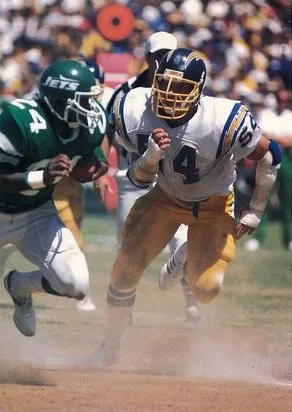
Billy Ray Smith Jr., one of the most beloved players in San Diego Chargers history and a College Football Hall of Famer, died Wednesday at 64 years old. His family confirmed he had been on a "long journey with dementia caused by CTE." Another giant of the game, gone too soon and in the worst possible way.
Who Billy Ray Smith Jr. Was
If you weren't a Chargers fan in the 1980s, you might not know the name. You should. Smith was a first-round pick out of the University of Arkansas, selected fifth overall in the 1983 NFL Draft, the first defensive player off the board in that entire class. He spent all ten of his NFL seasons in San Diego, never once suiting up for another team.
The New York Post reports that in 1986, Smith posted a career-high 11 sacks and forced four fumbles. The following year, playing in only 12 games because of the players' strike, he still managed to intercept five passes. By 1989 he was Second-Team All-Pro. Not a mercenary, not a journeyman. A Charger for life, in the truest sense of the phrase.
Before all of that, he was a monster at Arkansas. Two-time All-American. Team captain. 299 career tackles, 63 of them for a loss. Lou Holtz, who coached him in Fayetteville, once said: "Billy Ray is so quick he plays tennis with himself." That's the kind of thing coaches say about maybe one player per generation.
The Man Behind the Linebacker
Here is what separates Smith from just being a box score. The guy was genuinely, apparently, a force of nature as a human being. Chargers owner Dean Spanos, in a statement reported by the New York Post, called him "truly, larger than life. Always smiling. Lighting up every room he walked into."
Smith worked with teammates to create an after-school program called "Bates Street" for local kids. He met his wife, ABC 10News anchor Kimberly Hunt, during a United Cerebral Palsy telethon. After his playing days he became a fixture on San Diego television and radio. The man never really left the community that adopted him. He just changed uniforms.
In 2009, Chargers fans voted him one of the 50 greatest players in franchise history. He was inducted into the College Football Hall of Fame back in 2000, the sixth Arkansas Razorback to receive that honor. When he accepted, he said he wished he could have brought every teammate from those huddles with him. "Football is the ultimate team game," he said. "You feel a little bit uncomfortable getting so much praise."
The Kicker Story, Because It Deserves Its Own Section
In a 1985 preseason game against the Saints, both of the Chargers' regular kickers were sidelined with groin injuries. So they turned to their linebacker. Smith, who had last kicked a football in high school, lined up for a field goal with four seconds left and San Diego trailing 20-18.
He made it. Except the officials waved it off because he had tape on his kicking shoe. So, according to the New York Post, Smith threw the shoe away and kicked it again with no time on the clock. Made that one too. Chargers win 21-20. This is a completely real thing that happened and it tells you basically everything you need to know about the kind of player Billy Ray Smith Jr. was.
CTE Claims Another One
Smith's family released a statement saying he "faced his long journey with dementia caused by CTE with unmatched bravery, dignity, and strength." He was 64 years old. To put that in perspective: the average American man lives to 76. Smith lost more than a decade, and before that, who knows how many years were swallowed by the slow deterioration that CTE brings.
CTE, chronic traumatic encephalopathy, is a degenerative brain disease found in people with a history of repeated head trauma. The NFL spent years disputing its existence and its link to football. They lost that argument. What they haven't lost, apparently, is the ability to keep putting players on the field and collecting the revenue while the long-term tab gets paid by families like the Smiths.
Smith is survived by his wife Kimberly and their daughter Savannah. He was 64 years old. He should have had more time.
The Dingo Take
You are supposed to look at a death like this and call it a tragedy and move on to the next story. That is what the sports-media cycle is designed to make you do. Honor the man, post the highlights, fold the tent. And Billy Ray Smith Jr. absolutely deserves to be honored. He was, by every account, extraordinary, the kind of person who made a city better just by being in it.
But he was also 64 years old with dementia, killed by a disease that accumulates in the brain one hit at a time over a career that the NFL profited from enormously. The league settled a class-action concussion lawsuit for $765 million back in 2013 with a cap that researchers said was almost certainly insufficient. The checks kept rolling in for the NFL. The bills kept rolling in for the players. Smith is not the first and will not be the last.
The family called his journey one of "bravery, dignity, and strength." That's true and it's heartbreaking. A man who recorded 63 tackles for loss and kicked a game-winning field goal in his socks deserved a better ending than this. They all do.



Comments