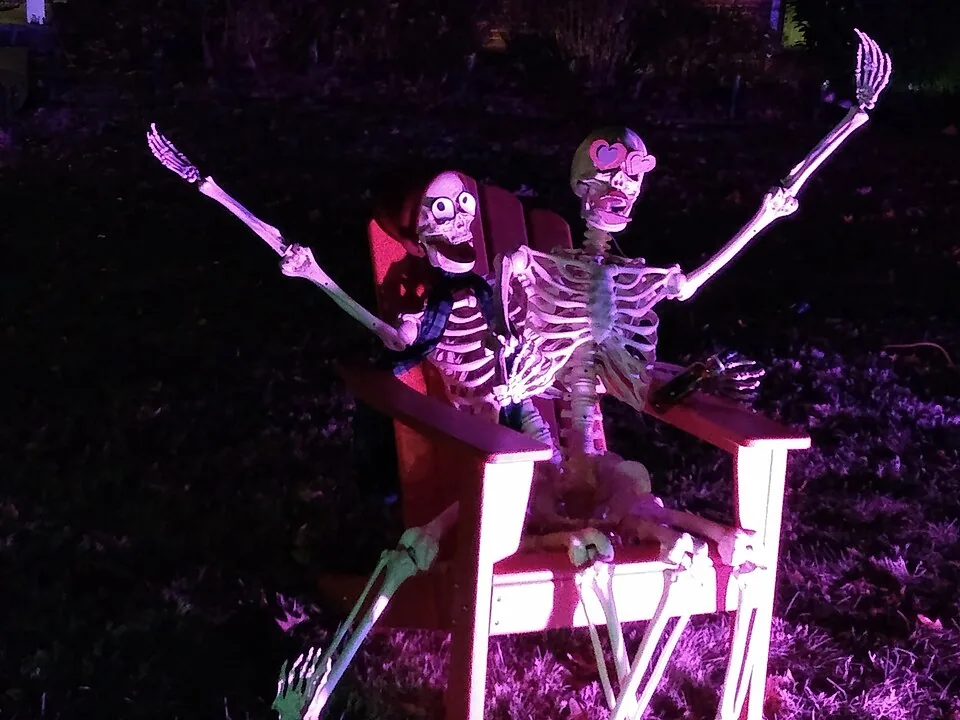
A guy in Holly Springs, North Carolina built a skeleton display so big it made the local news, felt a little weird about the attention, and decided to point it at something useful. Six years later, more than 600 households across the country are doing the same thing, and they've raised over $1.1 million for St. Jude Children's Research Hospital. Yes, this is a good news story. Please stay calm.
One Dad, Too Many Skeletons
In 2020, Jeff Robertson went "a little overboard" with his Halloween yard, according to Goodgoodgood's reporting on the project. We all remember 2020. Everyone was stuck at home, and a lot of people channeled their feelings into aggressive decorating. Robertson's skeleton army drew horror fans who drove hours just to see it.
Then came the family huddle. The attention was nice, but they wanted to take the spotlight off themselves. "How can we use this for good?" Robertson said. The answer was a fundraiser for St. Jude, and Skeletons for St. Jude was born.
Notice what didn't happen here. Nobody launched a podcast. Nobody monetized the haunt with a merch drop. A family looked at a pile of attention and asked where it could be sent instead.
The Numbers Are Getting Serious
The project has raised over $1.1 million so far. This is year seven, and the stated goal is $2 million. A week before Halloween, 202 households had already pinned their addresses to the "Fright Map" website so donors can find them. In total, 625 homes are signed up, and the haunt runs from Halloween through December 25.
That's a long season for a skeleton. Somewhere in America, a plastic corpse is going to spend Christmas Eve on a lawn next to a donation jar, and honestly, good for it.
The pitch from the organizers is simple: "Same haunt you already build. Way bigger reason." The money goes to a hospital where families don't get a bill for treatment, travel, housing, or food. Read that last part again and then think about the rest of the American health care system. We'll wait.
Forty Animatronics and a Personal Reason
In Grand Rapids, Michigan, Jeffery Broking spent October setting up more than 40 animatronics at his grandmother's house. He told WDIO that he's been dealing with seizures the past few years and has met lots of sick kids and their families. "I just want to give back," he said.
That's the whole mission statement. No branding consultant, no five-point strategy. A guy with a health struggle of his own decided to build a small mechanical nightmare and let strangers throw money at it for children's cancer care.
A 12-Foot Flaming Skeleton, Safely
Over in Willits, California, one house already had a 12-foot flaming skeleton burning on its lawn. Safely, the reporting stresses, which we appreciate. Participant Krystle Coffman said the household would be handing out candy and might have "a few special surprises."
In Delmar, Maryland, Elizabeth Stripling laid out skeletons, pumpkins, tombstones, and spiderwebs across her lawn and her neighbor's. She told WMDT that she was already decorating and already had skeletons, so why not turn it into an excuse to grow the collection. That is the most relatable motivation in the history of philanthropy.
Stripling, who directs outreach and training at the Kennedy Krieger Institute's Center for Autism Services, also made the point that matters most. Kids in the hospital on Halloween night might get a little light from knowing people out here are thinking about them and wishing they could celebrate with them.
Why This Works
The genius of the thing is how little it asks of anyone. You don't have to learn a new hobby or sit through a gala. If you already build a haunt, you put out a donation jar and tell your neighbors why. If you don't, you walk past a lawn, drop in a few bucks, and feel better about your species for the rest of the evening.
Halloween is already the one holiday where adults are encouraged to behave like children, spend money on nonsense, and decorate with dead things. Skeletons for St. Jude simply attached a purpose to the nonsense. It's a small trick, and it's raised more than a million dollars.
The Dingo Take
The official story about America right now is that we are a fractured, miserable country where nobody agrees on anything and neighbors can't stand each other. The facts in this story say otherwise. 625 households, strangers to each other, are quietly doing the same thing at the same time for sick kids they will never meet. No algorithm made them. No outrage cycle fed them.
Now, let's not get misty. A country where a child's cancer treatment depends on whether enough people in Maryland and Michigan feel generous in October is not a country that has solved anything. The fact that this fundraiser is so necessary, and so charming, is also an indictment. People shouldn't have to build 40 animatronics to keep families from getting a bill. But that's the system we have, and until someone with real power decides to fix it, give credit to the people filling the gap with plastic bones and donation jars.
So if you see a lawn with a skeleton army and a jar out front, stop. Put in some cash. The skeleton will not thank you, but a kid at St. Jude might get a better December because of it.




Comments