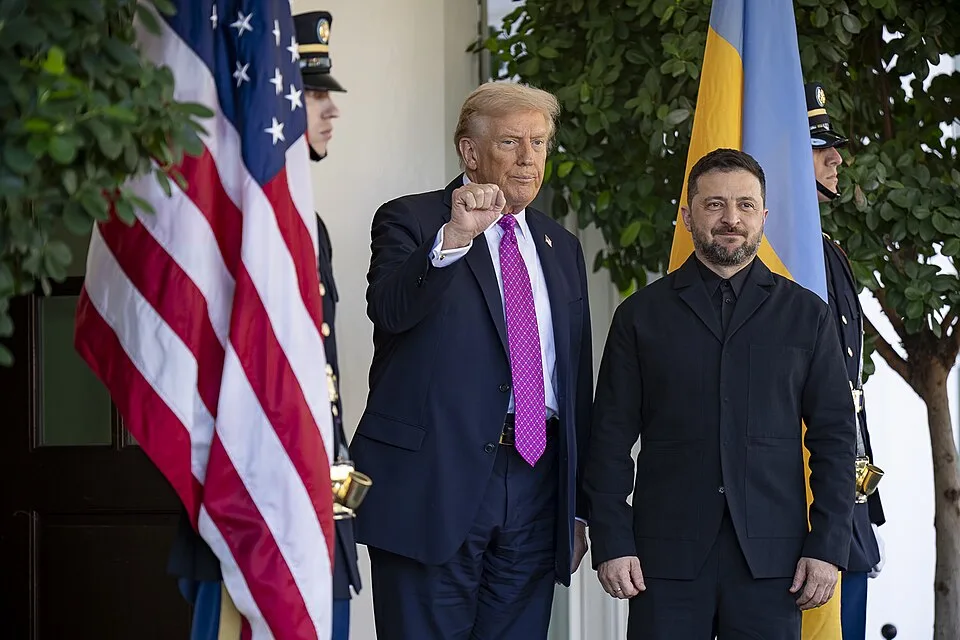
Ukraine's ambassador to the United States stood in front of reporters Thursday and said the relationship between Kyiv and Washington has genuinely, meaningfully improved. The baseline for that improvement, worth remembering, was a nationally televised humiliation in the Oval Office where JD Vance lectured Volodymyr Zelenskyy like a disappointing nephew. So. Progress.
Five Meetings in Six Weeks, Which Is Five More Than Most Expected
CBS News reports that Ukrainian Ambassador Olga Stefanishyna told reporters at a Christian Science Monitor breakfast Thursday that the "overall dynamics" of the US-Ukraine relationship have shifted, crediting recent personnel changes at the State Department and White House for helping move things along. In the past six weeks alone, Zelenskyy has had two phone calls and three in-person meetings with Trump, including one earlier this week.
That is a remarkable turnaround from February 2025, when Trump and Vance invited Zelenskyy to the Oval Office and proceeded to lecture him on camera in what many observers described as a set-up. The Ukrainian president left without a deal, without a commitment, and without much dignity intact. The fact that he has now spent more face time with Trump in six weeks than most allied leaders manage in a year suggests something has genuinely shifted in the calculation on both sides.
Ukraine Changed Its Pitch — And It Seems to Be Working
Stefanishyna made clear that Ukraine has made a deliberate strategic pivot in how it approaches the Trump administration. According to CBS News, Kyiv has moved away from asking for military, political, and moral support — the kind of language that lands with European allies but bounces off this White House like rubber — and started delivering concrete "deliverables" instead.
Those deliverables include defense industrial cooperation and a push to manufacture Patriot missile interceptors on Ukrainian soil. Raytheon has already sent teams to Ukraine. Lockheed Martin is seeking approvals to dispatch technical personnel. The White House asked for a full roadmap after the Zelenskyy-Trump meeting in Ankara. CBS News reports that the current production timeline estimates range from twelve months to five years, though Ukraine believes it can beat that. Whether you find this encouraging or terrifying probably depends on how you feel about the phrase "twelve months to five years" appearing in a sentence about air defense manufacturing during an active war.
"Ukraine should be this success case for President Trump," Stefanishyna said. Which is savvy framing. If there's one thing Trump responds to, it's being told he can win something.
The Winter Deadline Nobody Is Saying Out Loud
The urgency underneath all of this diplomatic optimism is real and specific. CBS News reports Stefanishyna said Ukraine is pushing hard to reach a ceasefire before what she called "the deadliest winter." That phrase is doing a lot of work. Ukraine has been through brutal winters since Russia's full-scale invasion began, and air defense has been the difference between civilian survival and catastrophe.
On that front, she acknowledged there have been no "firm commitments" for additional air defenses before winter, even with Defense Secretary Pete Hegseth present at the Oval Office meeting this week. Discussions are underway about long-term procurement deals and potential missile swaps with countries that already have existing contracts. That is diplomat-speak for: we don't have what we need yet, but we're still talking. With winter approaching and Russian missiles still flying, "still talking" is not exactly the phrase you want defining your air defense situation.
A Russian Missile Hit Poland. That Tends to Clarify Things.
Stefanishyna pointed to something concrete and alarming to make her case that this isn't just Ukraine's problem anymore. CBS News reports that a Russian ballistic missile reached Poland this week, and the ambassador used it directly: "We did our best to destroy this missile... but we were not successful."
This is the argument Ukraine has been making for years and the one Western audiences keep treating as an abstraction until it stops being one. A missile landing in NATO territory is the kind of event that has a way of cutting through the noise. Stefanishyna also highlighted Ukraine's long-range strikes into Russia as a "game-changer," noting that Russians are seeing missiles in places that, as she put it, "Russia has never seen any missiles, like for centuries." Whether or not that accelerates ceasefire talks or hardens Russian resolve is a question nobody has answered yet.
The Graham Bill, the Loomer Visit, and Other Signs of the Times
CBS News reports that Stefanishyna expressed hope that Congress will pass the bill Senator Lindsey Graham was working on before his death this month. The legislation would impose new tariffs on countries buying Russian oil and expand sanctions. She predicted that if signed into law within two to three months, it would have a "devastating effect" on Russia's ability to fund the war.
In what might be the single strangest paragraph to emerge from a foreign policy briefing in recent memory, the ambassador also addressed Laura Loomer's recent trip to Ukraine. Loomer, the conservative activist previously banned from multiple social media platforms for remarks too toxic even for the pre-Musk internet, visited Kyiv. Stefanishyna called the trip "impactful" and said she hopes it prompts more conservative influencers to visit. She declined to discuss the embassy's role in organizing it or who paid for it. She did confirm that her recommendation for Loomer to visit McDonald's in Kyiv was her own idea, and that Zelenskyy had "fun" during their interview. War is full of surprises.
Finally, CBS News notes that Stefanishyna announced she is stepping down as ambassador amid domestic political pressures and an ongoing asset-declaration investigation in Ukraine. She said Zelenskyy did not ask her to resign and wanted her to stay through the critical Patriot negotiations. Make of that what you will.
The Dingo Take
You are supposed to believe that the same administration that staged a public dressing-down of a wartime leader on live television as a power move has now, eighteen months later, become a good-faith diplomatic partner for that same leader. And here is the thing: the evidence suggests it might actually be partially true. Five meetings in six weeks is not theater. Patriot production roadmaps are not theater. Pete Hegseth sitting in an Oval Office meeting about air defense is at minimum a change in posture, even if it hasn't produced firm commitments.
But the gap between "improved dynamics" and "what Ukraine actually needs before winter" is enormous, and it is measured in missile interceptors and ceasefire timelines. Stefanishyna is doing her job, which is to publicly frame everything as encouraging so the Trump administration keeps taking her calls. That is smart diplomacy. It is also the only play available when your country is in its fifth year of a war, a Russian missile just landed in Poland, and your air defense stocks are not where they need to be heading into what your own ambassador calls the deadliest winter yet.
The Laura Loomer McDonald's anecdote is funny. The part where there are still no firm commitments on air defenses is not.



Comments