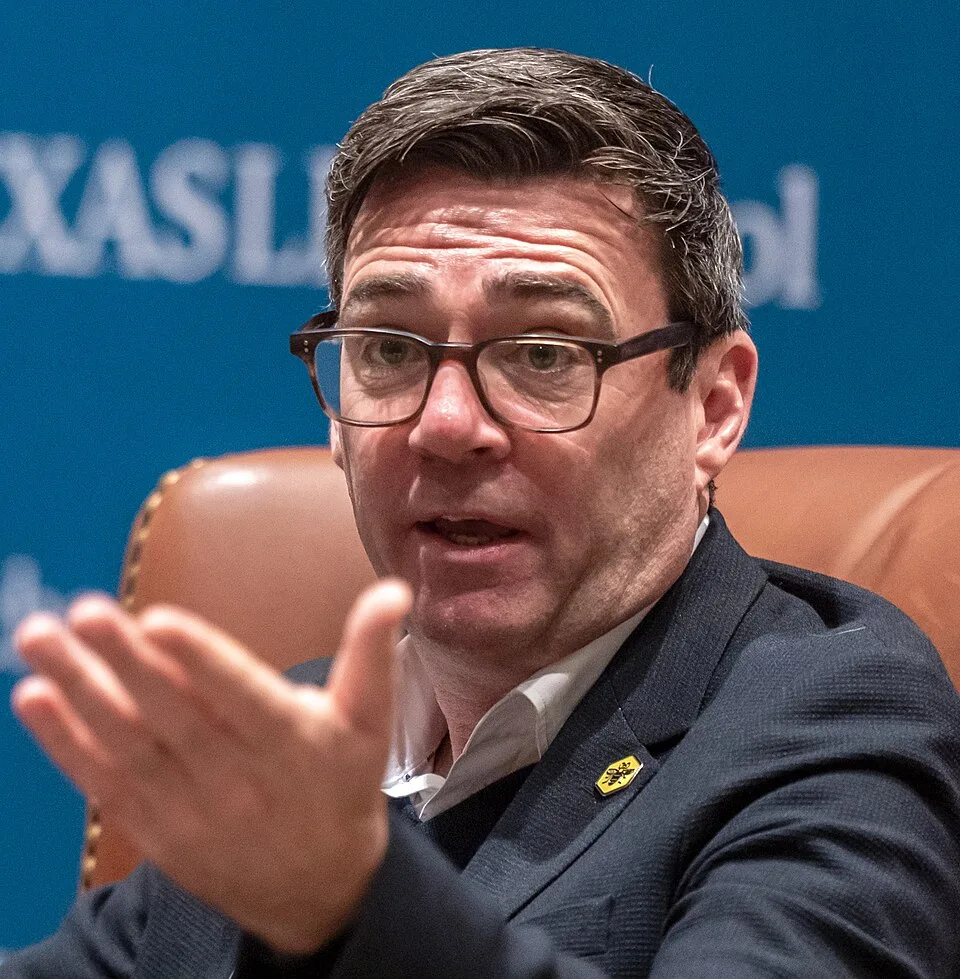
Andy Burnham has been prime minister for less than two weeks and his net approval rating is already up 17 points. Great start. Shame there's a functionally insane American president sitting on the other end of a phone he can barely predict, let alone influence. The question isn't whether Burnham can charm Trump. The question is whether Britain can stop needing to.
The Honeymoon, And The Orange Cloud Hanging Over It
By any early measure, Andy Burnham has nailed the opening chapter. No-notes speeches. Social media agility. An easy manner that has somehow won plaudits from a press that usually sharpens its knives before a new prime minister finishes the oath. According to polling cited by The Guardian, his net approval has climbed with every voter category except Reform UK supporters, and even some of them like bits of what they see.
That is a genuinely impressive start. It is also completely irrelevant if Donald Trump decides to do something catastrophic this afternoon, which, statistically speaking, is not out of the question.
Burnham watched what happened to Keir Starmer. The earliest signs of economic growth appeared earlier this year, green shoots poking through, and then Trump teamed up with Israel to attack Iran and the whole thing got torched. Starmer's careful, flattery-first strategy of managing Washington bought him precisely nothing when it mattered. Burnham has to reckon with that reality right now, not six months in.
The 'Handle Trump' Debate Is Already Exhausting
There are two camps forming around how Burnham should manage his relationship with the White House. Camp One says: do what Starmer did. Swallow your dignity, pile on the flattery, maybe offer to drill in the North Sea as a goodwill gesture. As The Guardian notes, some advisers are literally suggesting Burnham promise more fossil fuel extraction even while parts of Suffolk are actively on fire from climate-driven wildfires. Cool strategy, guys.
Camp Two says Trump is a bully and only respects strength, so stand up to him, accept the row, and come out the other side with your credibility intact. This sounds braver and is almost equally useless.
The Guardian's Jonathan Freedland puts it plainly: different world leaders have tried both approaches and both have failed, and sometimes succeeded, and the reason is that Trump has an attention span measured in seconds and changes his mind without logic, warning, or consistency. Senior US administration officials have admitted privately they have almost no sway over him. A British prime minister trying to manage Trump through the sheer force of relationship-building is not a strategy. It's a prayer.
The Real Answer: Stop Being So Dependent on a Chaos Agent
Here is where the analysis gets genuinely interesting, and where Burnham might actually have something to work with. If you cannot change Trump, and you cannot reliably influence him, the move is to reduce your exposure to him. That points somewhere very specific: Europe.
Britain's European neighbours have been quietly drawing the same conclusion and acting on it. As The Guardian reports, EU member states are pooling resources, borrowing collectively to make defence spending cheaper and more efficient, and running the SAFE loan programme, which is funding joint defence procurement to the tune of 150 billion euros. That is not a talking shop. That is a security architecture being built in real time, without Washington's involvement or permission.
Mark Leonard, director of the European Council on Foreign Relations, told The Guardian directly: "The EU is becoming a security community." Joint action on energy, cybersecurity, election interference, vaccines, climate, immigration. In a world that keeps finding new ways to become more dangerous, Europe is finding safety in numbers. Britain, their nearest neighbour, is standing outside in the rain watching it happen.
The Economic Case Is Just As Strong As The Security One
This is not just about bombs and tanks. There is a hard economic argument sitting underneath the security case, and it is one that fits Burnham's domestic agenda almost perfectly.
Spending defence budgets on European-made equipment rather than American hardware functions as an industrial policy. The French have understood this for decades. The Germans are catching up fast. According to The Guardian, Berlin has decided to spend only 8 percent of its massive 80-billion-euro rearmament programme on US weapons. The EU is shifting explicitly toward a buy-European approach. That means manufacturing. That means jobs. That means exactly the kind of reindustrialisation agenda Burnham has been talking about at home.
Burnham has already shown he is willing to tackle problems his predecessors ducked. This week he committed to taking on social care, which has been political poison for twenty years. The Guardian's Freedland argues that same boldness could extend to foreign policy, starting with an honest admission that the postwar foundation of UK security, dependence on the United States as guarantor, is no longer stable. A president who openly muses about abandoning NATO and threatened to seize Greenland from a NATO ally is not a guarantor. He is a liability.
What A Burnham Foreign Policy Could Actually Look Like
The pitch would be this: Britain cannot rely on Washington, Europe is building the alternative, and we should be inside that tent rather than outside it. It is a break from orthodoxy. It would cause a fuss. It would also be true.
The foreign policy implications of closer European security cooperation do not require Britain to re-join the EU, though The Guardian's framing makes clear the benefits accumulate faster if the relationship deepens significantly. It requires treating European partners as the primary strategic relationship, not a consolation prize after the Americans lose interest.
Burnham's opening pitch to voters has been that he will speak candidly, confront ducked problems, and break from orthodoxies that have held too long. A foreign policy built around European solidarity and reduced American dependence would be entirely consistent with that framing. It would also be, and this matters, actually useful in a world where Trump can incinerate your economic recovery before you've finished your morning briefing.
The Dingo Take
Britain has spent the better part of a decade telling itself it could have a special relationship with whoever happened to be sitting in the Oval Office, no matter how erratic, hostile, or actively deranged that person turned out to be. This strategy produced Brexit, a trade deal that never materialised, and Keir Starmer standing next to Donald Trump looking like a man trying very hard not to make a sudden movement near a large unstable dog. The results speak for themselves.
Burnham is starting with goodwill and momentum, which is more than most recent British prime ministers can say at this stage. What he does with it on the international front will determine whether any of the domestic agenda he's promising survives contact with geopolitical reality. The choice, as The Guardian's reporting frames it, is not really between being tough or being nice to Trump. It's between continuing to orbit an unpredictable superpower that has made clear it does not particularly care about Britain's interests, or building real relationships with the 27 countries sitting directly across the Channel who are in the process of constructing exactly the kind of collective security and economic architecture Britain actually needs.
One of those options requires swallowing a lot of post-Brexit pride. The other requires hoping that a man whose Gaza announcements are met globally with immediate scepticism will, at the crucial moment, come through for us. Andy Burnham did not get where he is by backing bad odds. He should stop pretending these are good ones.


Comments