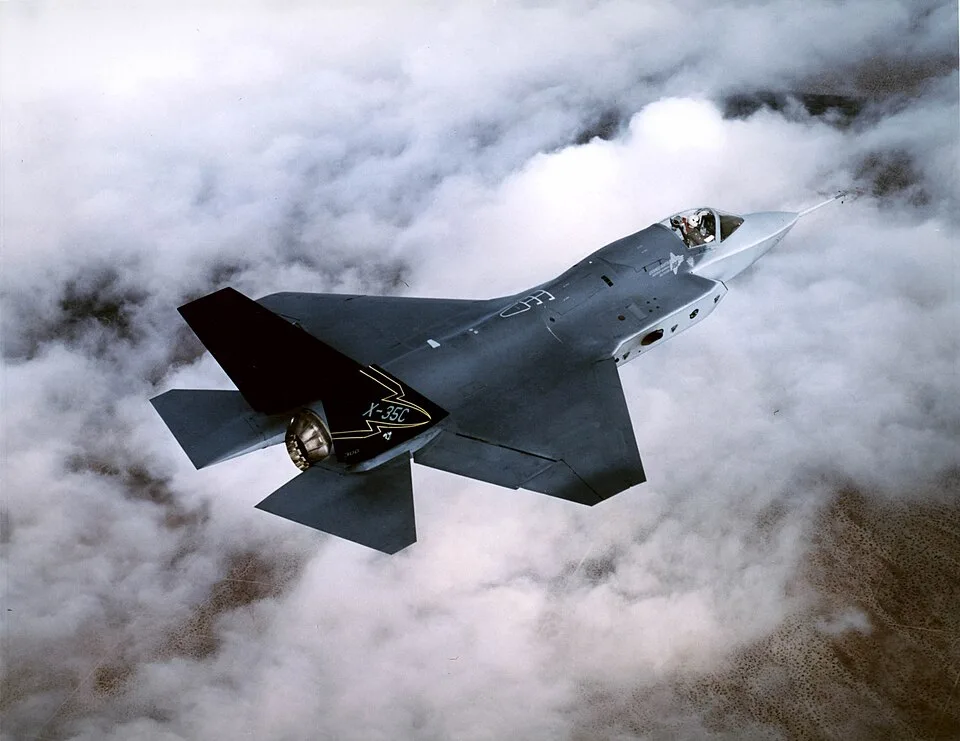
The United States Marine Corps managed to lose a $109 million stealth fighter jet on Friday morning, crashing it near their own air base in San Diego. The pilot ejected, survived with non-life-threatening injuries, and the Marines are now doing what the Marines do after they destroy a $109 million piece of equipment: launching an investigation that will take several months.
What Actually Happened
According to The Guardian, an F-35B fighter jet went down near Marine Corps Air Station Miramar on Friday morning, sparking a vegetation fire that San Diego firefighters had to come out and handle. The pilot ejected before impact and was transported to a local medical facility in stable condition. The Marine Corps confirmed the injuries were non-life-threatening.
The crash has been classified as a "Class A mishap," which is the military's way of saying this is as bad as it gets short of someone dying. The classification kicks in when damage exceeds $2 million, an aircraft is destroyed, or a service member is killed. Given that a single F-35B runs about $109 million, they cleared that $2 million bar with roughly $107 million to spare.
As of Friday, the cause of the crash remained unknown. The Marine Corps is being tight-lipped, referring press questions back to Miramar, where spokespeople are presumably sitting quietly in a room trying not to make eye contact with anyone.
The Plane Itself, Which Is Worth More Than Your Entire Neighborhood
The F-35B is one of several variants of Lockheed Martin's advanced stealth fighter, and it is specifically the fancy one with a vertical landing capability, designed for short takeoffs from aircraft carriers and amphibious assault ships. The Marine Corps, Navy, and Air Force all fly versions of the F-35. The "B" designation means it has a lift fan system that lets it hover and land like a helicopter, which is impressive right up until the moment it doesn't.
The $109 million price tag is for a single airframe, and that's before you factor in maintenance, fuel, training, and the assorted infrastructure required to keep one of these things flying. The F-35 program as a whole is the most expensive weapons program in Pentagon history, with a lifetime cost estimate that has crept past $1.7 trillion, according to previous Pentagon reporting. Every time one of these goes down, that number gets a little worse.
This Is Not the First Time This Month
Here's the part that should make you put your coffee down. The Guardian reports that just last month, a Marine fighter jet crashed in Washington state. Federal authorities called that one a "non-fatal aviation mishap," according to the Yakima Herald-Republic. The Marine Corps is apparently having a summer.
Mishap investigations, the Marines note, can take several months to complete. Which means answers about what sent a $109 million aircraft into the ground outside San Diego on a Friday morning are probably not coming before the holidays. Maybe not before next summer, either. Sit tight.
San Diego's Friday Morning, Ruined
San Diego Fire spokesperson Candace Hadley confirmed to The Guardian that firefighters were dispatched to deal with the vegetation fire that broke out near the crash site. So in addition to managing a downed military jet, first responders got to spend their Friday morning stamping out a brush fire in the California heat.
Hadley referred further questions to Miramar, which is the official San Diego way of saying "this is above our pay grade and we are not touching it." The crash site's proximity to the base raises its own questions, none of which the Marine Corps has answered yet.
The Dingo Take
A $109 million aircraft is gone. It is sitting in pieces somewhere near a Marine base in San Diego, and the people responsible for it are telling us to check back in several months when the investigation wraps up. That is the deal the American taxpayer gets. You fund the most expensive weapons program in the history of human civilization, and when a piece of it falls out of the sky, you wait in line for answers behind a military bureaucracy that moves at its own pace, thank you very much.
Two Marine aircraft down in two months is not a trend anyone should be comfortable dismissing as coincidence. Maybe it is. Maybe these are two totally unrelated incidents and the F-35 program is humming along fine and this is just the acceptable attrition rate for operating extraordinarily complex machinery. Or maybe there is a pattern here worth taking seriously before a third one goes down somewhere populated. The investigation will tell us. In several months.
The pilot surviving is genuinely good news, and credit where it's due, the ejection system worked and the guy is going to be okay. But "the pilot lived" is a pretty low bar for a $109 million aircraft operated by the most powerful military in the world. We should probably want more than that. At minimum, an explanation faster than the one currently on offer.





Comments