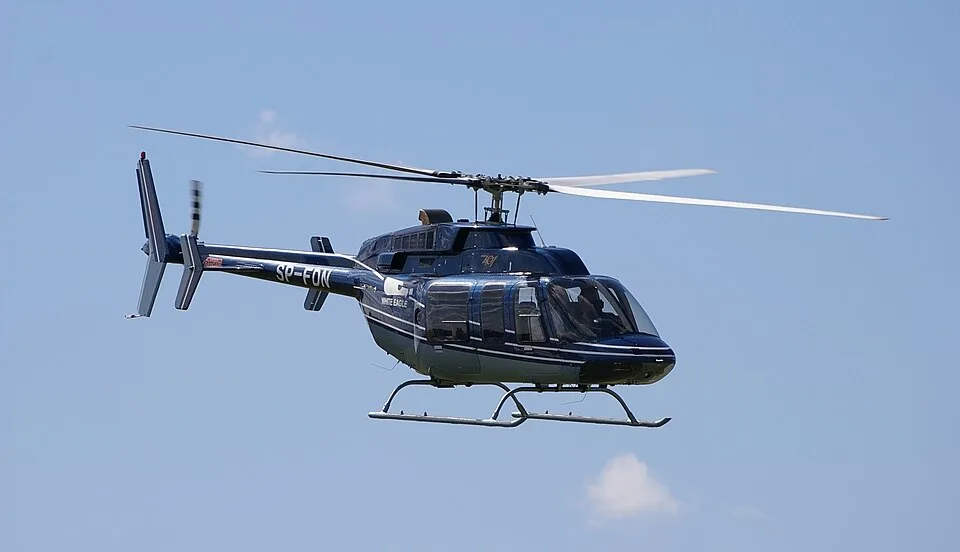
Two firefighting helicopters collided in midair over Greece on Sunday, killing two crew members and sending one aircraft into the ground while the pilots were actively trying to save people from a wildfire. This is where we are now. The fires aren't just destroying the land — they're killing the people we send to fight them.
What Happened Over Psatha
According to CBS News, both aircraft were Bell helicopters operating over the Psatha area west of Athens, each carrying a two-person crew. Footage captured one helicopter crashing to the ground after the collision. Of the four crew members, two were killed — one Greek national and one Danish — and two others, one Greek and one British, were pulled out alive.
The crash didn't happen in some freak isolated incident. It happened in the middle of a full-scale wildfire operation in which nearly 500 firefighters and 23 aircraft had already been deployed. The skies over western Attica were crowded because the situation on the ground demanded it. Gale-force winds were pushing flames through dry forest at a pace that crippled the response, and some aircraft couldn't even reach the sea to collect water because the conditions were that bad.
This is what a crisis looks like when it compounds. Bad fire. Worse wind. Aircraft in the sky trying to do the impossible. And then two of them hit each other.
A Fire That Was Already Catastrophic Before Sunday
The blaze started Friday near Agios Vasileios and tore toward Porto Germeno and into the forested mountains west of Athens. CBS News reports that 254 people were evacuated by sea on Friday alone, with another 12 on Saturday — sea evacuation being the last option when fire and smoke seal off the roads from coastal communities. Let that sink in. These people weren't driving out. They were being pulled off coastlines because the roads were gone.
Authorities ordered evacuations of Kandili, Agia Skepi, and Toutouli. Porto Germeno, a seaside community on the Gulf of Corinth, was particularly at risk. Prime Minister Kyriakos Mitsotakis was briefed on the operation, which is the kind of sentence that tells you everything is already very bad.
The geography here matters. Western Attica is the region containing Athens. This is not a distant rural province. Flames were advancing toward communities and an industrial district simultaneously, and the smoke was visible over the mountains ringing the capital. A local farmer, Minas Tzortzanis, put it as plainly as language allows: "A pristine forest, a paradise, was surrendered to the hands of the fire. There are no words to explain what has happened. Destruction. Total destruction."
Greece Has Seen This Before, and That's the Worst Part
CBS News notes that the advance carries what they call "grim resonance" in the region — which is a very restrained way of pointing out that this is the area where the 2018 Mati wildfire killed 104 people. That blaze remains Europe's deadliest this century. The communities in the path of the current fire exist in the shadow of that catastrophe.
This week alone, before Sunday's helicopter collision, two firefighters had already died battling a fire on Crete, and a third was killed in the Peloponnese. Greece is hemorrhaging people fighting these fires. And the fires are not stopping.
Elsewhere in the country, flames threatened homes on Kefalonia and another fire burned near Nea Tenedos in Halkidiki. Greece is not dealing with a wildfire. It's dealing with wildfires, plural, across multiple islands and regions, at the same time, in August.
This Isn't a Greece Problem. It's a Continent Problem.
Zoom out and the picture gets worse. CBS News reports that fires across France and Spain have driven roughly a third of a million people from their homes and vacation sites, emptying entire communities at the peak of the European summer and stretching emergency services across multiple simultaneous disasters. Three hundred thousand people displaced. At the height of tourist season. Across three major countries.
Europe entered 2026 coming off what CBS News describes as its worst fire year on record, with more than 3,860 square miles burned in 2025. Over the past four decades, wildfires have been linked to nearly 800 deaths across much of Europe, according to the European Environment Agency. These aren't historical anomalies. This is a trend line pointing in one direction.
The underlying driver is not subtle. Europe is the world's fastest-warming continent, having warmed more than twice the global average since the 1980s, according to the EU's Copernicus Climate Change Service. Scientists at World Weather Attribution conducted a rapid analysis while the French fires were still burning and found that human-caused climate change made those extreme fire-weather conditions at least twice as likely. Twice as likely. While the fires were still going.
The Dingo Take
Two people died in midair over a wildfire trying to stop other people from dying in a wildfire. That sentence should not be a thing that exists. And yet here we are, in August 2026, watching a continent that has been specifically told by its own scientists that it is warming faster than anywhere else on Earth continue to watch that play out in real time, in real flames, with a real body count.
The political class will do what it always does. There will be statements. Expressions of condolences for the Danish and Greek crew members who died. Somber press conferences. Mitsotakis will look appropriately grave. And then in six months, when the fire season is over and the news cycle has moved on, the same governments that can't stop talking about emergency response capacity will go back to arguing about carbon policy as if it's a lifestyle preference and not an existential engineering problem.
Three hundred thousand people displaced across France, Spain, and Greece. Firefighters dying on Crete and in the Peloponnese. Two helicopter crews colliding over Athens. And scientists are on record saying the conditions that caused this were made at least twice as likely by choices human beings made about fossil fuels. At some point, calling this a "wildfire crisis" is like calling the Titanic a "buoyancy issue." The ship is going down. The question is whether anybody in charge is actually going to try to stop it.




Comments