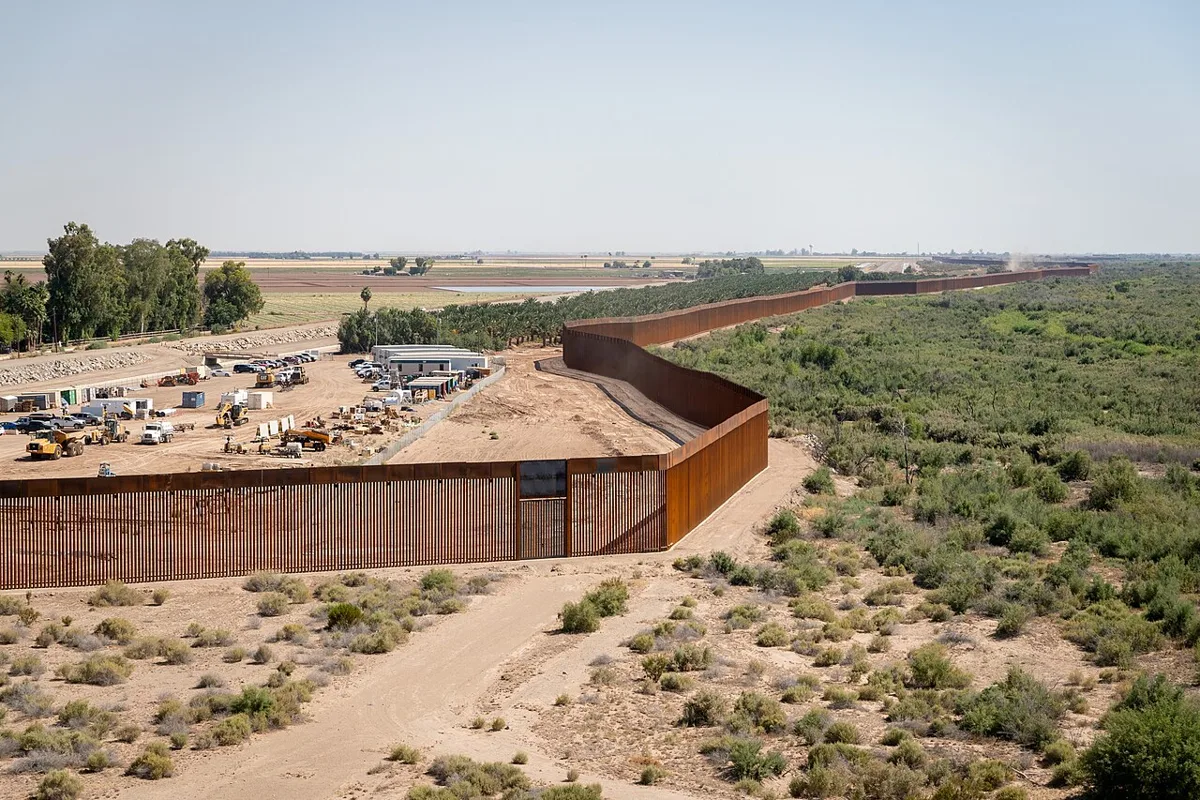
Federal contractors working for Fisher Sand and Gravel showed up to a remote Arizona valley last week and crushed three ancient cottonwood trees with excavators. The trees were estimated to be among the oldest living things on the border. Now a rotating crew of protesters is living in the last one, 200 feet in the air, calling it their Statue of Liberty.
What Is Actually Happening in Lochiel
The town of Lochiel sits in the San Rafael Valley in the remote southeastern corner of Arizona, elevation high enough for bears and porcupines, landscape lush enough that they filmed Oklahoma here. The Guardian reports that until recently, the border through this valley was marked by hip-high vehicle barriers that animals could walk around. Now the Trump administration is building two parallel 30-foot walls through all of it.
On July 27th, according to The Guardian, contractors drove excavators directly into a grove of towering cottonwood trees that locals call the "grandmothers" and crushed three of them. One person was arrested that day by the local sheriff's department and released without charges. The remaining protesters have since organized a full tree-sit around the last surviving ancient cottonwood, with a rotating person stationed on a platform high in the canopy at all times.
Several dozen people are now camped on private land nearby with the property owner's permission. They are feeding and supplying whoever is up in the tree. The demonstration has been peaceful. The tree has not come down.
A 200-Year-Old Tree, a Threatened Bird, and a Promise the Government Already Broke
Here is the part that should make you genuinely angry. Kate Scott, founder of the Madrean Archipelago Wildlife Center, and Erick Meza of the Sierra Club spent months sending letters to Customs and Border Protection asking the agency to route construction around the cottonwood grove. According to The Guardian, CBP responded with a letter dated June 18th promising not to cut the trees down if any birds were nesting in them.
Meza filmed a bird actively nesting in the trees shortly before the excavators arrived. The contractors crushed them anyway. Then, on August 4th, conservation advocate Russ McSpadden spotted a western yellow-billed cuckoo in the last remaining tree. The yellow-billed cuckoo is a federally threatened species.
This is the part where you might expect federal law to kick in. It does not. The Guardian reports that federal contractors building border infrastructure are exempt from dozens of federal statutes, including the Endangered Species Act, because the Real ID Act gives DHS sweeping authority to waive laws when building border barriers. A threatened bird in a 200-year-old tree on federal land, and the government can legally bulldoze both. No comment was provided by DHS, CBP, or Fisher Sand and Gravel.
Why This Valley Specifically, and Why It Matters
The San Rafael Valley is not just pretty. The Guardian spoke to McSpadden, a conservation advocate at the Center for Biological Diversity, who explained that cottonwood trees can only grow where underground water exists. They are markers of river corridors in a state where, he says, roughly 90 percent of riparian forests have already been destroyed by groundwater extraction, development, and mining.
This particular valley is the headwaters of the Santa Cruz River, which originates here, flows south into Mexico, then curves back north and west into Arizona. The mountains flanking the valley represent two of the most important binational wildlife corridors in the entire borderlands region. Meza told The Guardian that a second border wall, built 60 feet north of the first, is uniquely destructive precisely because it severs those corridors in one of the most biodiverse stretches of land in the country.
The local county sheriff, David Hathaway of Santa Cruz County, has publicly opposed border wall construction in the area and told reporters that illegal immigration through this valley is practically nonexistent. The wall going up here is not a response to a crisis. It is a project completing itself on its own momentum, eating a 200-year-old tree on the way through.
The Woman Who Spent Two Years in a California Redwood Is Paying Attention
Julia Butterfly Hill, who famously lived in a California redwood for two years in the late 1990s and saved it, has reached out to the Lochiel organizers and told The Guardian she hopes to visit. Her observation about what this kind of protest means is worth sitting with.
"I always remind folks that when we see people doing direct action like this, it's only because every other system has failed," she said. They tried letters. They tried the Endangered Species Act. They tried appealing to the agency's own written promise. Every other option was closed before someone climbed into that tree.
A total of 384 miles of secondary border barriers are currently in development, according to CBP. The cottonwood the protesters are defending is directly in the path of one of them.
The Dingo Take
You are supposed to believe this is about border security. The local sheriff says illegal crossings through this valley are practically nonexistent. The agency CBP put that in a letter. Nobody is disputing it. The wall going through Lochiel is not stopping a wave of anything. It is a construction project eating ancient trees, blasting mountains, and drilling wells to mix cement, in a biodiverse valley where the main wildlife corridor runs right through the proposed footprint. This is not security policy. This is performance, with excavators.
The government broke its own written promise not to cut the cottonwoods if birds were nesting. A bird was nesting. They cut them anyway. Then a threatened species showed up in the one tree still standing, and it does not matter, because DHS waived the Endangered Species Act before the contractors ever arrived. They wrote the legal immunity into the project before the project started. There is no recourse left except to sit in the tree.
A 200-year-old cottonwood in a remote Arizona valley has become a cleaner symbol of this administration's governing philosophy than anything a speechwriter could manufacture. It survived two centuries of desert heat, drought, and the entire 20th century. It took a federal contractor with an excavator and a waiver from the Real ID Act to threaten it. A few dozen people with camping gear and a platform in the canopy are the only thing standing between it and the same machine that took the grandmothers down on July 27th. Watch this one.




Comments