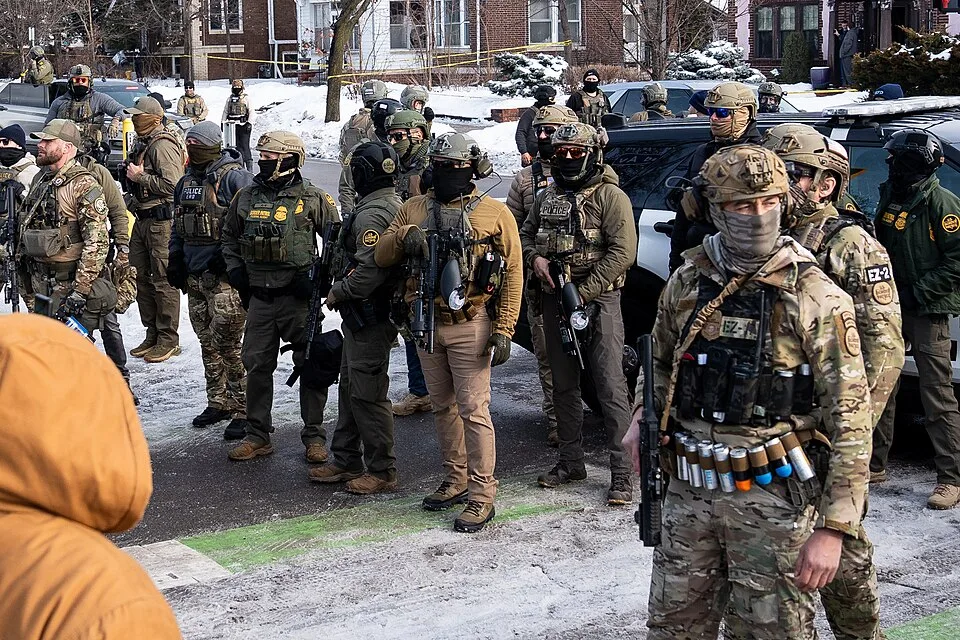
A federal judge ruled Monday that New York cannot force ICE agents to show their faces while conducting immigration enforcement operations, handing the Trump administration a partial win in what has quietly become one of the weirder legal battlegrounds of the second term. But the same judge refused to let the feds bulldoze New York's ban on local police cooperating with ICE, which is the part that actually matters to most New Yorkers.
What the Judge Actually Said
U.S. District Judge Mae D'Agostino of the Northern District of New York issued a preliminary injunction Monday blocking enforcement of the state's face covering and identification provisions. According to The Guardian, D'Agostino's 51-page ruling found that while New York "appears to be well-intentioned in its pursuit of transparent policing," the constitutional argument ultimately runs in the federal government's favor.
The supremacy clause is the legal mechanism here. It bars state governments from regulating federal law enforcement, and D'Agostino found the Trump administration showed a sufficient likelihood of success on that claim to justify putting the mask ban on hold while the case continues. In plain English: states cannot write dress codes for federal agents, even when those federal agents are deliberately hiding their identities while arresting people.
Fox News reports the judge's ruling explicitly names not just ICE but the FBI, DEA, and Customs and Border Protection as agencies that would have been affected. So New York was not just trying to unmask immigration agents. It was trying to unmask the whole apparatus. The judge said no.
The Part New York Actually Won
Here is the part the Trump administration does not want you focusing on. D'Agostino refused to block New York's ban on 287(g) agreements, the formal arrangements that allow local police departments to perform federal immigration enforcement functions. That ban takes effect later this month, and it is now cleared to go forward.
The judge's reasoning is worth quoting directly. As The Guardian reports, D'Agostino found the cooperation ban is an "appropriate means of furthering New York's legitimate interests in protecting public welfare and choosing how state and local resources are expended." She also noted that local participation in federal immigration enforcement is voluntary under federal law, meaning New York opting out is entirely within its rights.
Governor Kathy Hochul and Attorney General Letitia James put out a joint statement welcoming that part of the ruling. "Local law enforcement should be focused on local matters, and New York taxpayers should not have to foot the bill for any collaboration with ICE," they said. They also made clear they are reviewing their options on the mask portion, which is lawyer-speak for: this is not over.
How We Got Here
Hochul signed what became known as the New York mask law in late May, according to The Guardian. It was a direct response to the tactics federal immigration agents have used throughout Trump's second term, which have included agents in unmarked clothing conducting street-level arrests with no clear identification visible to bystanders or to the people being detained.
The legal fight over this is not unique to New York. Federal judges have already blocked similar laws in California, Virginia, and Pennsylvania. The Department of Justice sued Virginia over its version, and the pattern is consistent: courts keep finding that states cannot regulate how federal agents dress on the job, regardless of how legitimate the transparency concern is. D'Agostino herself acknowledged the policy question is real, writing that New York officials "may be correct" that masked, unidentified agents create dangerous situations. She just said it is not her call to fix that.
The Administration's Victory Lap, Such As It Is
James Percival, general counsel for the Department of Homeland Security, did not wait long to gloat. According to The Guardian, he took to X to declare that Democratic-led states "continue to stack losses as they try to pass unconstitutional bans on ICE officers wearing masks." Which is technically true about the mask portion and completely ignores the cooperation ban surviving intact. Classic.
DOJ lawyer Brandon Neuman had argued in July that both provisions were invalid because states simply cannot legislate the behavior of federal agencies. He got half of what he asked for. The administration will almost certainly frame this as a total victory in press releases and on cable news. That framing is wrong, but accuracy has rarely been this administration's priority when a win, partial or otherwise, is available to spin.
The Political Backdrop Nobody Is Ignoring
This ruling drops into the middle of a competitive gubernatorial race. Hochul is running for re-election in November against Nassau County Executive Bruce Blakeman, who according to The Guardian supports ICE tactics and opposes the cooperation ban. Immigration enforcement has become a central campaign issue.
For Hochul, the split ruling is actually workable politically. The mask ban was always the more legally shaky of the two provisions, and she knew it. The 287(g) cooperation ban surviving gives her something concrete to point to: New York cops are still not required to do ICE's job. That is a meaningful protection for immigrant communities regardless of what federal agents are allowed to wear on their faces.
The Dingo Take
You are supposed to believe that the most pressing legal question of our immigration enforcement era is whether a cop can make a federal agent show his face. That is not wrong exactly, but it does flatten something genuinely alarming into an argument about hats. The underlying reality is that the Trump administration has deployed agents in unmarked clothing to arrest people on American streets, and the judicial system's consistent answer to states trying to address that has been: not your problem to solve. Which makes it everyone's problem.
The 287(g) ruling is the real news here and it is getting buried under the flashier mask headline. New York just got judicial confirmation that it does not have to lend its police force to federal immigration operations. That is the firewall that actually matters. ICE can wear whatever it wants to wear. What it cannot do, in New York, is conscript local law enforcement into doing its work for it. That distinction is enormous for anyone living in a mixed-status community wondering whether their local precinct has become a feeder system for deportations.
D'Agostino wrote that whether federal agents are conducting operations "in a sufficiently transparent manner is an important question" but that it is not one she can answer right now. Someone should answer it. Agents with no visible identification arresting people in the street is not a gray area in any democratic tradition worth defending. The courts keep punting. Congress is not going to act. And in the meantime, the masks stay on.



Comments