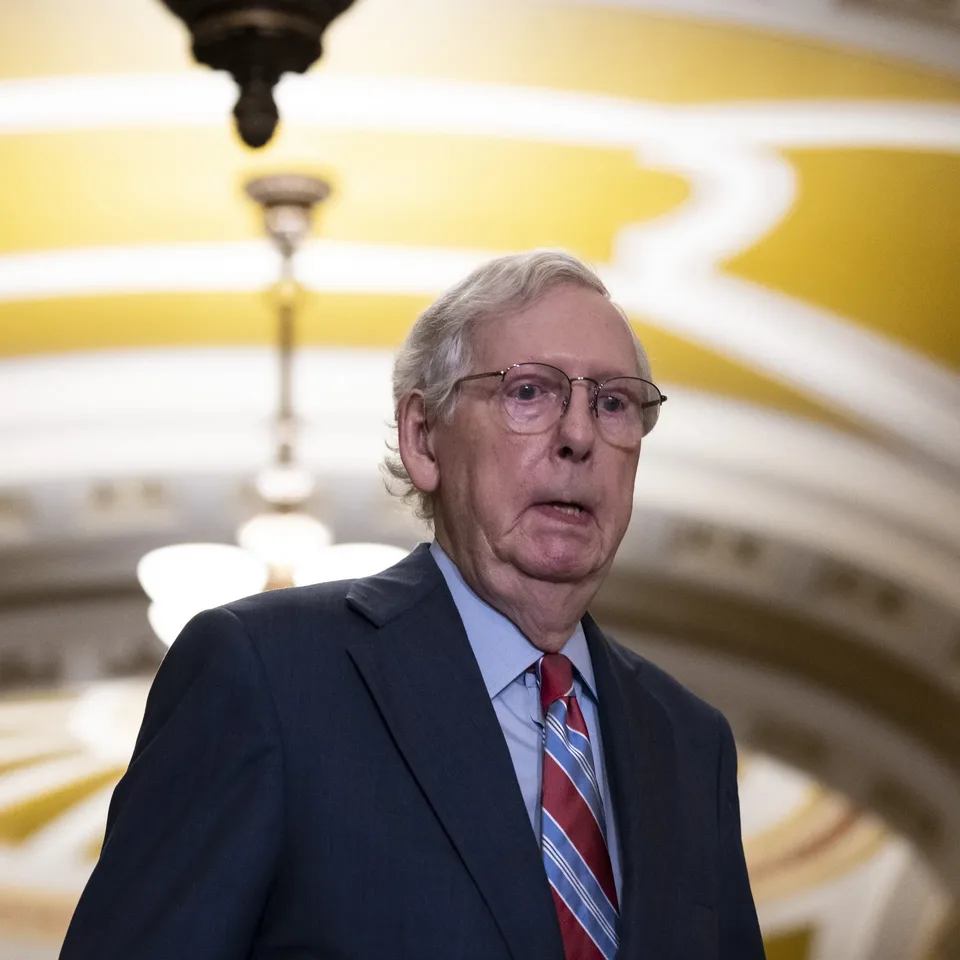
Mitch McConnell has been discharged from a rehabilitation facility after vanishing from public life for nearly eight weeks, and his big announcement is that he'll be doing physical therapy at home during a congressional recess most Americans didn't know was happening. He still has not explained what actually happened to him. Not really.
Here's What We Know, Which Isn't Much
According to the New York Times, McConnell was hospitalized in June after falling unconscious at his home. That's it. That's the most specific medical detail the public has received in two months. He is 84 years old, he lost consciousness, and the Senate just quietly went on without him.
In July, McConnell finally broke his silence with a statement explaining he had suffered from a fall and a "mild" case of pneumonia, and had been transferred to a rehabilitation center. The word "mild" is doing a lot of heavy lifting there. Most people who get mild pneumonia do not disappear into a rehab facility for the better part of two months.
His Thursday discharge statement, per the Times, said he would maintain an "intensive regimen of physical therapy" at home and continue to engage with his staff on "important Senate business." He is a United States Senator. From home. During recess. We are supposed to find this reassuring.
The Photos No One Believes Are Real
McConnell's office has released photos of him with his wife, Elaine Chao, alongside his statements. The Times reports that skeptics have asserted, without evidence, that these photos were generated by artificial intelligence, and have demanded video of the senator appearing alive and conscious.
Now, to be clear: there is no actual evidence the photos are AI-generated. None. Demanding video proof of life as a condition of believing a sitting U.S. Senator is still alive is, clinically speaking, a crazy thing to do. But here we are. This is where we live now. When an 84-year-old senator falls unconscious and then vanishes for two months with no real medical explanation, the conspiracy theory machine doesn't need an invitation.
McConnell's office could have prevented all of this with a single press availability, a doctor's statement, anything. They chose not to. Whatever you think about the AI photo crowd, the communications strategy here has been a masterclass in creating exactly the information vacuum that produces them.
The Part Where His Absence Actually Breaks Something
While the question of whether McConnell is okay has consumed most of the attention, the New York Times flags something more concrete: Republicans in the Senate are working with a slim majority, and McConnell's absence is costing them votes they cannot afford to lose.
On Thursday, the same day McConnell announced his discharge, the Senate Agriculture Committee failed to advance this year's farm bill. The Times reports that Republicans on the panel simply did not have the votes to push it through over Democratic opposition. The measure was defeated and has been punted to the fall.
The farm bill is not a flashy piece of legislation. It is not the kind of thing that generates cable news segments. But it governs hundreds of billions of dollars in agricultural support and food assistance programs, and it is now stuck in committee because one senator has been incapacitated for two months with no timeline for full return.
What 'Recovering at Home' Actually Means for the Senate
McConnell's statement says he will "continue to engage with staff and colleagues on important Senate business" from home. Engaging with staff is not the same as casting votes. It is not the same as chairing meetings or applying procedural leverage or doing any of the things that McConnell, specifically, has spent decades being very good at.
The Senate is on its August recess now, so the immediate arithmetic crisis is paused. But the fall session is coming, and McConnell's return to any kind of active Senate role remains an open question. His statement sets no return date. His doctors have apparently not medically cleared him for a full return to work. What that means in practice, for the Republican caucus and for Kentucky's representation in the Senate, nobody is officially saying.
McConnell has served in the Senate since 1985. He has survived political defeats that would have finished most careers. Whether he survives this particular chapter is a question his office has decided the public simply does not need answered.
The Dingo Take
You are supposed to believe that releasing two photographs and a pair of carefully worded statements is sufficient transparency for a sitting U.S. Senator who has been absent from his duties for eight weeks following an unexplained loss of consciousness. You are supposed to accept "mild pneumonia" as a complete medical accounting. You are supposed to read "intensive regimen of physical therapy" and not ask what, exactly, is being rehabilitated. You are supposed to feel fine about all of this.
The frustrating part is that McConnell's health is, genuinely, his own business in a personal sense. He is a human being and not a lab specimen. But he is also one of 100 people who votes on legislation affecting 330 million Americans, and his state of Kentucky has exactly one senator doing that job right now. The transparency bar for that role is not high. It is just: tell us something true and specific. That bar has not been cleared.
What this whole episode has really exposed is that the Senate has no serious mechanism for handling incapacitated members. No mandatory disclosure. No clear protocol. Just a communications team releasing photos and hoping the questions go away. McConnell wrote the book on playing hardball with institutional rules. It is a particular kind of irony that the institution he shaped so aggressively has no rule that could have forced him to tell anyone a single useful thing about what happened in that house in June.




Comments