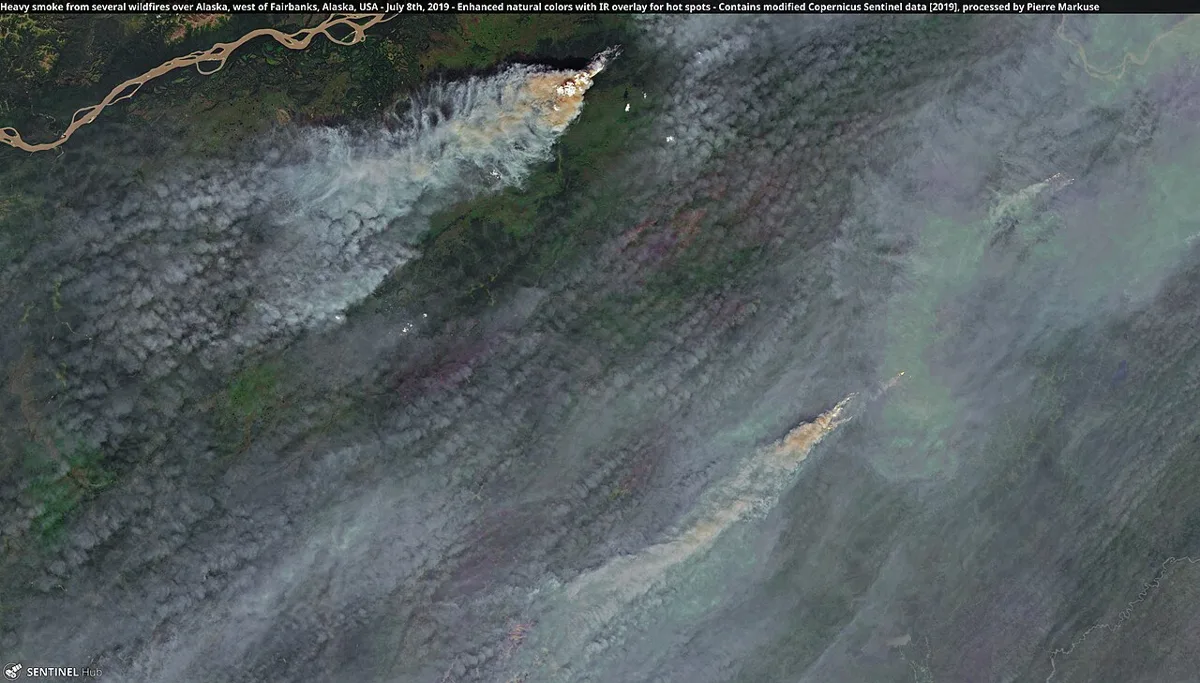
Emmanuel Macron called the wildfires tearing through France the country's 'most difficult situation since the second world war.' That is an extraordinary thing for a sitting head of government to say. It is considerably less extraordinary when you notice that he said it and then did not treat it like a war.
The Continent Is on Fire, Literally
France and Spain are battling historic wildfires right now. The Associated Press described the evacuation effort as one of the largest on the European continent since World War II. Emergency aircraft fill skies choked with black smoke. Historic towns are in ruins. Forests are ash. Firefighters are working until they physically cannot stand.
And it is not just France and Spain. As the Guardian reports, the fires are hitting much of Europe simultaneously. Canada currently has nearly a thousand wildfires burning. Australia has been wrestling with this for years. The US has watched entire towns disappear. Brazil, Greece, Portugal, Chile, Russia, Turkey, Indonesia — every one of them has felt it. This is the world now. This is what we built.
World Leaders Have Discovered the Perfect Response: Words
Here is what Macron did after calling this France's worst crisis since the second world war: he gave more speeches. Spanish Prime Minister Pedro Sánchez has also been admirably vocal about linking the fires to the climate emergency, which is good, and also insufficient in the way that a doctor correctly diagnosing your cancer and then shrugging is insufficient.
In Canada and the United States, as the Guardian notes, leaders have been even less willing to make the connection to fossil fuels at all. So Europe gets the accurate diagnosis with no treatment plan, and North America gets neither. Great. Fantastic. Very reassuring stuff from the people in charge of large militaries and massive economies that could theoretically do something about this.
The Wartime Analogy Everyone Uses and No One Means
The WWII comparison has become the go-to rhetorical move for climate emergencies, and writer Seth Klein, in the Guardian, makes the case that it is actually a useful analogy — but only if you take it seriously. During Australia's catastrophic 2020 fires, the government was forced to deploy more military assets than at any point since the second world war. That happened. That was real. The scale is not a metaphor at this point.
Klein's argument is sharp: we mobilize brilliantly to fight fires after they start. We are genuinely terrible at mobilizing to prevent the conditions that create them. We send the water bombers. We do not stop burning the fuel. Governments have mastered the rearguard action and completely abandoned the idea of winning.
What did actual wartime mobilization look like? According to Klein's analysis in the Guardian, governments in genuine emergency mode told the truth about severity, spent whatever it took, built new public institutions to get the job done, shifted from voluntary to mandatory measures, and committed to not leaving anyone behind. Check your mental list of current government climate policies against that list. Take your time. We'll wait.
The Fossil Fuel Elephant in the Burning Room
The Guardian points out something that the rest of the media has been notably reluctant to say clearly: these fires trace back to our continued burning of oil, gas, and coal. Not exclusively, not mechanistically, but causally and undeniably. The climate scientists said this would happen. It is happening. The connection is not complicated.
Yet Klein notes that connecting extreme weather events directly to fossil fuel combustion remains rare in political discourse. Leaders will call it a wartime crisis. They will not call it a consequence of the industry they continue to subsidize. That is a remarkable piece of cognitive dissonance to maintain while standing in front of cameras with orange skies behind you.
The 'New Normal' Is Not Normal and Never Should Be
The phrase 'new normal' has become a kind of linguistic sedative. Klein writes about arriving at a family holiday spot in British Columbia to find water-bomber float planes scooping from the lake directly in front of the rental house, helicopters circling every five minutes, flames dotting the hills after dark, the sky glowing red. That is the vacation now. That is summer in large parts of the world.
Calling it normal is a choice. It is a choice to frame adaptation as the primary strategy rather than prevention. Sure, we should make communities more fire-resilient. Sure, we should plan better. But as Klein makes clear in the Guardian, no amount of preparation outpaces an accelerating crisis you refuse to address at the source. You cannot sandbag your way out of a flood you are actively making worse.
The Dingo Take
You are supposed to believe that governments calling this a World War II-scale emergency, and then continuing to greenlight fossil fuel projects, represents a coherent policy position. It does not. It represents leaders who have correctly identified the problem, correctly communicated its severity, and then decided that the next logical step is to see what happens. The wartime analogy is everywhere. The wartime action is nowhere.
What is genuinely maddening about this moment is that we actually know what to do. Klein's piece in the Guardian is not presenting some radical new theory. The WWII mobilization template exists. Countries remade their entire economies in a few years when they decided the threat was real enough to warrant it. The threat is real enough. The decision has not been made.
The phoney war phase of climate politics has lasted thirty years and counting. At some point, the events stop being warnings and start being the thing itself. We are at that point. The fires burning across Europe and Canada right now are not a preview. They are not a stress test. They are the actual war, playing out in real time, while the generals argue about whether to take it seriously.





Comments