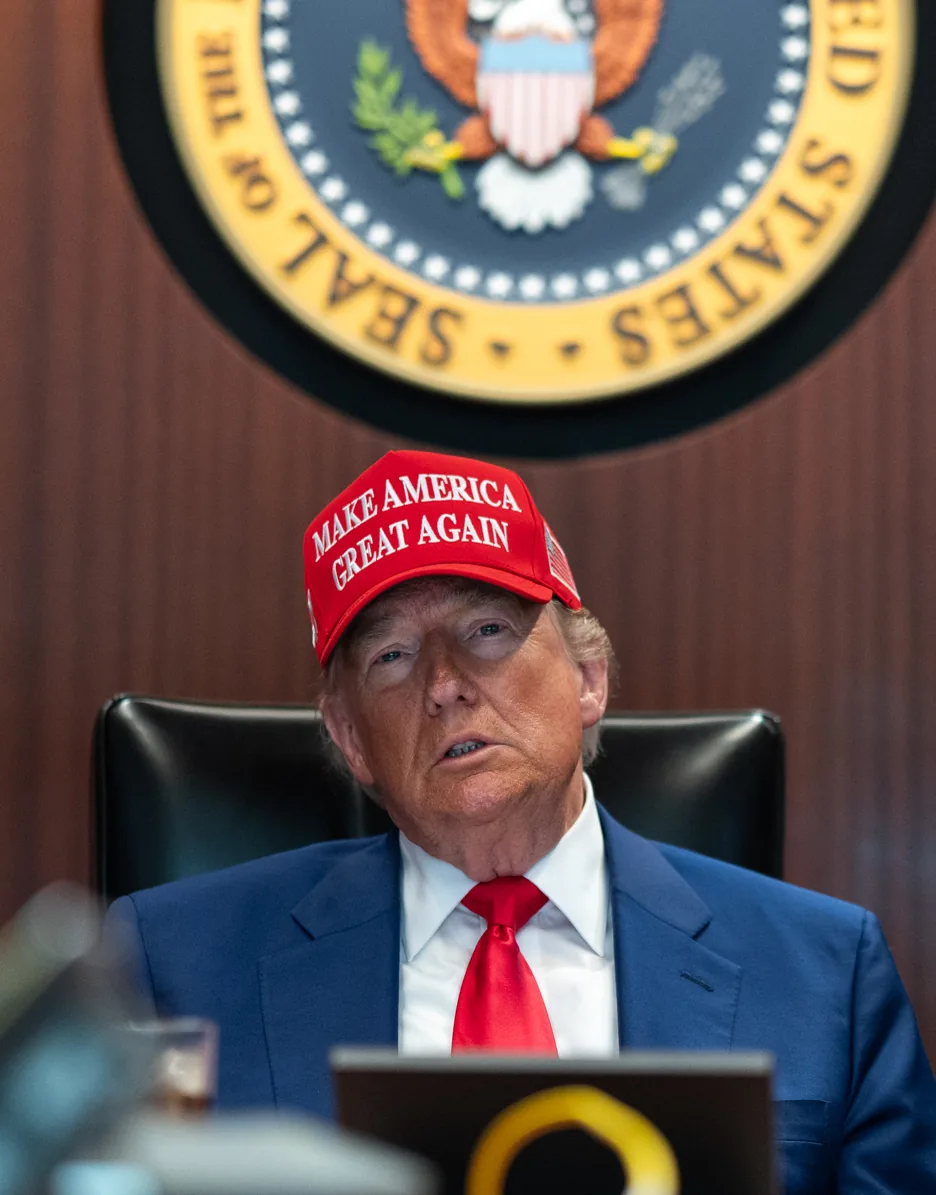
Donald Trump stood in front of the Republican midterm convention in Dallas on Wednesday and told the crowd the war with Iran will be over 'very shortly after the election.' The war he predicted would last four or five weeks is now in its seventh month. And apparently the Iranians are the ones holding things up, because they're hoping Democrats win so they can negotiate with someone dumber. Sure.
The Sales Pitch, Seven Months Late
According to NBC News, Trump made the Iran war a centerpiece of his speech at the Republican midterm convention at American Airlines Center in Dallas. The strategy was bold, in the way that showing up to your own performance review seven months late and blaming traffic is bold. He's taking his biggest political liability and asking the base to see it as a feature.
The core argument goes like this: Iran bad, nuclear weapons bad, therefore war good, therefore shut up about the gas prices. Trump literally dramatized a conversation where a guy complains about fuel costs and Trump wins the argument by pivoting to mushroom clouds. It is, rhetorically speaking, the political equivalent of a magician's misdirection, except the rabbit he's pulling out of the hat is a seven-month military conflict with no clear end date.
The Numbers Are Not Good
An NBC News Decision Desk Poll powered by SurveyMonkey found that 69% of Americans disapprove of Trump's handling of the war. Read that number again. Nearly seven in ten Americans. That is not a polling blip. That is a sustained, majority rejection of a military campaign that has driven up gas prices, stretched into its seventh month past the administration's own projected timeline, and still has no announced end condition beyond 'Iran doesn't get nukes.'
Among Republicans specifically, the erosion is striking. The share of Republicans who say they strongly approve of Trump's handling of the war has dropped 18 percentage points since the spring and now sits at 30%, per NBC News. That is the number from his own party's most loyal segment. When you're bleeding support among people who would follow you into a Chili's during a tornado warning, you have a problem.
The 'Election Is Part of the Timeline' Explanation
To be fair to the convention delegates, NBC News gave them a chance to explain their continued support, and some of them gave it a genuine shot. Ohio alternate delegate Jack Etheridge offered the philosophical take that 'any good thing in life is worth waiting for' and suggested the election itself is simply 'part of the timeline.' That's one way to frame 'the war is going badly and my guy said it would be over by now.' Another way is to just say that.
Etheridge also added that the Iranians are 'taking advantage' of the election for their own purposes, which tracks with Trump's own claim that Iran is 'hanging out for dear life, hoping that we lose.' So the official Republican explanation for why the war is still going is: the enemy is strategically timing their resistance to American midterm elections. This is presented as evidence of Iranian cunning, and not at all as an indictment of the original timetable.
Four Dollars a Gallon vs. the Mushroom Cloud Argument
Former Pennsylvania GOP official Vince Galko made the war's signature pitch to NBC News as bluntly as anyone has managed yet: 'consumers can afford to look at $4 gas for a few weeks rather than looking at a mushroom cloud over their kids' school.' Which, yes, technically true! Mushroom clouds are worse than high gas prices. This is the lowest possible bar for a foreign policy argument and they are currently using it as their ceiling.
Sen. Rick Scott of Florida told NBC News it falls on Trump to explain and sell the war to Americans, which is a polite way of saying the war is not currently selling itself. Scott's own pitch was: 'Would you like us to stop Iran from trying to kill us or allow them to kill us?' Scott called it 'a good choice.' It is the kind of binary that makes sense if you accept every premise inside it, which is doing a lot of work.
What 'Very Shortly After the Election' Actually Means
Trump told the crowd the war will be over 'very shortly after the election' and also predicted oil and gas prices will drop once the fighting stops. NBC News reported both claims without apparent irony, which is really the only way to report them. These are the same analytical tools that produced the four-to-five-week estimate, offered to a public that has now watched seven months go by.
The midterm elections are in November. 'Very shortly after' is doing a lot of heavy lifting as a military forecast. These are the same two words the administration has been using about the war's conclusion since roughly month two. At what point does 'very shortly' stop being a prediction and start being a genre of fiction?
The Dingo Take
You are supposed to believe that the war being in its seventh month, past the president's own four-to-five-week forecast, with 69% public disapproval and an 18-point drop among his own base, is actually a sign of Iranian strategic cunning rather than a catastrophically mismanaged military campaign. You are supposed to hear 'the war will end very shortly after the election' and think: credible timeline, from a credible source, with a credible track record on this specific subject. You are supposed to accept that the enemy is the one responsible for the scheduling conflict.
The gas price argument is the tell. When your best-case pitch for an ongoing war is 'at least it's not a nuclear detonation over an elementary school,' you have already lost the argument. You've also implicitly admitted that the only metric by which this war is a success is 'it could theoretically be worse.' That is not a foreign policy. That is a hostage negotiation with yourself.
Seven months. Sixty-nine percent disapproval. 'Very shortly after the election.' The Republican convention in Dallas gave Trump a standing ovation anyway, because the alternative is admitting they cheered for this from the start. The Iranians, allegedly, are hanging on for dear life hoping Democrats win. Trump's own base is apparently hanging on hoping November comes fast enough that 'very shortly' still sounds like a promise and not a punchline.


Comments