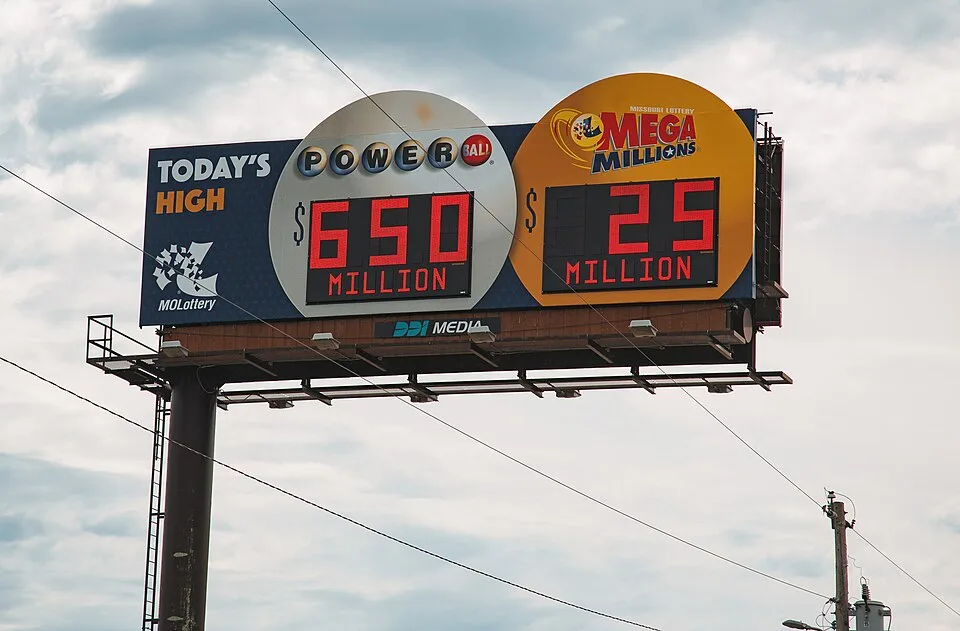
Saturday night's Powerball drawing hit $863.8 million, the largest jackpot of the year and the eighth-biggest in Powerball history, and as of the drawing, it remained unclear whether anyone had won. The winning numbers were 5, 9, 35, 54, 63, and a Powerball of 7, in case you're the kind of person who checks these things after the fact in a spiral of regret. Oh, and Britain is playing now.
The Numbers, the Stakes, the Crushing Math
According to CBS News, Saturday's jackpot clocked in at an estimated $863.8 million. That sounds like a life-altering sum of money, because it is. But if you opted for the lump sum — which most winners do — you'd walk away with $370.7 million before taxes. So roughly half, before the federal government takes its very enthusiastic cut.
The odds of winning are 1 in 292.2 million. To put that in perspective, you are more likely to be struck by lightning while simultaneously being attacked by a shark than you are to correctly guess all six of those numbers. The lottery industry has built an empire on people choosing not to think about this.
The jackpot has now gone 41 consecutive drawings without a winner, CBS News reports, dating back to May 2. That's months of ticket buyers dutifully funding public education initiatives — which is the polite way the lottery industry describes 'taking your money.' There have been smaller wins along the way, including a $1 million ticket in Ohio for matching all five white balls Wednesday, which honestly sounds incredible until you remember the jackpot is $863 million.
Where This Sits in the Hall of Lottery Infamy
CBS News reports this is the eighth-largest Powerball jackpot ever, and the 16th-largest lottery jackpot in U.S. history when you throw Mega Millions into the comparison. The current record holder is still the $2.04 billion jackpot won by Edwin Castro from a single ticket sold in California in November 2022. One ticket. One guy. Two billion dollars.
Here is something genuinely wild about that record: even the $2.04 billion jackpot, the largest ever awarded in the history of American lottery games, paid out 'only' $997.6 million as a lump sum. No jackpot has ever crossed the $1 billion mark for a cash payout. The number is always, always smaller than it sounds. That is not an accident. That is a feature.
To crack the all-time top seven, CBS News notes this jackpot would need to hit $1 billion. Given that 41 drawings have passed without a winner, and the pot keeps swelling, that milestone is not exactly out of reach. Powerball Product Group chair Stephen Durrell told CBS News that 'entering the top 10 largest Powerball jackpots is when we historically see a lot of players join in the game.' Translation: the rubberneckers are arriving.
The British Are Coming. To Lose Money, Apparently.
Here is the sentence nobody had on their 2026 bingo card: Powerball tickets went on sale in the United Kingdom on July 21. CBS News reports that Saturday's drawing is the first major jackpot to include UK participants, meaning this was the first time British citizens could also voluntarily hand over money at 1-in-292-million odds.
The logic, from Powerball's perspective, is straightforward. More players means bigger jackpots grow faster when no one wins. This is good for the brand and objectively terrible for everyone playing. The UK has its own perfectly functional national lottery — the EuroMillions pays out enormous sums and has made plenty of British people very wealthy — and yet the appeal of an American-style jackpot apparently crosses the Atlantic without friction.
So now Americans and Britons are united in the shared human experience of picking wrong numbers on a Saturday night. Post-Brexit cooperation, finally, in the only arena that matters: collective financial disappointment.
What Happens Next
If no winning ticket surfaces from Saturday's drawing, the jackpot rolls over again and grows. With UK ticket sales now adding volume to the pool, CBS News notes the jackpots should grow faster going forward. That $1 billion threshold — and the inevitable media circus that comes with it — edges closer every week without a winner.
The next drawing follows the standard schedule. If you are already calculating which numbers to pick, the mathematically correct answer is that it doesn't matter, because the odds are identical regardless. Quick picks perform statistically the same as hand-chosen numbers. The lottery does not reward intuition or superstition or the birthday numbers of your children. It rewards, occasionally and randomly, someone who bought a ticket.
The Dingo Take
You are supposed to look at $863.8 million and feel something — excitement, maybe, or at least a faint stirring of 'what if.' And fine, that's the product. The lottery has always been a legal tax on hope, engineered to be just plausible enough to keep you buying. Nobody plays the lottery because they think they'll win. They play because $2 is a cheap price for 48 hours of daydreaming about telling their boss to go to hell.
What's genuinely interesting about this moment isn't the jackpot size — we've been here before, we'll be here again. It's the UK expansion. American lottery culture, one of the country's most aggressively exported psychological quirks, has now officially spread to Britain in a formal, sanctioned way. The British government, which theoretically exists to protect its citizens from predatory financial schemes, has apparently decided that Powerball is fine, actually. Welcome aboard, lads.
Forty-one drawings. No winner. The jackpot will keep climbing until some random person somewhere matches six numbers by pure chance, becomes immediately wealthy beyond all practical comprehension, and then spends the next decade dealing with the specific misery that apparently comes with sudden enormous wealth. Studies on lottery winners are not encouraging. But sure. Play your numbers. Somebody has to win eventually, and the alternative is thinking too hard about the odds, which is no way to spend a Saturday night.



Comments