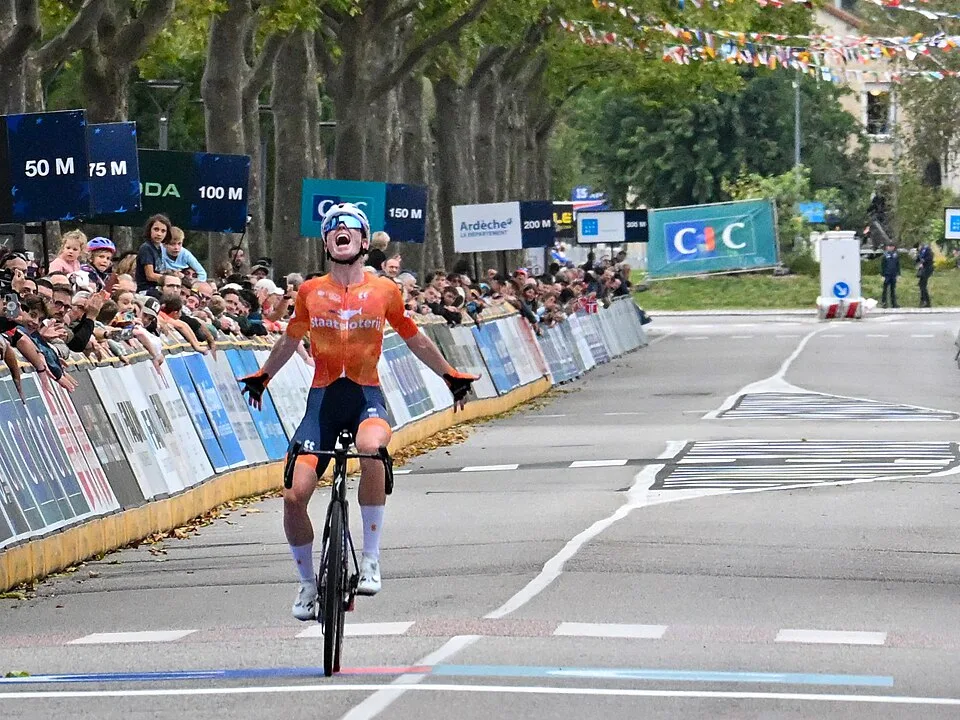
Katarzyna Niewiadoma-Phinney started the final stage of the Women's Tour de France just eight seconds behind Demi Vollering. She finished it one minute and eighteen seconds behind her. That is not a race. That is a lesson.
One Stage to Go, Already Over
Sunday's final stage was supposed to be the dramatic showdown. Two champions, eight seconds apart, four brutal mountain climbs finishing in Nice. On paper, it was a coin flip.
Vollering flipped the coin, caught it, pocketed it, and rode away.
According to the Associated Press, Vollering attacked roughly 800 meters from the summit of the final climb, dropped Niewiadoma-Phinney on the spot, and went on to win the stage by over a minute. She crossed the finish line with her arm in the air before she even crossed it, tapping her temple to hammer the point home. Mental strength. Message received.
She then raised her bicycle over her head like it weighed nothing. Because at that point, it probably felt like it did.
The Ghost of Four Seconds Past
Here is the part that makes this story actually hurt, in the best possible way. Two years ago, Vollering lost the Tour de France by four seconds. Four. On the final stage. To Niewiadoma-Phinney.
So the rematch ending with Vollering winning by 1 minute and 18 seconds is not just a victory. It is a very specific, very deliberate kind of revenge that athletes spend years cooking.
The AP reports that Niewiadoma-Phinney had started Sunday looking short of energy after her own impressive solo win up Mont Ventoux on Friday. She had burned everything she had trying to get ahead. It wasn't enough. Vollering had saved hers for exactly the right moment.
A Cyclist Who Has Now Won Everything
Let's put Vollering's resume in plain language. She has now won two Tours de France, two Spanish Vueltas, and the Giro d'Italia. That is five Grand Tour titles. She completed the triple crown of women's cycling in June when she won the Giro, according to the AP, joining only one other woman in history to have done it: her Dutch compatriot Annemiek van Vleuten.
She is 29 years old.
"I still have a lot of dreams," Vollering said after the race. "On and off the bike." Which is either the most understated thing a dominant champion has ever said, or a warning to the rest of the peloton. Probably both.
The podium behind her was filled out by Spain's Paula Blasi Cairol in second on the stage and Italy's Elisa Longo Borghini third overall, more than four and a half minutes back. Swiss rider Marlen Reusser, who had been a contender, crashed on a descent and ended the race 14th, nearly 26 minutes adrift.
The Climbs That Were Supposed to Decide It
Sunday's route featured four climbs, the first three each 7.7 kilometers with a 5.9% average gradient. The final climb was shorter at 6 kilometers but steeper, with an average gradient of 7.6% and one section hitting a brutal 12%. The course designers clearly wanted carnage.
What they got was Vollering making it look like a training ride.
The AP notes that Niewiadoma-Phinney, despite her best efforts to stay with her rival, simply could not apply pressure when it mattered. When Vollering went, she was gone. There was no catching her. The final time gap of over a minute on a single mountain stage is the kind of number that gets shown in highlight packages for a decade.
The Podium, the Anthem, and the Single Tear
After the finish, as the Dutch national anthem played, Vollering stood on the podium trying very hard not to cry. She almost made it. The AP reports one tear broke through first, then a few more followed as the weight of what she had done settled in.
"It's not only the dream of winning the Tour de France," Vollering said. "It's also the dream of living this life, of working hard along with passionate people. It all starts with dreaming. Go chase the dreams and don't let anyone stop you."
For context, nobody stopped her. Not once. Not even close.
The Dingo Take
Women's cycling has a problem, and the problem is that Demi Vollering exists and the rest of the world hasn't fully caught up to what it's watching. Five Grand Tour titles before age 30, a revenge win so complete it rewrote the story of a four-second loss from two years ago, and a finishing kick that turned a potential photo finish into a one-minute blowout. This is one of the best athletes on the planet operating at the peak of her powers.
And yet the Women's Tour de France still doesn't get the coverage it deserves. The race that just concluded in Nice produced drama, mountain warfare, a crash that derailed a contender, and a final stage showdown that delivered exactly the kind of reckoning that sports are supposed to produce. It had everything. The question of why it isn't on the front page of every sports section is not a complicated one, and the answer isn't flattering to anyone making programming or editorial decisions in 2026.
Vollering is chasing more dreams, by her own account. The sport is lucky to have her. The fans who showed up in Nice and the ones who tracked the race wherever they could find it know exactly what they saw. Here's hoping a few more people are paying attention next time.




Comments