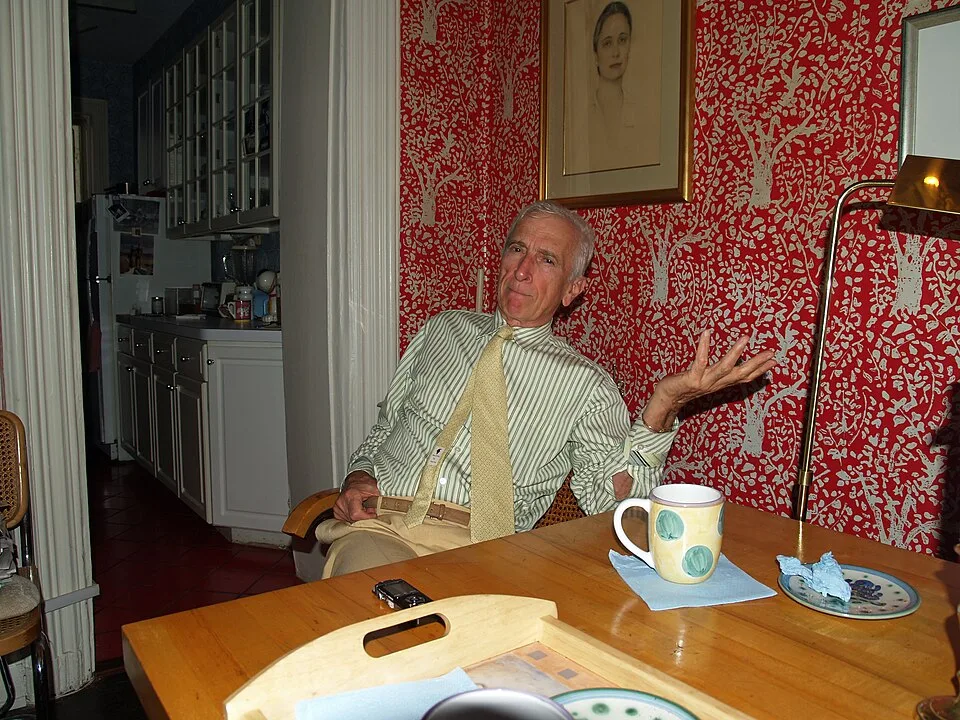
Gay Talese once spent 33 days interviewing more than 100 people to write a profile of a man who refused to talk to him. The piece became one of the most famous magazine stories in American history. The New York Public Library just acquired his entire archive, which feels like the right moment to stop and ask: does anyone make journalists like this anymore?
The Guy Who Made the Lightbulb Guy Famous
Talese's first piece for The New York Times was about The New York Times. Specifically, about the revolving sign on the Times building that broadcast headlines in five-foot-high letters around Times Square. Nobody had ever thought to write about the man who changed the bulbs. Talese found him. Electrician James J. Torpey got his name in the paper. Talese didn't get a byline. He didn't care.
"I wanted to be the lamplighter for those people who were in the dark," Talese told CBS News. "I wanted to write about people and make them known enough to have an obituary written about them, because they were known." That right there is the whole philosophy, laid out in two sentences. While everyone else was chasing riots and bankers fleeing to Rio, Talese was staking out the fourth floor of the Times building to find the man with the bulb machine.
His own description of what journalists chase, from "The Kingdom and the Power," is worth reading twice: "gloom is their game, the spectacle their passion, normality their nemesis." He wrote that in 1969. It has not aged a single day.
Frank Sinatra Would Not Talk to Him. So He Did Something Better.
By 1965, Esquire under editor Harold Hayes was running the best magazine writing in America. Norman Mailer was there. Tom Wolfe was there. Talese was there. Hayes gave him a contract and told him to write three pieces. Talese chose Frank Sinatra.
Sinatra refused to speak to him. A lesser writer goes home. Talese spent 33 days interviewing more than 100 people in Sinatra's orbit instead. The resulting piece, "Frank Sinatra Has a Cold," published in 1966, is still taught in journalism schools sixty years later. The central hook was that Sinatra had a cold and therefore couldn't perform, which rippled anxiety through everyone around him. That's the whole premise. A celebrity, sick, inconvenienced. And Talese turned it into something that reads like a short story written by someone who genuinely understood power.
"Sinatra with a cold is Picasso without paint, Ferrari without fuel," Talese wrote. That's the lede. Nobody was writing like that in 1966. Time and Newsweek were running what NYU journalism professor Robert Boynton described to CBS News as "very flat, corporate writing." Talese blew the doors off. He didn't know the piece would land the way it did. "I didn't care about the Sinatra piece," he told CBS. "And I have written many good pieces." Which is either genuine modesty or the most casual flex in the history of American letters.
The Art of Hanging Around
Talese has a phrase for his method: "the art of hanging around." His profile of boxer Joe Louis opens not with Louis speaking to Talese, but with Louis speaking to his wife at the Los Angeles airport. The exchange is mundane and devastating in the same breath. Louis says he stayed out all night in New York. His wife says when he's in California all he does is sleep. Louis says he's an old man. She says yes, but in New York he tries to be young again. That's the whole piece in four lines of dialogue. CBS News published the exchange in full, and it holds up.
Boynton, who teaches at NYU's Arthur L. Carter Journalism Institute, told CBS that he encourages his students to be what he calls "Talesian," which means going the extra mile, being creative, showing up early, staying late. He also described watching Talese stop mid-trip to interview a construction worker on the street, because of course he did.
Talese spent years embedded with bridge builders for his book "The Bridge," climbing the scaffolding over the Verrazzano Narrows in a suit and tie. He spent years inside the world of nudist colonies and adult bookstores for "Thy Neighbor's Wife." The man does not do phone interviews and call it reporting.
Seventy Years, One Archive, No Shortcuts
The New York Public Library has now acquired Talese's professional and personal archive, according to CBS News. Seventy years of notebooks, drafts, letters, and whatever else a man accumulates when he spends six years writing a single book. "I've always been a very slow writer," Talese said, without apparent embarrassment.
His career covers everything from the internal politics of the Times to the death of boxing's golden age to the mechanics of the American sex industry. He is 90 years old. He has been, at various points, celebrated as a pioneer and criticized for getting too close to his subjects. Both things are probably true. The criticism comes from real places. The celebration does too.
The Dingo Take
Thirty-three days. One hundred people interviewed. Zero quotes from the subject. That is what Gay Talese turned in as a magazine story, and it became the most talked-about piece of its generation. Compare that to the current media environment, where the dominant format is a 400-word aggregation of another outlet's scoop, where "sources familiar with the matter" do the heavy lifting, and where showing up in person to watch someone do their job for weeks at a time would be considered an unreasonable use of resources. We built an entire industry out of doing the opposite of what Talese did, and then we wonder why nobody trusts it.
This is not nostalgia for some golden age that only existed for certain people in certain rooms. Talese's era had its own profound blind spots, and he has not always been immune to them. But the specific skill he embodied, the willingness to wait, to observe, to resist the urge to summarize before you understand, that skill is genuinely scarce right now. We have more information than any previous generation and less patience for the kind of reporting that might actually make sense of it.
The New York Public Library preserving his archive is the right call. Put it somewhere climate-controlled, make students sit with it, and make them explain in writing why Sinatra's cold was worth 33 days of Talese's life. If they can answer that question, they might be journalists. If they can't, they can always start a newsletter.



Comments