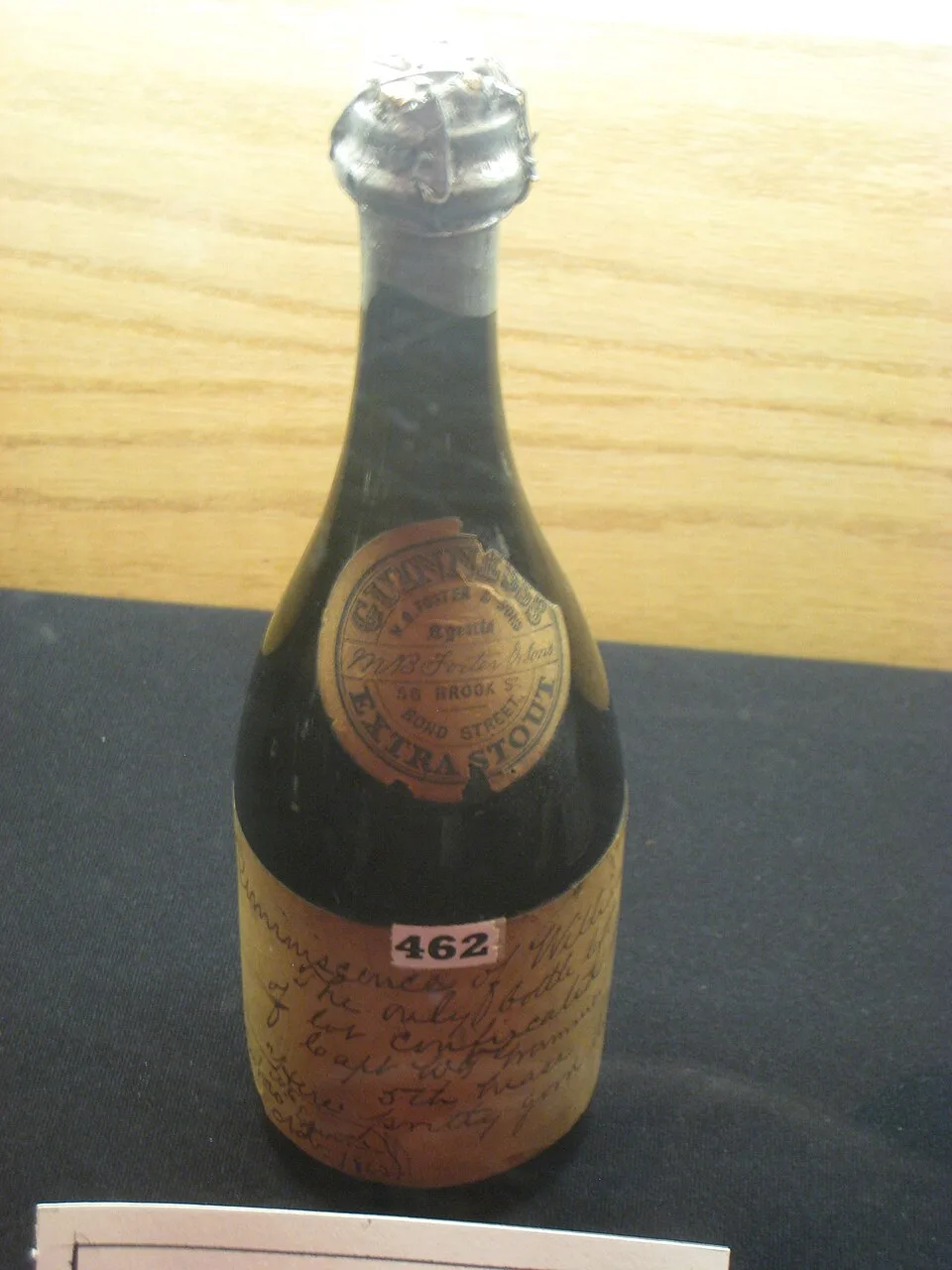
A Belgian diver was poking around a 19th century shipwreck in the English Channel and found something that will make your local craft brewery weep: a bottle of Guinness Extra Stout from 1864, intact, corked, and potentially still drinkable. The bottle has been sitting in the wreck of the Mindoro, three miles off Dover, since the ship went down on November 27 of that year. It is older than the telephone, older than the lightbulb, older than most of the grudges currently animating American politics.
How You Find a Beer Older Than Your Great-Great-Grandmother
Stefan Panis, a 47-year-old underwater photographer from Belgium, was diving the Mindoro wreck last year when he spotted the bottle in what appeared to be the ship's cargo hold. The New York Post reports that when he surfaced and got a clear look, the embossed label read 'Guinness Extra Stout London.' His words upon this discovery were, quote, 'Wow this is amazing.' Which, honestly, is about right.
The Mindoro was a barque that sank after colliding with a sailing ship called the Khersonese in late 1864. It went down with its cargo, which apparently included at least one case of stout, and possibly many more. Panis told the BBC he suspects the wreck may be hiding an entire case of 24 bottles, and possibly multiple cases. So there's a chance there's enough 162-year-old Guinness down there to throw a historically confusing party.
Science Is Now Involved, as It Should Be
Panis and fellow diver Eddie Huzzie, 68, didn't just crack it open on the boat like normal people. They sent samples to microbiologists at KU Leuven, a research university in Belgium, to find out what exactly they were dealing with. Good instinct. When you find a corked bottle of anything that has spent a century and a half at the bottom of the sea, you check with a professional first.
The results of that analysis could be extraordinary. Panis told the BBC that there is 'always a chance that we can recover the complete DNA' from the yeast or other biological material in the bottle, and if they do, researchers could potentially recreate the exact recipe of the beer as it was brewed in the 1860s. A re-brew. Of Victorian-era Guinness. Using DNA pulled from a shipwreck. This is the timeline we are living in, and for once it has produced something genuinely delightful.
As for whether the beer itself is still drinkable, Panis told the Post the key question is whether seawater got through the cork. If the seal held, he believes the stout is likely still good. He's also said he would drink it if given the green light. Which tells you something about either his confidence in the seal, his tolerance for risk, or the particular appeal of a beer no one alive has ever tasted.
Diageo Has Entered the Chat
Panis also reached out to Diageo, the global drinks conglomerate that now owns the Guinness brand. Their response, per the New York Post, was the kind of carefully worded corporate statement that somehow still managed not to be completely soulless: 'Discoveries like this provide a fascinating window into our past and help build a deeper understanding of our heritage.'
Diageo added that their Guinness Archive team is now liaising with the divers to gather more information and evaluate the find. 'Liaising with the divers' is doing a lot of work in that sentence. Somewhere in Dublin, there is a person whose job title now technically includes 'communicating with the guys who found century-and-a-half-old stout in a shipwreck,' and that person is having a better Monday than you are.
The Part Where Panis Admits He Doesn't Even Really Like Guinness
Here is the detail that makes this story perfect: Stefan Panis, the man who found the beer, who has spent real time and energy sending samples to universities and contacting multinational corporations about it, has admitted he is not a huge fan of Guinness stout. He told the Post this directly. He found the most significant beer discovery in recent memory and his personal preference runs elsewhere.
And yet he says he would still take a sip if the scientists clear it. That is the spirit of inquiry right there. That is a man who understands that some experiences transcend personal taste. You don't have to love Guinness to understand that drinking a bottle from 1864 would be one of the stranger and more remarkable things a human being could do on a Tuesday afternoon.
The Dingo Take
You are supposed to be tired of the news. Exhausted, actually. And most days the news earns that exhaustion. But then a Belgian diver surfaces in the English Channel holding a bottle of Victorian stout and suddenly the world is a slightly more interesting place to be alive in.
There is no villain here. No one is getting hurt. The worst possible outcome is that the cork failed, the seawater got in, and the world's most historically significant Guinness turns out to be undrinkable saltwater sludge. That would be sad but survivable. The best possible outcome is that scientists extract 160-year-old yeast DNA, recreate a beer that was being shipped commercially the same year Ulysses S. Grant was promoted to lieutenant general, and Stefan Panis takes a sip on camera while a Diageo marketing team watches nervously from a conference room in Dublin.
The DNA re-brew angle is the one to watch. If KU Leuven can pull viable genetic material from that bottle, we could end up tasting something that predates electricity in homes, predates the automobile, predates the completion of the Suez Canal. That is not a beer. That is a time machine with a cork. Someone fund this immediately.



Comments