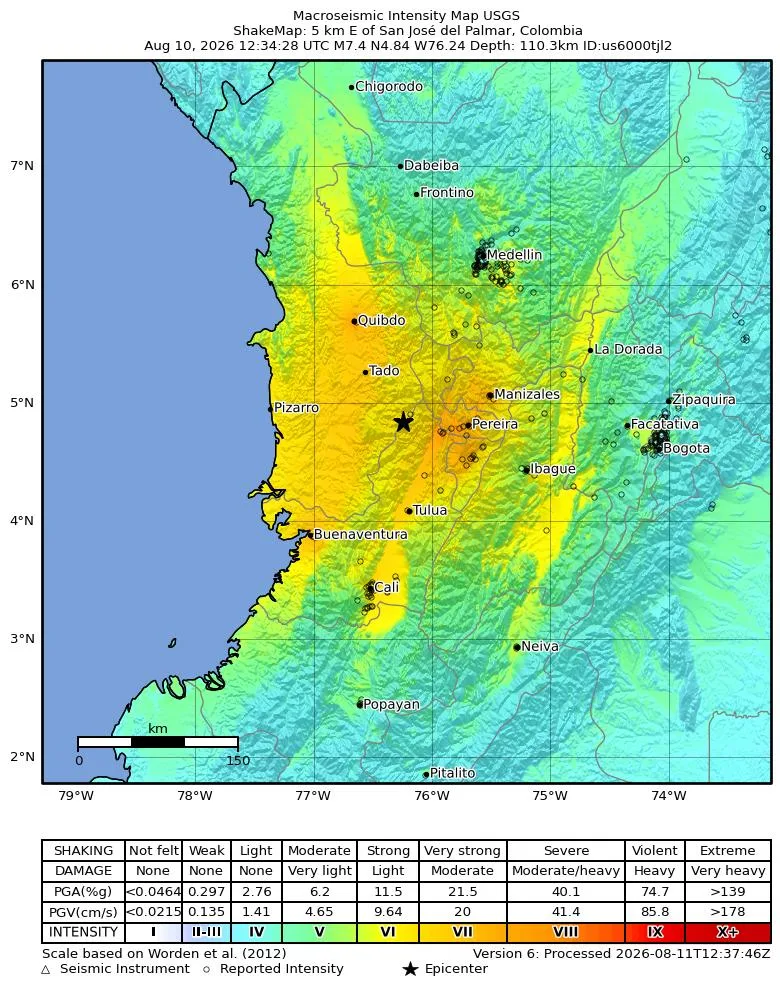
A magnitude 7.4 earthquake tore through western Colombia on Monday, strong enough that people felt the ground move in Bogotá, 250 miles away, and all the way to the Caribbean coast in Barranquilla. The governor of Chocó province is already reporting injuries and serious structural damage in the regional capital of Quibdó. Nobody has a full picture yet, and that is the part that should worry you.
What We Know Right Now
According to CBS News, the United States Geological Survey and its Colombian counterpart both placed the epicenter near San José del Palmar, a small municipality in the Chocó department in Colombia's west. That put the quake roughly 250 miles from Bogotá, which is a long way to feel a tremor this clearly.
Witnesses described shaking across the capital and reportedly felt it in Barranquilla, a coastal city in the country's north. When a quake rattles people across that kind of geographic spread, it tells you something about the energy involved. A 7.4 is not a footnote. It is a significant seismic event by any reasonable measure.
The timing matters too. Monday means people were moving around, working, in buildings. That is not when you want a 7.4 to hit. The worst-case scenarios for casualty counts come when structures are occupied, and right now nobody is reporting a final count of anything.
Quibdó Is Taking the Worst of It
CBS News reports that Chocó Governor Nubia Carolina Córdoba-Curi posted to X confirming injuries and what she called significant damage to buildings in Quibdó, the province's largest city. She said her government is currently in the process of assessing the damage, which is official-speak for: we do not know how bad it is yet.
Quibdó sits in one of the most geographically isolated regions of Colombia. The city is hard to reach under normal conditions. Roads in Chocó are notoriously difficult, the terrain is dense, and infrastructure in the department has historically been underfunded compared to other Colombian regions. When buildings start coming down in a city like that, getting help in quickly is not simple.
Injuries are confirmed. Deaths are not yet reported, but the honest read of a 7.4 with confirmed structural damage to buildings in an occupied city is that you hold your breath and wait for the numbers to come in.
The Geology Here Is Not Subtle
Colombia sits at a collision point of three major tectonic plates: the South American Plate, the Nazca Plate, and the Caribbean Plate. The country is one of the most seismically active in South America, and the western regions, particularly near the Pacific coast, sit directly on fault lines that have produced large earthquakes before.
The 1999 Armenia earthquake, also in western Colombia, killed more than 1,900 people and devastated the coffee-growing region. That was a 6.1. This is a 7.4. Magnitude scales are logarithmic, which means each whole number jump represents roughly 31 times more energy released. The gap between a 6.1 and a 7.4 is not a rounding difference.
None of this means Monday's earthquake will reach that level of devastation. Building codes, preparedness, and the specific geography of the fault rupture all affect outcomes. But the region's history with seismic events gives you no reason to assume the best-case scenario.
What Comes Next
Aftershocks are essentially guaranteed after a quake this size. Significant earthquakes regularly produce aftershocks strong enough to collapse structures that survived the initial event, which is why evacuations matter and why getting people out of damaged buildings is the first priority.
Colombia's national disaster response agency, known as UNGRD, has not issued a full statement as of the initial reporting from CBS News. Governor Córdoba-Curi's X post is among the first official acknowledgments, and the fact that she is calling the building damage significant while still in the assessment phase suggests the picture on the ground is still coming into focus.
This is a developing story. The next several hours of reporting will tell you a great deal about whether this is a catastrophe or a serious but manageable crisis. Watch the casualty figures. Watch whether any infrastructure critical to the relief operation, bridges, roads, the airport in Quibdó, has taken damage. Those are the numbers that determine how the story ends.
The Dingo Take
A 7.4 earthquake hitting a geographically isolated region with historically underfunded infrastructure is not a story that tends to improve as the details come in. Chocó is one of the poorest departments in Colombia. Quibdó is not a city with a surplus of structural engineering redundancy or quick-deploy emergency resources. The governor is on X saying injuries and significant damage while simultaneously admitting she is still figuring out what happened. That gap between what officials know and what is actually on the ground is where the real story lives right now.
What you should be watching for in the next 24 hours: confirmed fatalities, the status of access routes into Quibdó, and whether the national government is mobilizing resources at a scale that matches the size of this event. Colombia's government under President Gustavo Petro has made a rhetorical priority of addressing inequalities in regions like Chocó. How a government responds to a disaster in a historically neglected region is a pretty clean test of whether that rhetoric is operational or decorative.
The people of Quibdó did not choose to be in the path of a 7.4. They did not choose to live in a region that has been underprioritized for infrastructure investment for generations. The earthquake is nobody's fault. The response, whatever it turns out to be, is entirely a choice.



Comments