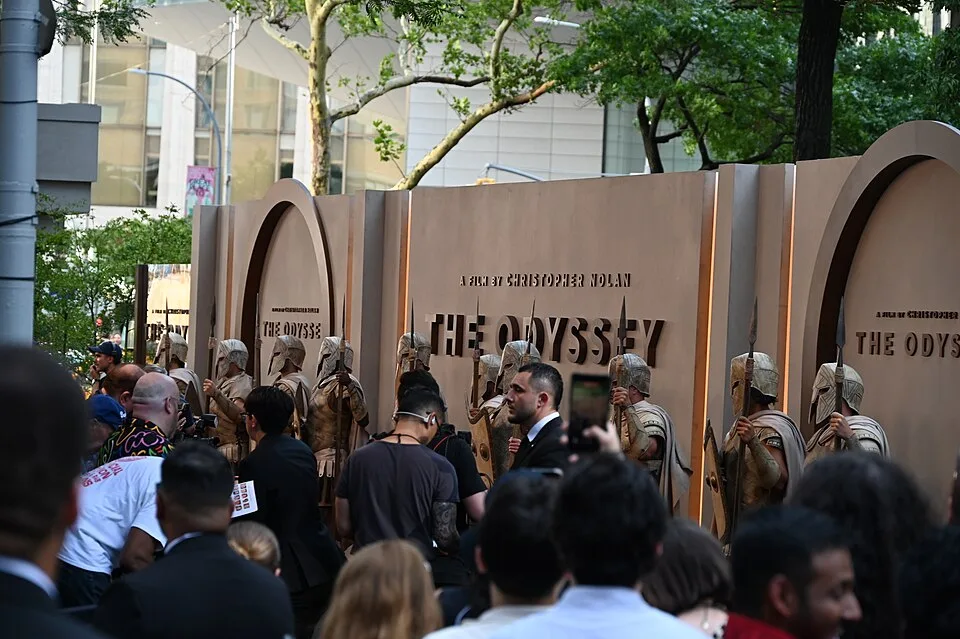
Christopher Nolan made a billion-dollar movie about an ancient Greek poem, and the immediate cultural response from a significant chunk of the viewing public was to Google whether Troy is a real place. It is. It has been. For approximately three thousand years. But sure, let's start there.
The Numbers, Which Are Genuinely Ridiculous
Four weekends. That's all it took for The Odyssey to become Nolan's highest-grossing film ever, pulling in $1.1 billion at the global box office, according to Deadline. The same outlet reports it's also the highest-grossing R-rated movie of 2026, both in North America and worldwide.
Let that sit for a second. An R-rated adaptation of a 2,700-year-old epic poem about a guy trying to sail home is outperforming everything else released this year. Globally. The Hollywood conventional wisdom that audiences won't show up for serious, challenging, historically grounded filmmaking continues to age like milk left out in a Moroccan summer.
People Are Searching 'Is Troy Real' at a 3,421% Increase
Here is where the story gets genuinely fascinating, and also a little bleak. According to an analysis by Nibble, a learning app, Google search interest in traveling to Troy jumped 3,421% after the film's mid-July release. Searches for 'flights to Troy' were up 966%, as Travel + Leisure reported.
But the real kicker is the parallel surge in searches asking whether Troy is an actual place. Travel + Leisure noted this directly, suggesting that 'many viewers left the theater wondering whether Homer's legendary city is somewhere they can actually visit.' Troy, for the record, is in northwestern Turkey. Archaeologists have been excavating it since the 1870s. It is a UNESCO World Heritage Site. It is, and has always been, quite real.
This is not a knock on curiosity. Curiosity is good. Curiosity is how civilization works. The fact that a Nolan blockbuster sent millions of people down a rabbit hole about Bronze Age archaeology is, on balance, an unambiguous win for the species.
Where Nolan Actually Filmed This Thing
Nolan, famously allergic to green screens, shot on location across five countries: Greece, Italy, Morocco, Scotland, and Iceland. Page Six reported the specific locations, and they are, frankly, spectacular choices.
In Greece, the crew used Voidokilia Beach in the southwestern Peloponnese and Nestor's Cave, which sits directly above it on a rocky trail, to represent the Cyclops' lair. The cave, per Page Six, was used to film scenes with Polyphemus, the one-eyed giant who traps Odysseus and his crew and starts eating them. Practical location for a practical filmmaker.
For Ithaca, Nolan went to Favignana, the largest of Sicily's Egadi Islands, a 30-minute ferry ride from Trapani. Ancient Troy got the Aït Benhaddou treatment in southern Morocco, a 17th-century fortified settlement and UNESCO World Heritage Site about 30 minutes from Ouarzazate. The Trojan Horse beach scenes were filmed on the Atlantic coast at Essaouira. And Findlater Castle in Aberdeenshire, Scotland, ruins dating to the 14th century perched above the Moray Firth, got pulled in for good measure.
The Tourists Are Coming, Ready or Not
Findlater Castle officials released a statement that managed to be both genuinely moving and extremely aware of the marketing opportunity in front of them. 'For nearly eight centuries, Findlater Castle has stood witness to the ebb and flow of history, from Viking occupation to royal sieges,' they said, per Page Six. 'Now, thanks to Christopher Nolan's vision, these ancient ruins will introduce millions of cinema-goers around the world to the raw beauty of the Banffshire coast.'
That's the film tourism machine kicking into gear in real time. Every one of these locations is now going to get the Peter Jackson's New Zealand treatment to some degree. Voidokilia Beach is remote. Nestor's Cave requires a steep rocky hike to reach. Aït Benhaddou is 110 miles from Marrakech. None of that is going to stop the wave of Odyssey-inspired travelers who are already searching for flights.
A Side Note About the Egadi Islands That Deserves More Attention
Buried in the location rundown is a genuinely extraordinary detail. The waters around Favignana and the Egadi Islands, where Nolan set Ithaca, were the site of the 241 B.C. Battle of the Aegates, the decisive naval battle that ended the First Punic War between Rome and Carthage. In September 2025, Sicilian officials announced the discovery of a well-preserved bronze helmet near that battle site, along with weapons, according to Page Six.
So not only is the movie about ancient history, it was filmed at locations where people are literally still pulling ancient history out of the sea floor. That's not a coincidence Nolan's production team stumbled into. That's a man who does his homework.
The Dingo Take
You are supposed to believe that Hollywood is in crisis. That audiences are exhausted and checked out, that nobody wants to sit in a theater for two-plus hours, that serious filmmaking is a dead commercial proposition. The Odyssey just made $1.1 billion in a month from an R-rated adaptation of an ancient Greek poem shot on real beaches and in real caves by a director who refuses to use a green screen. So maybe the crisis is not with audiences.
The 'Is Troy real' search surge is getting a lot of mockery online, and honestly, it doesn't deserve it. People walked out of a movie and wanted to know more about the world it depicted. They went home and searched for flights to places they'd never heard of. They learned that a significant naval battle happened near the island where the movie set Ithaca. That is the best possible version of what popular culture can do, and it happened because someone made something genuinely good instead of the fourteenth installment of an existing IP.
Findlater Castle stood through Viking raids and royal sieges and eight centuries of North Sea winters, and now it's going to get absolutely mobbed by tourists in Nolan-branded fleeces. There are worse fates. The ancient world just got a $1.1 billion advertisement. Homer, wherever he is, is either thrilled or furious about the royalties situation.



Comments