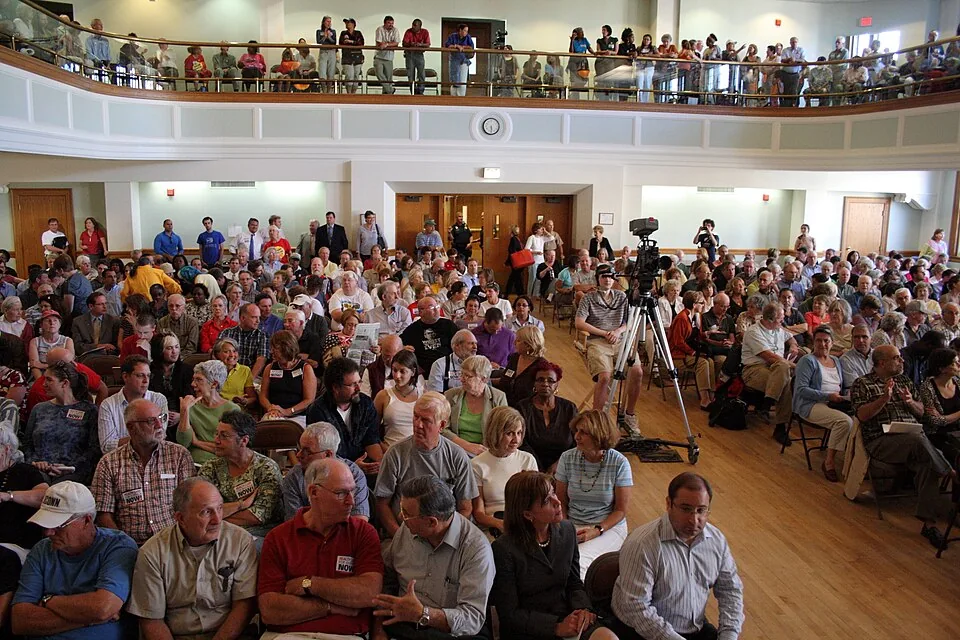
After voters spent last year showing up to town halls and making their representatives visibly uncomfortable, House Republicans have landed on a solution: stop holding town halls. August recess, once the traditional moment when lawmakers went home to face the people who elected them, has quietly become a season of strategic unavailability. Your congressman is in your district. He just doesn't want to see you.
The Vanishing Act
According to Axios, the open congressional town hall is now an endangered species. After a wave of explosive constituent confrontations last year, a significant number of Republican lawmakers have simply stopped scheduling them. Not scaled them back. Stopped.
Think about what that actually means. These are elected federal officials, on a paid recess, in the districts they represent, actively avoiding unscripted contact with the humans who sent them to Washington. The job description is, at minimum, supposed to include talking to those humans.
This is not a new instinct in American politics. Politicians have always preferred friendly crowds to hostile ones. But there's a difference between preferring a chamber of commerce breakfast to a union hall and canceling public accountability entirely. One is strategy. The other is something closer to contempt.
The One Guy Who Still Shows Up
Into this void steps Rep. Mike Flood, Republican of Nebraska, who is apparently so old-fashioned that he still believes elected officials should meet their constituents. Axios reports that Flood holds in-person, open town halls and has continued to do so even as his colleagues have abandoned the practice en masse.
"You've got to show up in the town square and answer the questions. I told people I'd do it when I ran, and I kept my promise," Flood told Axios.
That quote should not be as remarkable as it is. "I said I'd do a thing and I did the thing" is a sentence that describes the bare minimum of keeping a campaign promise. The fact that it now reads like an act of political courage tells you everything about how low the bar has sunk for the rest of the Republican caucus.
Flood is not some progressive firebrand. He is a Nebraska Republican. If he can walk into a room full of constituents and take questions without melting, the argument that it's simply too dangerous or too chaotic for other members to do the same gets a lot harder to make.
Why It Got This Bad
To be fair, last year's town halls were not gentle. Voters across the country showed up furious about Medicaid cuts, Social Security, the general sensation that their government was being auctioned off in real time. Some of those confrontations went viral. Some members got screamed at. A few probably cried in their cars afterward.
But here's the thing: that's supposed to happen sometimes. That's what representative democracy looks like when the representatives do something a lot of their constituents hate. The feedback loop is supposed to sting. A congressman getting an earful from a 68-year-old constituent worried about losing her healthcare is not a PR crisis to be managed. It is the system functioning correctly.
When lawmakers respond to that feedback by eliminating the feedback mechanism, they are not protecting themselves from bad optics. They are telling their constituents that their opinions are only welcome at the ballot box, and even then, only if they vote the right way.
What They're Doing Instead
The playbook for avoiding accountability while appearing engaged is well-worn at this point. Tele-town halls, where the congressman controls who gets unmuted. Curated constituent meetings with pre-screened attendees. Facebook Live sessions where hostile comments can be deleted before they're read. Friendly interviews on local radio with hosts who will not ask follow-up questions.
None of these are the same thing as standing in a gymnasium in your district and taking questions from whoever shows up. They are simulations of accountability designed to produce the optics of accessibility without any of the actual risk. They are, in a word, fake.
The voters who are being avoided by their representatives are not, for the most part, professional agitators. They are people who have a question about their Medicare, or their kid's student loan, or the tariff that just killed their small business. They drove to a school cafeteria on a Tuesday night to ask it. They deserved an answer.
The Dingo Take
You are supposed to believe that members of Congress are skipping town halls because the environment has become too toxic and too dangerous for productive dialogue. That is the framing their offices would prefer. What is actually happening is that a significant chunk of the Republican caucus voted for things that are wildly unpopular with their own constituents, and they would rather not stand in a room and have that fact demonstrated to them out loud.
The congressional town hall was never a comfortable institution. It was not designed to be. It was designed to make elected officials periodically reckon with the people whose lives their votes affect. The discomfort is the feature. When a party decides en masse that the discomfort is no longer acceptable, what they're really deciding is that the reckoning is no longer acceptable. That is a much bigger problem than a few bad news cycles.
Mike Flood, Nebraska Republican, is doing the job. His colleagues are on recess. There is a difference.




Comments