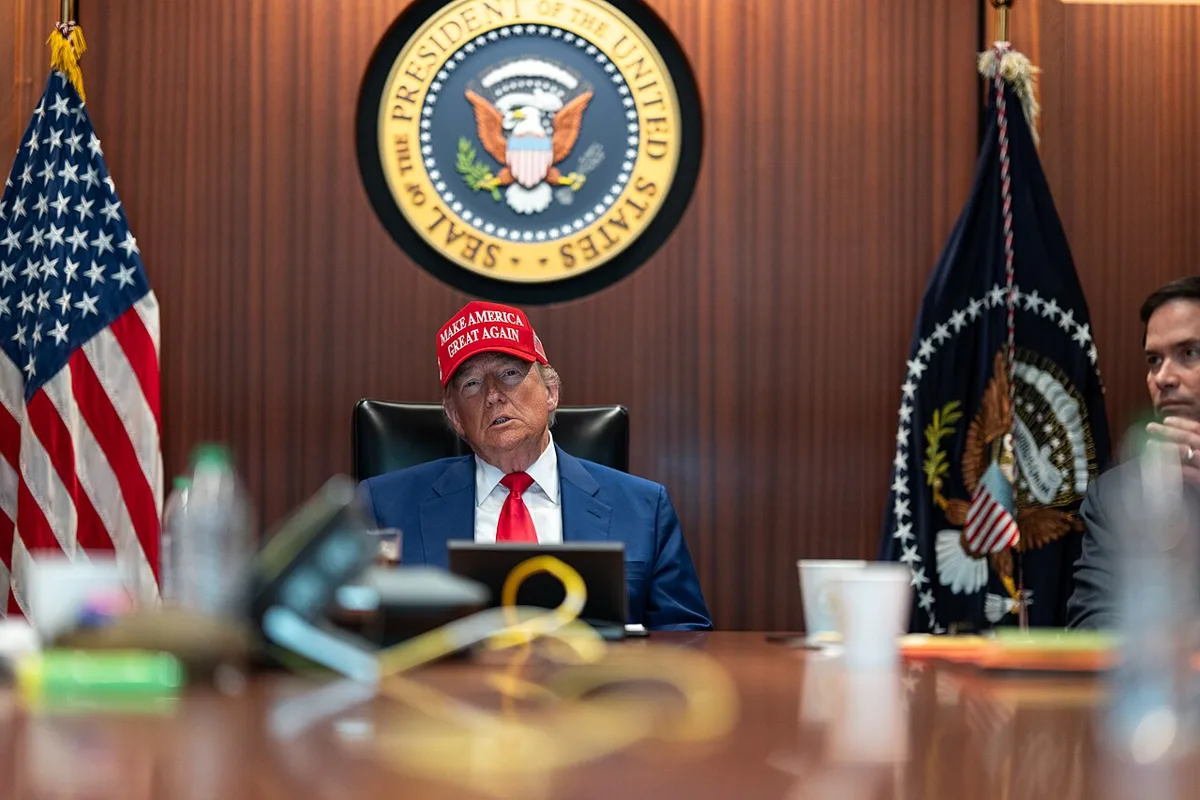
Donald Trump is playing what he calls a 'chess game' with Iran, which would be a more reassuring metaphor if one side weren't blockading a waterway that moves a fifth of the world's oil supply. Iran's Supreme National Security Council responded to America's semi-negotiating posture this weekend with a demand list that includes full war reparations, a permanent end to hostilities, and a promise that the U.S. will never threaten Iran again — ever. So: going great.
What 'Semi-Negotiating' Actually Looks Like
Trump told Axios on Sunday, during a phone interview, that the U.S. is 'low-keying' its approach to Iran. 'We are only semi-negotiating with them. We are just watching Iran with its huge inflation and the fact they have no money,' he said. He added that Iran is in 'very bad shape' and that the U.S. blockade on the Strait of Hormuz has made things worse for Tehran's economy.
The strategy, as best anyone can tell, is to let Iran bleed financially and wait for them to break. 'It will work out. It always works out. It's like a chess game,' Trump said. Which is a confident thing to say when the board also includes active Houthi attacks on Red Sea ports, an Israeli prime minister openly defying your peace plan, and a global shipping crisis that is very much not staying in the Middle East.
The problem with describing this as chess is that chess has rules, defined pieces, and a clear win condition. What is currently happening in and around the Persian Gulf has none of those things.
Iran's Counteroffer Is... A Lot
While Trump was telling Axios the situation would just 'work out,' Iran's Supreme National Security Council was publishing a statement through state broadcaster IRINN that reads less like a negotiating position and more like a verdict at the end of a war crimes tribunal — written by the side that considers itself the victim.
According to CBS News, the council's secretary Mohammad Bagher Zolghadr, who also holds a command position in the Revolutionary Guard, laid out the terms for reopening the Strait of Hormuz. The U.S. must never threaten Iran again. It must permanently end the war with Iran and its regional allies. It must lift the naval blockade of Iranian ports, withdraw its military from the area, lift all sanctions, unconditionally release frozen assets, and — the headline item — 'completely compensate' Iran for war damage.
Complete compensation for a war. That is the demand. The United States, which has been blockading Iranian ports and conducting military operations in the region, is being asked to write a check for the whole thing before the strait opens back up. There is no realistic universe in which that happens, which suggests Iran either doesn't expect it to happen or is setting maximalist terms before walking them back in whatever actual negotiations eventually occur. Neither option is particularly comforting.
The Houthis Hit the Same Port Twice in One Day
Meanwhile, the conflict is actively spreading in directions that have nothing to do with Iran-U.S. diplomacy. Iranian-backed Houthi rebels in Yemen attacked the port city of Mocha on the Red Sea coast twice in less than 24 hours, according to the Associated Press via CBS News. Mocha is the main port under Yemen's internationally recognized government and has been specifically renovated to handle shipping that avoids the Houthi-controlled port of Hodeida. The Houthis know exactly what they are doing.
The first strike on Sunday killed at least seven people, four of them troops and three civilians, and injured 15 civilians, according to the National Resistance Forces. The information ministry's assistant undersecretary, Fayed al-Noman, said the attack severely damaged port buildings, piers, commercial goods, and food supplies. Then the Houthis came back that same night with ballistic missiles and drones, with a Houthi military source telling Al-Masirah TV the second attack targeted weapons depots and Saudi troop concentrations.
The Houthis also separately claimed a drone strike on an Aramco refinery in the Saudi city of Jazan, saying it was retaliation for Saudi drones entering Yemeni airspace. So now there is a separate Saudi-Houthi escalation thread running alongside the Iran-U.S. standoff, both of which involve the Red Sea, both of which threaten global shipping, and both of which are happening simultaneously.
Netanyahu Killed the Gaza Plan Too, Just to Round Things Out
As if the Iran situation needed more company, Israeli Prime Minister Benjamin Netanyahu used a cabinet meeting on Sunday to formally reject the U.S.-backed Gaza peace plan that Trump called 'historic' just last month. According to CBS News, Netanyahu said plainly: 'Israel rejects the 15-point document,' adding that the Israeli military 'will not make any withdrawal until Hamas is truly disarmed.'
This puts Trump in the position of having his signature Middle East peace achievement rejected by his closest ally in the region, one week after celebrating it. Netanyahu is facing pressure from his right-wing coalition partners ahead of elections, and when Israeli far-right politics and American diplomatic ambitions collide, the far-right politics tend to win.
So the current scoreboard in the Middle East reads: Iran won't reopen the strait without full war reparations, the Houthis are attacking Red Sea ports twice a day, and Netanyahu just spiked the Gaza plan. Trump is playing chess. Against three opponents. Who are also playing each other.
The Dingo Take
You are supposed to believe that 'semi-negotiating' is a coherent foreign policy posture. That watching a country suffer economic collapse while a strait that carries a fifth of the world's oil stays shut is a strategy rather than a stalemate. That calling a crisis a chess game makes it one.
It is not a chess game. It is a multi-front military and diplomatic crisis with no clear American objective, no functioning peace process in Gaza, no leverage over the Houthis, and an Iran that has now publicly demanded the United States compensate it for the war before it opens a single shipping lane. The Trump administration's theory appears to be that economic pain will eventually force Iran to capitulate. Iran's theory appears to be that they can outlast the pressure and extract maximum concessions in the meantime. One of those theories is going to be right. The global economy is the collateral for the bet.
The Houthis hitting Mocha twice in 24 hours is the detail that should be getting more attention than it is. That port exists specifically because Hodeida is Houthi-controlled. The Houthis just hit the backup. There is no backup to the backup. The Red Sea is not a side story to the Strait of Hormuz crisis — it is the same crisis with a different dateline, and it is getting worse on a timeline that has nothing to do with whatever chess Trump thinks he is playing.





Comments