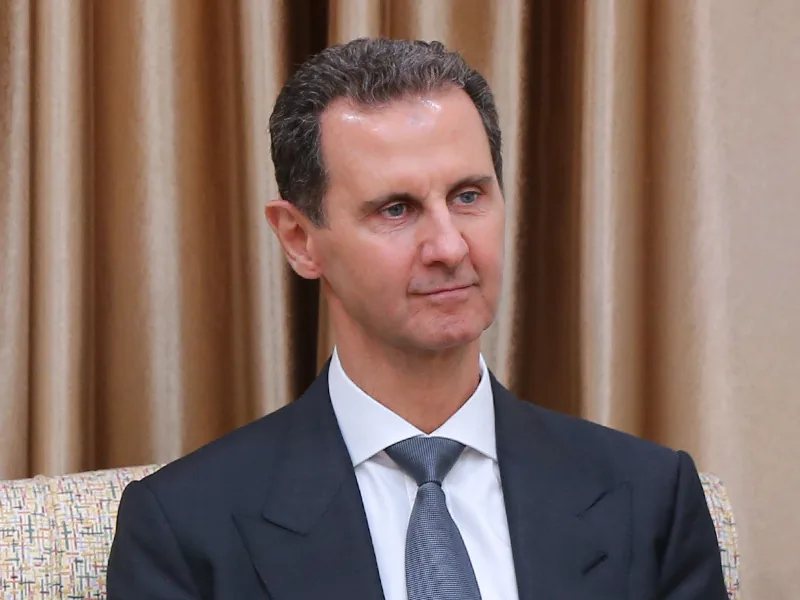
A Syrian court handed down a death sentence Tuesday to Bashar al-Assad, the man who spent fourteen years turning his own country into a mass grave. Assad, currently enjoying Russian hospitality after fleeing Damascus in December 2024, was tried in absentia alongside his brother Maher and cousin Atef Najib for war crimes and crimes against humanity tied to a conflict that killed approximately half a million people.
The Verdict Assad Will Never Have to Look At
The New York Post reports the Syrian court sentenced Assad, his brother Maher, and their maternal cousin Atef Najib to death for crimes committed during Syria's 14-year civil war. The charges cover crimes against humanity and war crimes, which is the judicial equivalent of saying someone robbed a bank and also set the bank on fire with everyone inside.
Assad and Maher, of course, were not present. They bolted to Russia when insurgents marched into Damascus last December, trading a presidential palace for whatever Vladimir Putin calls guest accommodations these days. The sentence is real. The odds of it being carried out are a different conversation entirely.
Najib, however, did not get to skip the proceedings. He stood inside a cage in a prisoner's uniform while the judge read the sentence. That image, one of Assad's most powerful enforcers reduced to a man in a cage listening to a death sentence, is worth sitting with for a moment.
Who Is Atef Najib and Why Is He in That Cage
Najib is not a name most people outside Syria would recognize, but he is central to how this entire catastrophe started. According to the New York Post, he served as head of the Political Security Branch in Daraa province in 2011, and he personally led the crackdown in that southern province that ignited the uprising and, eventually, the entire civil war.
Daraa is where it began. In early 2011, security forces arrested a group of teenagers who had spray-painted anti-government graffiti on a wall. Najib's branch reportedly tortured them. The community protested. The regime shot protesters. And then, over the course of months and years, Syria fell apart at a cost of roughly 500,000 lives and the displacement of millions more.
Najib was a former Syrian army brigadier general, a man with real rank and real authority, which is exactly why his detention and trial matters. He became, the New York Post notes, one of the highest-ranking officials to actually face a Syrian court. That distinction tells you a lot about how hard accountability has been to come by.
Half a Million Dead and the Man Responsible Is in Moscow
Let's put the scale of this plainly. Syria's civil war killed approximately 500,000 people. It displaced roughly half the country's pre-war population of 22 million. Cities were bombed into rubble. Chemical weapons were used on civilians. Hospitals were targeted. A United Nations commission documented systematic torture in government detention facilities that human rights organizations compared to the worst atrocities of the twentieth century.
And the man at the top of all of it is in Russia, which has no extradition treaty with Syria's new government and every incentive to keep Assad exactly where he is. Russia spent years propping up his regime with airstrikes and political cover at the UN Security Council. Handing him over now would be an admission of complicity that Moscow has zero interest in making.
The death sentence is symbolically enormous. Practically, for the moment, it changes nothing about Assad's daily life in exile.
What a Syrian Court Can and Cannot Do
An in absentia death sentence from a Syrian court carries real legal and historical weight. It establishes a formal record of guilt, it signals to the international community what the new Syrian government considers justice, and it puts every country in the world on notice that harboring Assad comes with diplomatic baggage.
What it cannot do is reach across Russian borders. International criminal accountability for heads of state has always been slow and uneven. Charles Taylor of Liberia eventually faced The Hague. Slobodan Milosevic died during his trial. Muammar Gaddafi was killed before any court got to him. The record on actually making powerful men answer for mass atrocities is, to put it charitably, inconsistent.
The question of whether Assad ever faces anything beyond an uncomfortable exile is genuinely open. Syria's new government is still consolidating power after the December 2024 fall of Damascus. International pressure, the durability of Russian protection, and the slow machinery of international law will all determine whether this sentence ever means anything more than paper.
The Dingo Take
You are supposed to look at this story and feel something like justice. A court, a sentence, accountability for one of the worst humanitarian catastrophes of the twenty-first century. And there is something real in that. The Syrian people who lost family to barrel bombs and chemical attacks and government torture chambers deserve to see Bashar al-Assad named as a war criminal by a court of law in his own country. That matters. It is not nothing.
But Assad is in Moscow eating whatever deposed dictators eat for breakfast, and Russia is not going to ship him home to be hanged. That is the brutal math of this moment. The sentence lands in a world where international accountability is only as strong as the political will to enforce it, and that will has a way of evaporating whenever a powerful patron decides it is inconvenient. Putin did not spend years and billions keeping Assad in power to hand him over to a noose the second he lost his throne.
Najib in that cage is the closest thing to real, tangible justice this story has right now, and his conviction is genuinely significant. But the man who gave the orders is sipping tea somewhere outside the reach of any court that actually wants him. Half a million people are dead. Their families got a headline. Assad got Russia. That gap between what justice looks like and what it actually delivers is the story of the last decade, and this verdict, righteous as it is, does not close it.



Comments