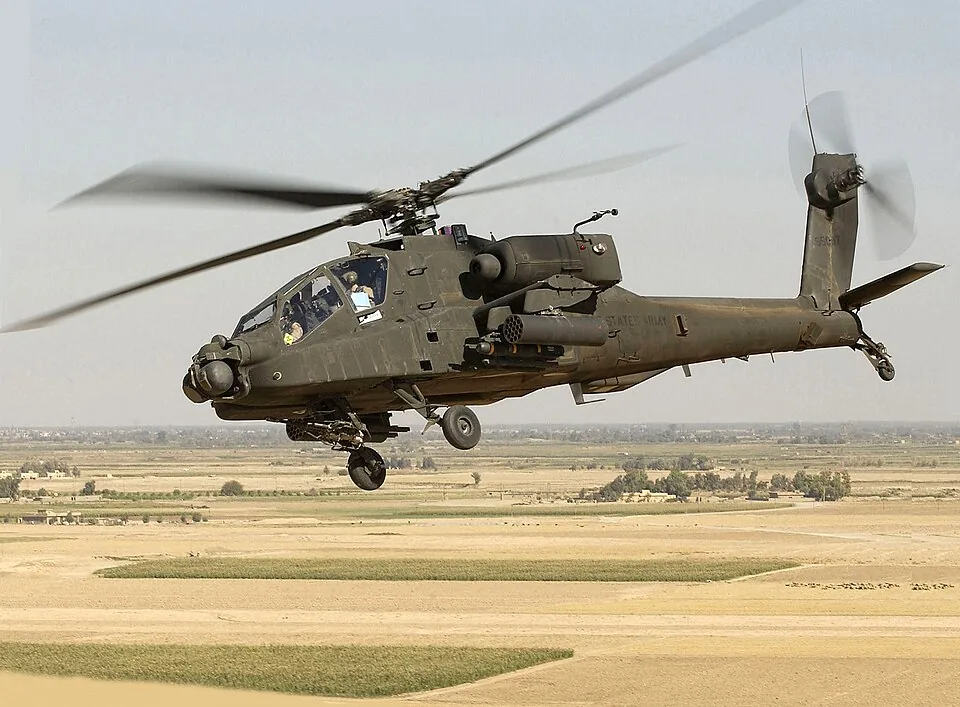
A U.S. Army AH-64 Apache attack helicopter went down in a field south of Salado, Texas on Wednesday afternoon, killing both crew members on board and igniting a wildfire that was still burning out of control more than an hour after the crash. The aircraft was based out of Fort Hood, one of the largest military installations in the country. Two people are dead, a fire is spreading, and nobody is saying why.
What Happened on the Ground
Bell County Sheriff's Office received an emergency call at approximately 1:33 p.m. local time, according to BBC News. When deputies arrived at the crash site in fields south of the small village of Salado, they found the wreckage of the Apache and a fire that spokesman Cliff Coleman described as "getting out of control very quickly."
CBS News reports that Coleman put it plainly: "You could tell this was a violent crash." Both people aboard the helicopter were pronounced dead at the scene around 2:30 p.m. local time. No homes or other structures were hit.
The wildfire the crash sparked was still burning as of 3:30 p.m. local time, CBS News reports. That is a detail easy to skim past, but worth sitting with. The helicopter came down hard enough to kill two trained soldiers instantly and start a fire that emergency crews could not contain for over an hour in the middle of the Texas summer.
The Aircraft and the Base
The AH-64 Apache is not a light training aircraft. It is a twin-engine attack helicopter, the Army's primary rotary-wing weapons platform, built to take and dish out serious punishment in combat. Two crew members, a pilot and co-pilot/gunner, fly it in tandem.
Fort Hood, formally known as Fort Cavazos after a 2023 renaming, sits near Killeen, Texas, roughly 70 miles north of Austin, according to CBS News. It is home to the 1st Cavalry Division, one of the Army's most storied heavy combat units. Salado sits just slightly southeast of the base, close enough that a helicopter in distress would barely have left familiar airspace before going down.
Brigadier General Ethan Diven, the acting commanding general of the 1st Cavalry Division, confirmed the aircraft's origin in a statement reported by both BBC News and CBS News. "Our immediate priority is securing the site and supporting the initial response efforts," Diven said. "Our thoughts are with the crew and their families as we await further information."
What the Army Is Not Saying
No cause. No names. No timeline for answers. The Army's public statement, as both outlets confirm, offered condolences and process language and nothing else. An investigation is ongoing. That is standard procedure after a crash like this, and it is fair to reserve judgment on what went wrong until investigators have had a chance to do their jobs.
But the absence of any preliminary information whatsoever, including the identities of the two people who died, means families of Fort Hood personnel spent Wednesday afternoon waiting by their phones with zero official clarity. That is a specific kind of awful. The Army knows who was on that aircraft. Notification procedures take time, which is why names are withheld, but the gap between "we know" and "we can say" is always hardest on the people closest to it.
The Broader Picture on Military Aviation Safety
Apache crashes are not unheard of. The aircraft has a long operational history stretching back to the 1980s, through Gulf War deployments, Iraq, Afghanistan, and dozens of training rotations in between. Crashes happen in training environments for a range of reasons: mechanical failure, pilot error, bird strikes, weather. No branch of the military has fully solved the problem of keeping complex aircraft in the air all the time.
What makes this one notable, beyond the obvious human tragedy, is the fire. A crash that sparks a wildfire spreading fast enough to alarm first responders in the middle of summer in central Texas is not a minor incident. The fuel load on an Apache at operational weight is substantial. Depending on wind conditions and dry brush, a crash like this can become a secondary disaster almost immediately. Wednesday's fire appears to have done exactly that.
The Dingo Take
Two soldiers are dead. That is the whole story, and it deserves to be said plainly before anything else. Whatever went wrong up there, two people who put on uniforms and climbed into one of the most complex machines the U.S. military operates did not come home Wednesday. That is not an abstraction.
The Army's statement is what it is: careful, procedural, and deliberately empty of anything that might later contradict an ongoing investigation. That is not sinister, it is protocol. But the press release cadence of military tragedy has a way of smoothing over the actual human weight of these moments, and it is worth resisting that smoothing. Brig. Gen. Diven's "our thoughts are with the crew" line is not cold, exactly. It is just the language institutions reach for when they cannot yet say anything real.
The investigation will tell us more, eventually. It might be mechanical. It might be something else entirely. For now, the facts are sparse and grim: an Apache went down hard in a Texas field on a Wednesday afternoon, both crew members died on impact, and a fire burned while first responders tried to figure out what had just happened. The Army says it is looking into it. So are we.




Comments