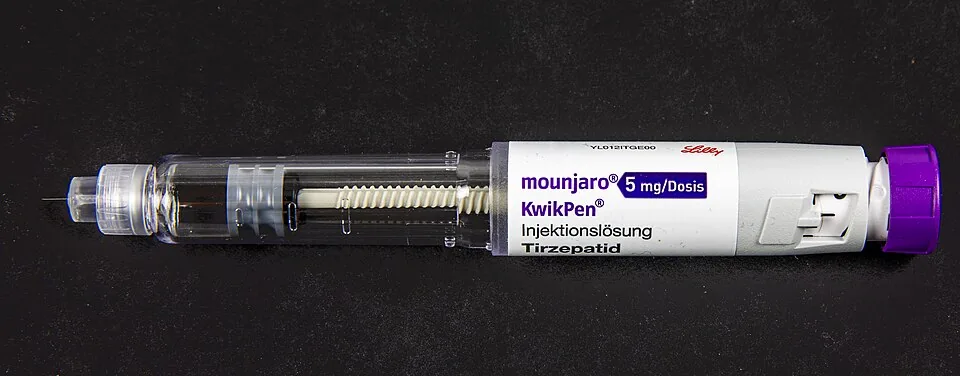
Eli Lilly is suing six companies for selling an unapproved version of its experimental weight-loss drug retatrutide, a drug that hasn't cleared FDA review, hasn't been proven safe for public use, and is currently available at a bodega in Brooklyn. A Brooklyn bodega. That was sold out. Of experimental weight-loss peptides.
The Drug That Doesn't Exist Yet Is Everywhere
Let's be precise about what's happening here. Retatrutide is not an approved drug. It is not legal to sell commercially in the United States. It is still in clinical trials, meaning scientists are still actively figuring out whether it's safe and effective. The FDA has not signed off. Eli Lilly itself doesn't plan to seek regulatory approval until early 2027.
And yet, as CBS News reports, you could walk into a convenience store in Brooklyn as recently as August 8th and see a poster advertising it on the wall. One store, a bodega called Mr. Green, reportedly had a cashier who told a CBS News reporter they were sold out. Sold out. The next big pharmaceutical breakthrough, the one still being studied in labs, was moving units faster than the Red Bull.
Who Eli Lilly Is Actually Suing
The six lawsuits Eli Lilly announced target a mix of the usual suspects in this kind of gray-market operation. Four of the companies, Astra Peptides, Legendary Peptides, Texas Peptides, and Lone Star Peptide, are marketing the drug "for research use" without a prescription, which is the pharmaceutical equivalent of a t-shirt that says "for novelty purposes only" on a bong. It's a legal fig leaf and everyone knows it.
The other two defendants are more brazen. Aesthetic Envy is a California med spa actively promoting retatrutide to clients. Striker Pharmacy has apparently just gone ahead and manufactured its own version of the experimental drug. A compounding pharmacy making its own imitation version of a drug that hasn't been approved yet. Let that sit for a second.
Max Denning, an associate vice president at Eli Lilly, told CBS News the supply is coming from "overseas manufacturers," and called the problem "global" and "enormous." He is not wrong on either count.
Social Media Turned a Clinical Trial Into a Consumer Craze
Here's the part that explains how we got here. Eli Lilly's trial results for retatrutide have been genuinely impressive. Wall Street analysts expect it to outperform the already blockbuster-level GLP-1 drugs like Ozempic and Mounjaro. The numbers leaked into public conversation. Fitness influencers picked them up. Weight-loss communities on social media ran with them. And suddenly there was mass consumer demand for a drug that technically doesn't exist yet as a commercial product.
Where there is demand and a regulatory gap, someone will fill it. In this case, a lot of someones. Telehealth companies, peptide vendors, med spas, compounding pharmacies, and apparently at least two bodegas decided the market opportunity was worth the legal risk. Federal law prohibits the commercial sale of unapproved drugs. The companies selling retatrutide have collectively concluded that this is somebody else's problem.
Eli Lilly's Own Executive Was Shrugging About This Last Week
This is where the story gets genuinely uncomfortable for Eli Lilly. CBS News reports that just last week, a financial analyst asked Kenneth Custer, an executive vice president at the company, whether Eli Lilly had a strategy to protect against what was "apparently available today" in the illicit market. His response was not exactly a war cry.
"I think people are eagerly awaiting authentic retatrutide to be available in the market," Custer said, according to a transcript compiled by S&P Global Market Intelligence. That's a very polished way of saying the quiet part out loud: that Eli Lilly's best argument against the illicit market is that eventually they'll have the real thing. Which is probably true! It's also not a strategy. Now, suddenly, six lawsuits.
Six Lawsuits Against a Bodega-Level Market
Denning acknowledged the obvious limits of what six lawsuits can accomplish against what he himself called a global, enormous problem. "Six lawsuits is not going to be the solution to everything, but it is a start," he told CBS News. He also called on regulators, social media companies, and payment processors to step up enforcement. That is a lot of institutions to be waiting on.
The FDA has authority here. Law enforcement has authority here. And yet CBS News found convenience stores openly displaying advertising for an unapproved experimental drug with apparently few if any consequences. The companies selling this stuff aren't hiding. They're hanging posters. The enforcement gap isn't theoretical. It is a poster on a bodega wall in Brooklyn.
The Dingo Take
You are supposed to believe that the system protecting Americans from unapproved drugs is working when the evidence is a sold-out shelf at Mr. Green's in Brooklyn. The FDA exists to make sure drugs are safe before they reach patients. That process is slow and frustrating and occasionally maddening, but it exists for reasons rooted in real history, in thalidomide and fen-phen and a hundred other disasters. What's happening with retatrutide is not a harmless workaround. People are injecting a drug whose safety profile is still being actively studied in clinical trials. We do not yet fully know what it does. That's the point of the trials.
Eli Lilly's lawsuit is legitimate and probably necessary, but six defendants is a rounding error against a market that has med spas, compounding pharmacies, peptide vendors, telehealth platforms, and bodega cashiers all moving product. The company spent months watching its executive wave off the illicit market as an investor relations footnote. Now they're playing catch-up against something that has had a multi-year head start.
The FDA needs to move faster on this, full stop. Not because Eli Lilly deserves protection for its patent, though that's also technically true, but because the alternative is an uncontrolled experiment on a large number of people who have no idea what overseas manufacturer produced the vial they're injecting. That's not a weight-loss strategy. That's a gamble. And right now, the house is a bodega in Brooklyn that's already cleaned out its stock.


Comments