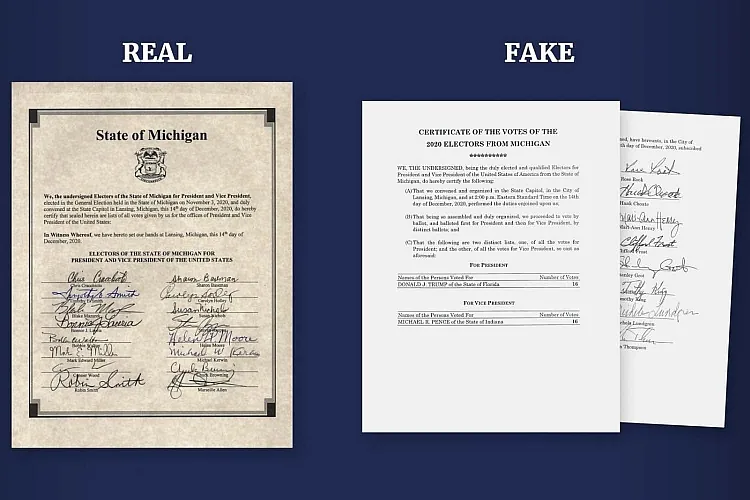
Six Nevada Republicans signed a fraudulent certificate handing Donald Trump electoral votes he did not win, broadcast the whole thing on video, and a judge just ruled there is not enough evidence they meant to deceive anyone. The yearslong fake electors case in Nevada is dead, dismissed Thursday by Judge Mary Kay Holthus, and the men who tried to steal a presidential election have walked away clean.
What They Actually Did
Let's get the facts on the table first, because they are genuinely stunning. After Biden won Nevada by more than 30,000 votes in 2020, six Republican electors gathered outside the state legislature and signed a certificate declaring Trump the winner anyway. They filmed it. They broadcast it online. The footage then became evidence against them in court.
The defendants included Michael McDonald, chair of the Nevada Republican Party, and Jesse Law, the former chair of the Clark County Republican Party. Nevada Attorney General Aaron Ford charged them with forgery and offering a false instrument for filing or record. They pleaded not guilty and argued, with a straight face, that the whole thing was just political theater.
That defense, which basically amounts to "we were only pretend-stealing the election," is now the official legal conclusion of a Nevada district court. Judge Holthus found that because the defendants openly announced what they were doing and why, the state could not prove fraudulent intent. The openness of the scheme, in other words, became its alibi.
The Judge's Reasoning, Such As It Is
Judge Holthus did not find that what the defendants did was fine or legal in any moral sense. What she found, according to NPR's reporting of the ruling, was that prosecutors failed to show the electors intended to deceive government officials into accepting their fake certificate as the real thing. She also found the state failed to disclose exculpatory evidence to the grand jury, which is a separate and significant procedural problem.
"The fact that Defendants openly announced both their actions and their asserted purpose, rather than concealing their conduct or attempting to secretly induce governmental reliance, weighs against a reasonable inference that they acted with fraudulent intent," Holthus wrote. Read that sentence a few times. The argument is that broadcasting your attempted electoral fraud on the internet is proof you were not committing fraud.
Prosecutors had argued something quite different. Their position was that the fake certificate was designed to be counted by Mike Pence on January 6th, 2021, slipped into the pile of legitimate electoral votes like a marked card in a rigged deck. The mechanics of the broader fake electors scheme, which stretched across seven states, strongly support that interpretation. But courts are not adjudicating the broader scheme. They are adjudicating intent, case by case, defendant by defendant.
Nevada Is Not Alone in This Failure
This is not an isolated outcome. As NPR reports, fake electors cases have now been dismissed in Arizona, Michigan, Georgia, and Nevada. The federal case against Trump himself, which charged him with conspiring to overturn the 2020 election, was dropped in late 2024 after he won the presidency again. A case in Wisconsin is still active, for whatever that is worth at this point.
Arizona's case has the most life left in it. Attorney General Kris Mayes dismissed her case as a procedural maneuver after losing an appeal, and she has vowed to bring it back to a grand jury for a new indictment. Whether that gambit succeeds is anyone's guess. The pattern, though, is clear: state-level prosecutions of the fake electors scheme have struggled badly in court, and the window for accountability is closing fast.
McDonald's defense attorney Richard Wright called Ford's plans to appeal "hasty" and "premature," and accused the attorney general of political motivation. Ford is currently running for governor as a Democrat. The irony of a man who literally helped try to cancel an election accusing someone else of playing politics appears to be entirely lost on Wright and his client.
The Scoreboard on Fake Elector Accountability
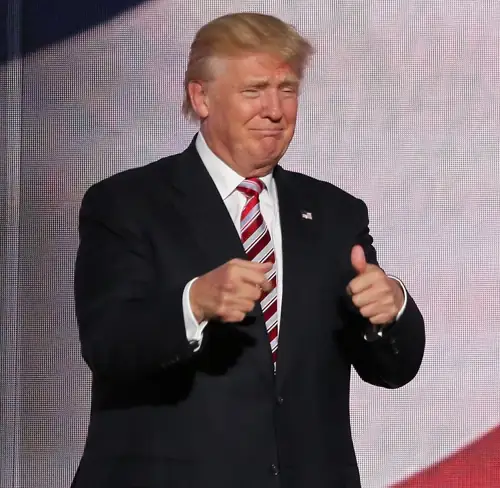
Step back and look at the big picture for a moment, because it is pretty bleak. A coordinated, multi-state scheme to submit fraudulent electoral certificates and help overturn a presidential election has now, six years later, resulted in roughly zero meaningful legal consequences for any participant. The architect of the scheme sits in the White House for a second time. The state-level participants are arguing they were just doing a bit.
The Wisconsin case remains ongoing, according to NPR, which makes it the last real thread of legal accountability for the fake electors operation still hanging by anything. The Nevada AG's office says it plans to appeal Thursday's dismissal, but appealing a ruling over evidence handling and intent standards is a slow, uncertain road. These cases were always going to be hard. They have turned out to be harder than that.
The Dingo Take
Six men filmed themselves submitting a fake certificate to steal an election and the court just said, sure, but did you mean it though? That is where we are. The "political theater" defense worked. It worked because the defendants were not subtle about what they were doing, and a judge decided that shamelessness is functionally equivalent to innocence. If you commit a crime loudly enough, in public, with a livestream, you may have invented a new legal shield.
The fake electors scheme was not some spontaneous act of political passion. It was a coordinated national operation, documented in meticulous detail by the January 6th Committee, designed to give Mike Pence fictional legal cover to throw out legitimate electoral votes. The fact that courts are struggling to convert that documented conspiracy into individual criminal convictions is not evidence the scheme was legal. It is evidence that the law has a very hard time prosecuting collective wrongdoing when each defendant can point at the room and say everyone knew what we were doing.
Ford is appealing, and maybe something comes of that. Mayes is trying again in Arizona. Wisconsin is still in play. But do not hold your breath. The system built to hold this particular crime accountable has been slower, messier, and less effective than almost anyone predicted. The men who tried to steal the 2020 election have mostly been inconvenienced by it. That's the verdict history is recording right now, and it is going to sting for a very long time.



Comments