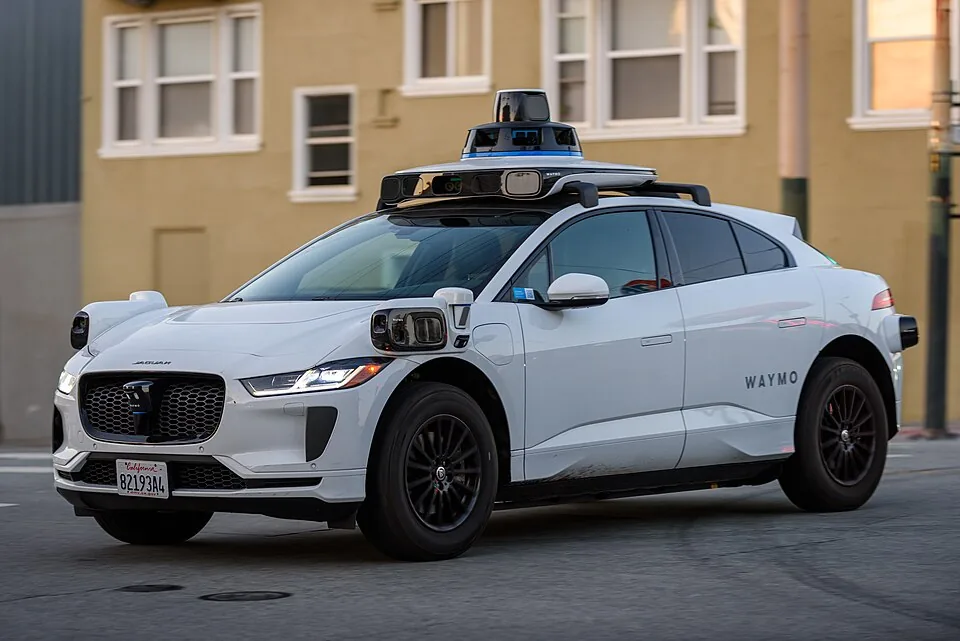
The good news: robotaxis are finally real, expanding into cities across America, and according to independent research, they crash 68% less often than human drivers. The bad news: a Waymo blocked an entire Los Angeles intersection for four minutes while a construction worker in a reflective vest screamed at it, to absolutely no effect. Both of these things are true simultaneously, and together they paint a pretty accurate picture of where we are with this technology.
Yes, They're Real. No, They're Not Everywhere.
Fully driverless taxis for hire have been promised since roughly the Obama administration, so it's worth pausing on the fact that they have actually arrived. As NPR reports, about a dozen major cities now have robotaxis as everyday technology, and Waymo is the dominant player. You've probably seen them: white electric vehicles bristling with sensors, topped with what NPR's Camila Domonoske describes as something that looks like a spinning top hat.
Waymo has about 20 more cities on its expansion list, including Washington D.C., where NPR host Rob Schmitz recently spotted one doing testing runs with no passengers. Not yet a paying ride, but coming. The company's head of product management, David Margines, told NPR the driverless future is 'absolutely here' and rolling out to more places, with the caveat that it's 'just not everywhere yet.' Which is, to be fair, an honest way to say 'we're working on it.'
Amazon's Zoox just received approval to launch commercial operations, and Tesla has the visually dramatic Cybercab waiting in the wings. In the cities where Tesla is currently running pilots, however, they're using regular-looking Tesla models rather than the sci-fi-looking Cybercab. The future, apparently, needs a few more dress rehearsals.
The Safety Numbers Are Actually Impressive
This summer, the Insurance Institute for Highway Safety looked at Waymo's crash data and found something that should, if we're being honest, be bigger news than it is. According to NPR's reporting on the study, Waymo vehicles are involved in crashes 68% less often than human drivers, measured by miles driven. David Kidd, the group's vice president for vehicle research, confirmed those numbers.
They're also far less likely to be the vehicle that strikes another car. They might still get rear-ended by a human being who wasn't paying attention, because you can't fix other people's bad driving from inside a Waymo. But the car itself is not the one slamming into things at a statistically alarming rate.
There's a catch, and it's a fair one. The IIHS compared Waymos to all human drivers, which includes people who are texting, drunk, exhausted, or doing all three. Safety experts NPR spoke with argue the comparison should be held to a higher bar, like professional drivers or at least humans who are demonstrably trying. It's a reasonable objection. 'Better than the worst drivers' is not the same as 'safe enough to trust unequivocally.'
They Don't Speed. They Do Shut Down in Intersections.
Here's where the story gets more complicated, and also funnier. Robotaxis don't make normal human driving mistakes. They don't speed. They don't get distracted by a text. They don't blow through a yellow light because they're running late. What they do instead is make completely different, weirder mistakes that no human would ever make.
Domonoske was in Los Angeles earlier this year when she ordered a Waymo and watched it roll into an intersection and just stop. Dead. Blocking traffic. A construction worker in a reflective vest started shouting and waving at it. The Waymo was unmoved, in every sense of the word. Domonoske, who is apparently a consummate radio journalist, kept her microphone rolling while apologizing to construction workers for being the person who summoned this thing. One worker's response, caught on tape: 'Welcome to the future.' It took four minutes for the car to clear the intersection.
This is the actual frontier we're at. Not the Terminator, not WALL-E. A confused white electric car ignoring a screaming man in a safety vest while it recalculates.
So What Happens Next?
Waymo's argument for improvement is the one every tech company eventually makes: more data. The more miles the vehicles drive, the more scenarios they encounter, the better the systems get at handling weird situations. David Margines told NPR directly that Waymos are not perfect and that the company is actively working on improvements. At least they're not claiming otherwise.
The job displacement question is also real and not going away. Ride-hail and taxi drivers are looking at a technology that, if it scales the way Waymo and Amazon and Tesla are hoping, restructures their entire industry. That conversation is mostly happening at the margins right now, in city council chambers and labor organizing meetings, while the tech press focuses on the cool sensor hats.
Expansion is the companies' clear priority. Waymo's list of target cities, Amazon getting commercial approval, Tesla's Cybercab sitting in the wings. The robotaxi industry is not quietly testing anymore. It is pushing into the mainstream, one blocked intersection at a time.
The Dingo Take
You are supposed to look at a 68% crash reduction and feel purely good about it. And honestly, part of you should. Human drivers are catastrophically bad. Tens of thousands of Americans die in car crashes every year, almost entirely because people speed, drink, get distracted, and make stupid decisions behind the wheel. If a machine can meaningfully cut into that number, that matters. That is not nothing.
But the construction worker screaming at a frozen Waymo in an LA intersection is doing more journalistic work than a hundred press releases. It captures exactly the gap between what this technology can do in controlled, well-mapped conditions and what the actual chaotic world throws at it every day. The car doesn't speed. The car also doesn't understand a man in a safety vest waving his arms and yelling. Those are different kinds of failure, and only one of them shows up in the crash statistics that make the headlines.
Waymo is the only company sharing the data needed for independent safety analysis. Every other player, including Tesla, which has been making self-driving promises for a decade, is a black box. That should bother everyone more than it does. The IIHS compared Waymo to all human drivers because that's the only data available. Until these companies open their books, 'trust us, it's safe' is not a safety record. It's a press release.



Comments