
A federal judge looked at Indiana's ban on student IDs at polling places and wrote that it "looks more like a solution in search of a problem." That's the judicial equivalent of calling someone a liar in a tuxedo. New Hampshire and Florida didn't care — they went ahead and passed their own versions anyway.
The Wave No One Asked For
Here's where things stand, according to NPR: New Hampshire banned student IDs for voting as of June. A federal appeals court put Indiana's similar ban back into effect in April, overriding a lower court ruling that had blocked it. Florida's Republican Gov. Ron DeSantis signed a student ID ban into law that kicks in 2027. Three states, one coordinated strategy, and not a single documented case of widespread fraud involving a student ID anywhere in the country.
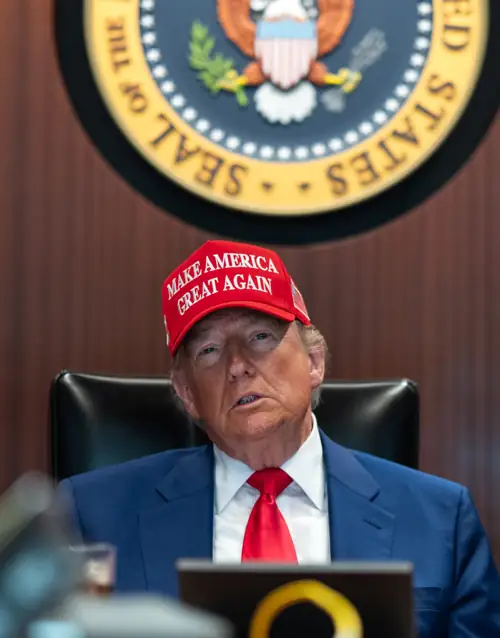
This isn't happening in a vacuum. NPR also reports that President Trump has been pushing a federal voting overhaul that would ban student IDs for in-person voting nationwide. That effort has failed so far. But the state-level labs are running, and the experiment they're conducting is: how many young people can we legally turn away from a polling place before anyone stops us?
A Solution Hunting Desperately for Its Problem
Let's be precise about what the evidence shows, because precision is the enemy of this particular con. NPR reports there is no evidence of widespread voter fraud involving student IDs. None. Local election officials don't even track what type of ID voters present when they check in, so there is no data suggesting student IDs have been a meaningful vector for anything except, you know, voting.
U.S. District Judge Richard Young, a Clinton appointee, found Indiana's ban likely unconstitutional and pointed out that student IDs had been accepted as valid voter identification in the state for nearly two decades without incident. He wrote that Indiana officials had "selectively excluded a form of identification that otherwise complies with the neutral criteria established by Indiana's voter ID law." That ruling is now paused while an appeals court takes a look, which is how courts do their slow grinding work while the 2026 midterms creep closer.
The sponsor of Indiana's ban, Republican state Sen. Blake Doriot, told a January hearing, according to NPR, "The last thing I want to do is to keep people from voting. The first thing I want to do is to keep people from voting who shouldn't be voting." He then offered no evidence of students who shouldn't be voting actually doing so. A remarkable performance.
Who Gets Hurt and Why That's the Point
Lia Symer, a Dartmouth senior in New Hampshire, told NPR she used her student ID to vote in 2024 without any issue. Like most college students, she doesn't carry her driver's license around campus. Student IDs get you into buildings, into dining halls, into libraries. They are literally what universities issue to prove you belong there. They are now, in New Hampshire, not good enough to prove you deserve a vote.
The complications don't stop at the state line. NPR reports that in Georgia, only student IDs from public institutions are accepted, which cuts out seven of the state's ten historically Black colleges and universities, including Morehouse and Spelman. In North Carolina, each college and university has to get individual approval from the state board of elections before their IDs can be used. The intricacy is not accidental. Complex rules that vary by school and state are exactly the kind of thing that trips up first-time voters who are already the least likely age group to turn out.
Michelle Kanter Cohen, policy director at Fair Elections Center, put it plainly to NPR: "What this really is, is a power grab of legislators saying that they don't want students to vote."
Young People Don't Drive Like Their Parents Did
Defenders of these laws will tell you the solution is simple: get a driver's license or a state ID. That argument is aging as poorly as a 2015 hot take about how Trump could never win a primary. NPR reports that young people are significantly less likely to obtain a driver's license than previous generations. Urban campuses. Rideshare apps. Transit systems. The assumption that every 20-year-old has a driver's license because their dad got one at 16 is not a policy argument, it's nostalgia dressed up as common sense.
The Coalition for Open Democracy filed a lawsuit this month challenging New Hampshire's ban, arguing it unconstitutionally burdens eligible students' right to vote and discriminates against younger voters based on age, according to NPR. That case is now working its way through the courts alongside the Indiana appeal, all of it racing against the calendar toward November's midterms.
The Federal Push Waiting in the Wings
State laws are just the ground floor. NPR reports that Trump's push to overhaul federal election rules would include a nationwide ban on using student IDs to vote in federal elections. That effort has stalled for now, but the scaffolding is being built at the state level in the meantime. New Hampshire, Indiana, Florida. A federal appeals court keeping Indiana's ban alive. DeSantis signing a law that doesn't even take effect until 2027, which tells you this is a multi-cycle project, not a one-time panic.
Voting rights advocates, per NPR, are now adding student ID navigation to their pre-midterm workload, trying to help students figure out what they need in which state before they show up at a polling place and get turned away. It is, as one Dartmouth student framed it to NPR, "just taking away an avenue for participation in our democracy." Which is the polite way to say it.
The Dingo Take
A federal judge called Indiana's student ID ban a solution in search of a problem. The Indiana legislature's response was to appeal the ruling and keep the ban in place. New Hampshire passed its own. Florida signed one into law. The message from Republican state legislators is not subtle: we cannot find fraud, we do not need fraud, the lack of fraud is irrelevant to what we are doing here.
The target is not fraudulent voters. There are no fraudulent voters using student IDs at any detectable scale anywhere. The target is students themselves, a demographic that skews young, educated, and not particularly inclined to vote Republican in the current political environment. Telling them their university-issued ID card is good enough to get into a lab or a dorm but not good enough to prove they are who they are at a polling place is not election security. It is the mechanism of a party that has decided it would rather change who votes than change what it stands for.
Watch what happens this fall. Watch how many students show up to vote and get turned away because they have their student ID but not a passport or a driver's license they don't own. Then watch the people who designed that outcome call the result a mandate.

Comments