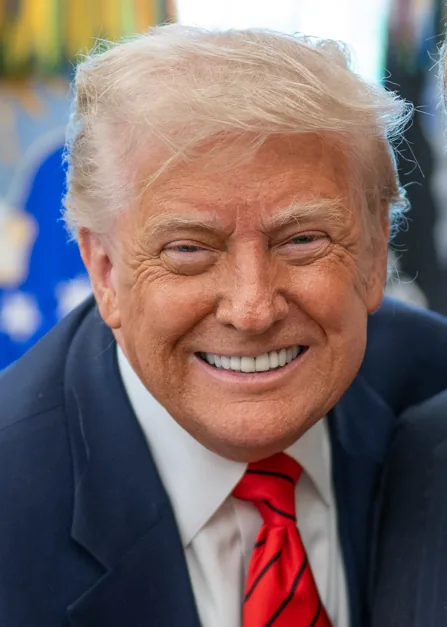
Donald Trump made $2.2 billion in revenue last year while serving as President of the United States. Congress looked at that number, shrugged, and went back to whatever it is Congress does now. According to the Guardian and other outlets, not only is no one stopping this, Trump is actively speeding up.
The Number Is $2.2 Billion. Read It Again.
Let that sit for a second. The sitting president of the United States generated $2.2 billion in revenues in a single year. Not before he took office. Not after. While holding the most powerful position on earth, with access to information that moves markets, trade policy that reshapes industries, and a justice department he has already demonstrated a willingness to weaponize.
Of that haul, the Guardian reports at least $1.4 billion came from cryptocurrency ventures alone. And here is the part that should make your blood pressure do something alarming: roughly one million investors in one of Trump's crypto projects lost nearly $4 billion combined as the value of their holdings collapsed. Trump got richer. His investors got torched. The presidency continued.
Then there is Truth Social, which was already a major revenue source. Trump is now reportedly planning to offer early access to his personal posts for $100,000 a pop. His posts move markets. He knows his posts move markets. He is charging people $100,000 to read them first. Lawsuits have been filed. The Freedom of the Press Foundation is among the groups calling it unconstitutional. It is proceeding anyway.
Congress Has Fully Checked Out
Eric Lipton, an investigative reporter for the New York Times, told NPR the quiet part out loud: "The Congress has decided not to commit oversight to this topic, and that's just the fact of the matter at this point." That is a veteran accountability journalist essentially saying the whole system of checks that was supposed to prevent exactly this has gone home for the year.
In any previous administration, a fraction of this would have triggered hearings, subpoenas, and at minimum a tremendous amount of very serious congressional frowning. Trump was impeached twice and convicted zero times, so perhaps the lesson he drew was that there are no real consequences waiting at the end of the road. He appears to have been correct.
Larry Noble, a law professor and former general counsel at the Federal Election Commission, told the Guardian's Peter Stone: "While Trump's second term is less than half over, it already looks like the most openly corrupt administration in our history." Not the most corrupt in recent memory. Not the most ethically questionable. The most openly corrupt in the entire history of the United States. That is a specific claim from a specific expert with a specific career spent working on exactly these questions.
Legal, Apparently. Ethical, Definitely Not.
Here is where it gets genuinely disorienting. The Guardian's Margaret Sullivan notes that while Trump's actions appall historians, academics, and millions of ordinary Americans, they may still fall within legal boundaries. The system was not built for someone this brazen operating this openly for this long without any institutional resistance.
There have been flashes of accountability. Trump tried to use the Justice Department to settle his $10 billion lawsuit against the IRS in a way that would have shielded him and his family from earlier tax return audits, potentially saving the Trumps around $100 million. A federal judge appointed by Barack Obama nullified major portions of that agreement. The legal fight continues. But one judge blocking one deal is not a functioning oversight system. It is a single speed bump on a highway.
Wealthy foreign nationals have also been investing in Trump family hotel and golf resort projects, which creates the kind of conflicts of interest that ethics lawyers used to write entire careers worth of warnings about. The response from the Trump operation, per Lipton's NPR interview, is essentially that the Trump family's businesses are good for the American economy. That is the whole answer. That is it.
The Public Notices, Even If Congress Doesn't
Two-thirds of Americans surveyed in a CNN poll said Trump does not put the good of the United States over his personal financial gain. That is not a close call in the polling. That is a landslide of public skepticism about the basic motivations of the sitting president.
His overall approval rating has sunk to 33%, with a disapproval rating of 64%, according to a Reuters/Ipsos poll. Those are historically bad numbers. The kind of numbers that, in a functional political environment, would produce massive legislative consequences. For now they are producing: nothing. Congress has the numbers. Congress has the reporting. Congress has the expert testimony. Congress is doing oversight on this topic at the level of zero.
Journalist Craig Unger argued on Substack recently that even the biggest investigative scoops no longer move the needle the way they once did, because the country no longer operates on a shared set of agreed-upon facts. Trump's long campaign to brand serious journalism as "fake news" has created a buffer against accountability that no single revelation can punch through. The corruption gets reported. The base does not care. The Congress does not act. The money keeps coming in.
November Is the Next and Maybe Only Check
The midterm elections in November represent what Sullivan describes as the only near-term mechanism that could introduce any friction into this operation. If Democrats flip the House, they get subpoena power. They get committee chairmanships. They get the ability to haul people in under oath and make the oversight that Lipton says Congress has abandoned into something that actually exists again.
Many forecasters think the House is genuinely within reach for Democrats. The Senate is considerably less likely to flip. So the most optimistic realistic scenario is a split Congress that can investigate but probably cannot legislate any real constraint into law. That is the ceiling. That is what "accountability" looks like right now.
Trump himself told the New York Times in January that his power is held back only by his "own morality." He said it in reference to foreign policy, but given the financial picture that 2025 produced, it seems safe to apply the quote more broadly. His own morality is the check. His own morality produced $2.2 billion in one year while a million crypto investors lost $4 billion. That is the morality we are working with.
The Dingo Take
You are supposed to look at $2.2 billion in presidential-year revenue and find a way to explain it that does not sound like what it is. The Trump operation has an answer for that: it is good for the economy. A former FEC general counsel has a different answer: it is the most openly corrupt administration in American history. Pick which expert you find more credible.
The thing that makes this story genuinely maddening, beyond the raw numbers, is the completeness of the failure. The press is doing its job. The Guardian, the New York Times, Reuters, NPR, they are all reporting this in real time. The public has clearly absorbed the message, which is why two-thirds of Americans tell CNN that Trump prioritizes himself over the country. And still the institution that is specifically designed to do something about it, the United States Congress, has, in Lipton's precise words, "decided not to commit oversight to this topic." Decided. Past tense. Done deliberating. Moving on.
A president who told a newspaper his only check is his own morality, who then made $2.2 billion in the year that followed, has given you all the information you need about how this ends. November is not a solution. It is a chance at a speed bump. The greedy toddler with his hand in the cookie jar is not going to stop because you gave the other kid slightly more say over the kitchen. But at this point, a speed bump would be something. Right now there is nothing.




Comments