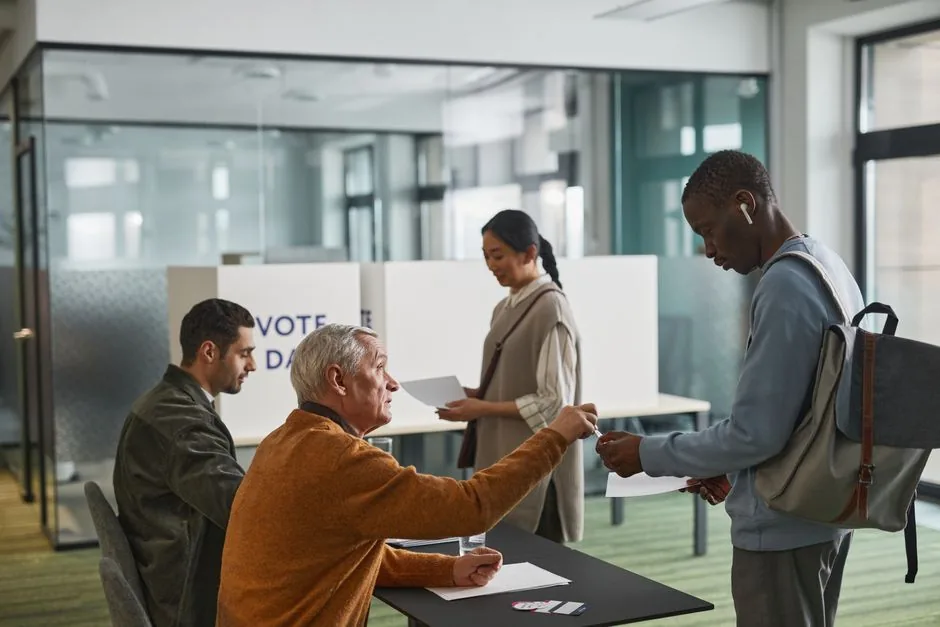
The Trump administration is promising to flood November's midterm elections with 1,000 Department of Justice monitors, which it's calling potentially the largest election monitoring effort in the department's history. Voting rights experts heard that announcement and responded with something close to a collective shrug. The punchline: even the people most suspicious of this administration think this particular plan is mostly just vibes.
The Big Scary Number That Isn't That Big or Scary
Here's the thing about 1,000 election monitors. It sounds like a lot until you remember that there are tens of thousands of polling places across the United States. One thousand people, spread across the entire country on a single day, is not an occupying force. It's a bad-attended convention.
Justin Levitt, a Loyola Law School professor who has actually worked on voting rights issues at the DOJ and the White House, told The Guardian he's not even sure they'll hit the number. "I'm skeptical they'll actually get to 1,000," he said. "Even if they did, that wouldn't be so different from the number in prior years." For context, CBS News reported that the DOJ sent 289 monitors during the 2022 midterms and 714 during the 2024 presidential election. Scaling up to 1,000 is an increment, not a revolution.
Levitt's full quote is worth sitting with: "The most anyone should expect from this group is a handful of suits standing quietly in the back of the room." A former DOJ official, speaking anonymously to The Guardian, put it even more bluntly: "1,000 DOJ monitors will only give us more videos of lawyers standing around with clipboards, following instructions from poll workers and being ignored by voters."
Harmeet Dhillon Steps to the Mic
The announcement came from Harmeet Dhillon, who leads the DOJ's civil rights section, and who told Bloomberg News earlier this week that the plan would be "probably going to be a historic number for a Republican administration." That qualifier at the end is doing a lot of work. A historic number for a Republican administration is a low bar when Republican administrations have historically not been deeply invested in voting rights enforcement.
The DOJ's own statement was aspirational rather than concrete: "We hope to have the largest monitoring effort in the department's history." They hope. Where exactly these monitors will be deployed, and whether the department can even find enough qualified people to staff the operation, remains unanswered. This is worth noting because the DOJ's civil rights division has shed scores of personnel under Trump. You don't rebuild institutional capacity for an operation of this scale by gutting the institution first.
Minnesota Said No Thanks and Then Watched Them Anyway
So far this election cycle, the DOJ has sent 75 monitors to more than 200 polling locations across five states, including Minnesota, Michigan, Arizona, Florida, and Wyoming. The Minnesota deployment is the most instructive case study in how this actually plays out on the ground.
Minnesota is a state with fresh, open wounds. Earlier this year, the Guardian reports, it saw an immigration enforcement surge that left two people dead and thousands deported, creating what officials described as deep distrust of federal authorities. When federal monitors showed up for the state's primaries, Minnesota decided to monitor the monitors. Secretary of State Steve Simon told The Guardian his office tracked the federal teams in real time, receiving updates on their locations. Hennepin and Ramsey counties, home to Minneapolis and St. Paul, flat-out refused to let the DOJ observers inside polling places. That meant the monitors had to stay outside a 100-foot boundary, like any random member of the public.
"There was no cat-and-mouse game," Simon told The Guardian. "They were very straightforward about that. And there were no major disruptions or obstructions." One or two monitors apparently drifted inside the boundary, got asked to move, and moved. That's the threat. That's the whole thing.
Why Everyone's Nervous Anyway
The expert consensus that this specific plan isn't a five-alarm fire doesn't mean the overall situation is fine. It is not fine. The Trump administration has issued executive orders trying to assert federal control over elections, and the courts have largely swatted those down. The DOJ has sued states trying to access private voter data. State officials around the country have said they no longer view the federal government as a partner in election administration. The president has denied the results of election defeats going back to 2020.
All of that is the context in which this monitoring announcement lands. Levitt acknowledged it directly: "This DOJ has amply earned the public's distrust." The distinction he and other experts are drawing is between the genuine threat posed by this administration's election posture broadly and this particular deployment, which based on all available evidence is mostly attorneys standing in parking lots looking at their phones.
The problem with bad-faith actors promising something alarming is that people reasonably assume the worst. The Trump administration has spent years cashing in that assumption. When they announce 1,000 monitors, the word "monitors" hits different than it would have a decade ago. That's not irrational. It's the entirely predictable result of spending years calling elections rigged and trying to overturn them.
The Logistics Don't Actually Add Up
Here is a practical problem the administration has not addressed: they have spent the better part of two years dismantling the civil rights division that would run this operation. The Guardian reports that scores of personnel have left the DOJ's civil rights division under Trump. You cannot announce a historically large election monitoring operation and also have presided over the hollowing out of the office responsible for it. Those two facts are in direct conflict.
A former DOJ official told The Guardian they doubted the department could even coordinate a deployment of that size. "DoJ may try to send 1,000 monitors into the field this November, but they probably won't be able to coordinate a deployment of that size," the official said. Recruitment, training, logistics, legal briefings, deployment coordination across multiple states and thousands of jurisdictions: that is not something you throw together after gutting your workforce. If the administration does manage to get close to 1,000 people in the field, the follow-up question is who those people are and what they actually know about election law.
The Dingo Take
You are supposed to believe that a department that has been systematically stripped of its career voting-rights staff is about to pull off the most ambitious election monitoring operation in American history. In November. With no clear deployment plan, no disclosed list of target jurisdictions, and a civil rights division that has been losing people out the back door for two years. Sure.
The experts are right that this specific announcement isn't the thing to panic about. Panic about the executive orders. Panic about the voter data lawsuits. Panic about a president who has never once conceded a loss and who is heading into midterms where his party could take a serious hit. The 1,000 monitors story is mostly noise. But the noise is designed to do something: to signal to MAGA supporters that the administration is watching, and to signal to everyone else that federal eyes are on their polling places. Intimidation doesn't require 1,000 people to work. It just requires the idea of them.
Minnesota's response is the correct one. You watch them back. You document where they go. You know your rights, and you make sure your local election officials know theirs. Because whether this particular deployment amounts to a bunch of lawyers standing in parking lots or something more aggressive depends entirely on whether states and localities push back hard enough to keep it that way.


Comments