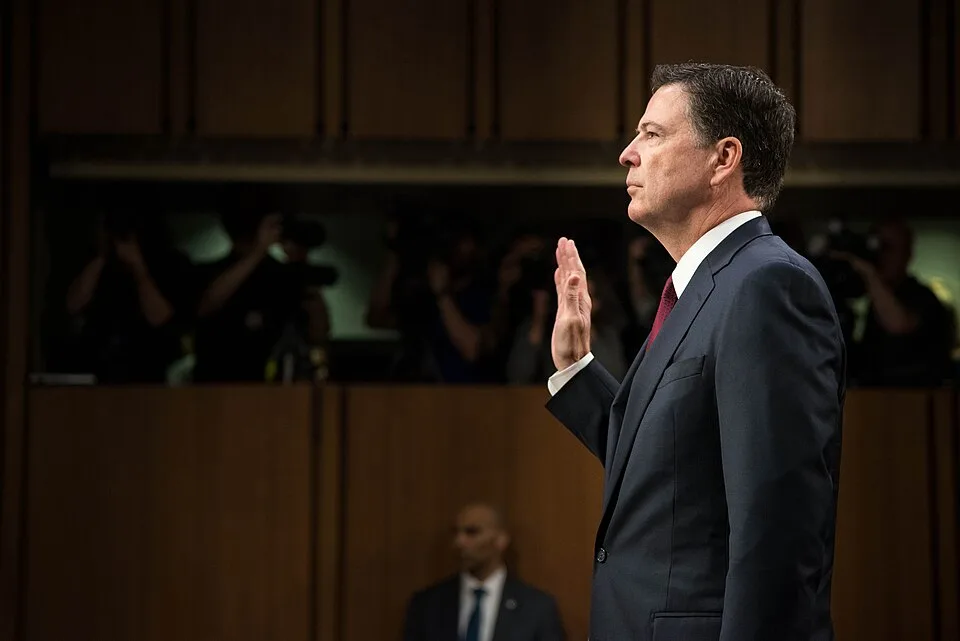
The Justice Department is now trying to send a former FBI director to prison, in part, because of a novel he wrote. Not a confession. Not a manifesto. A thriller. With a fictional prosecutor. That they found in a bookstore. This is where we are.
The Seashells That Started a Federal Case
Here is the chain of events that the full weight of the United States federal government is currently treating as a criminal conspiracy. In May 2025, James Comey posted a photo on Instagram while vacationing in North Carolina. The photo showed seashells arranged to spell out "8647." He took it down after backlash. The feds arrested him anyway.
The numbers, prosecutors argue, amount to a coded assassination order. "86" is slang for getting rid of something, originating in the restaurant industry where Comey once worked. Trump is the 47th president. Therefore, according to the Justice Department's reading, Comey was publicly signaling to his followers that someone should kill the president.
Comey has said it "never occurred to me, but I oppose violence of any kind so I took the post down." His lawyers argue the post was protected political speech and that "no reasonable observer would understand the phrase '86 47' to connote violence at all." The feds disagree, and they have now filed new documents insisting there is "no serious dispute" that the seashell photo could be interpreted as a threat.
When Your Own Fiction Becomes Evidence Against You
If the seashell argument sounds thin, prosecutors apparently agreed, because they went looking for more. What they found was Comey's debut novel, FDR Drive, published five days after the Instagram post.
According to The Guardian, prosecutors cited passages from the book and a Publishers Weekly review to suggest Comey's fiction revealed his true intentions. The novel's protagonist is a federal prosecutor who takes on a far-right media personality named Sam Buchanan, described as someone who "singled out his enemies by name and suggested 'something should be done' about them." Prosecutors appear to be arguing that Comey was writing himself a blueprint.
They also claimed Comey had an "apparent financial incentive to stir up controversy" by posting the seashells just before his book launch. The book has sold 6,471 copies, according to Circana BookScan. Not exactly the Dan Brown numbers you'd expect from a criminal mastermind ginning up a presidential assassination for publicity.
PEN America Did Not Take This Quietly
PEN America, the free expression organization, released a statement Friday that did not mince words. "Citing a novel to save an indictment that is constitutionally dubious is a desperate Hail Mary and should be rejected," said Mara Gassmann, PEN America's legal director.
Gassmann went further: "A political message, expressed through a photo of seashells, is no true threat; now, the government's use of Comey's work of fiction to support this prosecution compounds the first amendment concerns." She added that "extreme caution should be taken any time creative works are used to support criminal charges."
This is not an abstract academic concern. If prosecutors can use a thriller novel as evidence that its author harbored violent intent, every crime writer in America just got a little more nervous. Every political satirist. Every op-ed columnist who has ever written "someone should do something about this guy" and meant it entirely non-lethally, which is to say, all of them.
The Actual Legal Fight Here
Comey's legal team has moved to dismiss the case entirely, arguing the charges represent "vindictive and selective prosecution" driven not by genuine legal merit but by Trump's "yearslong campaign" to use the criminal justice system against him. The indictment, they say, is "not based on a good faith application of the law to the facts."
The federal charges themselves are serious on paper: making a threat against the president and transmitting that threat across state lines via social media. These are real laws. Whether a seashell photo meets the legal standard of a "true threat" is the central question, and it is a question the Supreme Court has actually addressed in recent years, narrowing what qualifies considerably.
Trump's history with Comey stretches back nearly a decade, to Comey's handling of investigations into Russian interference in the 2016 election. That investigation found Russia interfered "in sweeping and systematic fashion" but did not establish that Trump's campaign coordinated with Moscow. Trump fired Comey in 2017. The grudge, evidently, has survived the intervening years with remarkable vigor.
What the Government Is Actually Arguing
Step back and look at the scaffolding of this prosecution. The government's theory requires you to believe that a former FBI director, fully aware he was under the scrutiny of an administration that despises him, decided to publicly call for the president's assassination using a beach photo. And then published a novel as a companion piece. And timed it all to sell books.
The filing also argues there is "no serious dispute" that the post "could be interpreted" as a threat. That is doing a lot of work. A lot of things can be interpreted a lot of ways. That is, in fact, the entire problem with using artistic ambiguity as criminal evidence, which is precisely what PEN America is flagging.
Comey's lawyers say the government is punishing their client for "protected speech" and for being someone the president has hated for years. The government says it is simply enforcing the law. One of these explanations requires you to believe the seashell photo was a hit order. You can decide which one you find more plausible.
The Dingo Take
The DOJ cited a thriller novel to keep a prosecution alive that might otherwise collapse under its own weight. That is not a standard law enforcement tactic. That is a tell. When you are padding your legal filing with Publishers Weekly book reviews, you are not prosecuting a crime, you are assembling a vibe board and hoping a jury buys it.
The "8647" post was stupid politics. Comey knew how it would land, he took it down, and he said so. But "stupid politics" and "presidential death threat" are not the same legal category, and conflating them requires a reading of intent so aggressive that it would criminalize roughly half of American political speech overnight. PEN America is right to be alarmed, and not just on Comey's behalf.
If this prosecution succeeds on this theory, the precedent is terrifying. Your novel can be used to establish motive. Your Instagram can be a coded message. Your beach vacation photo can be an assassination plot. The Trump administration has spent considerable energy testing how far it can push the machinery of federal prosecution against its enemies. This case is one of the most brazen tests yet. Watch how the courts respond, because whatever they decide here will not stay contained to one retired FBI director and his very moderately selling thriller.


Comments