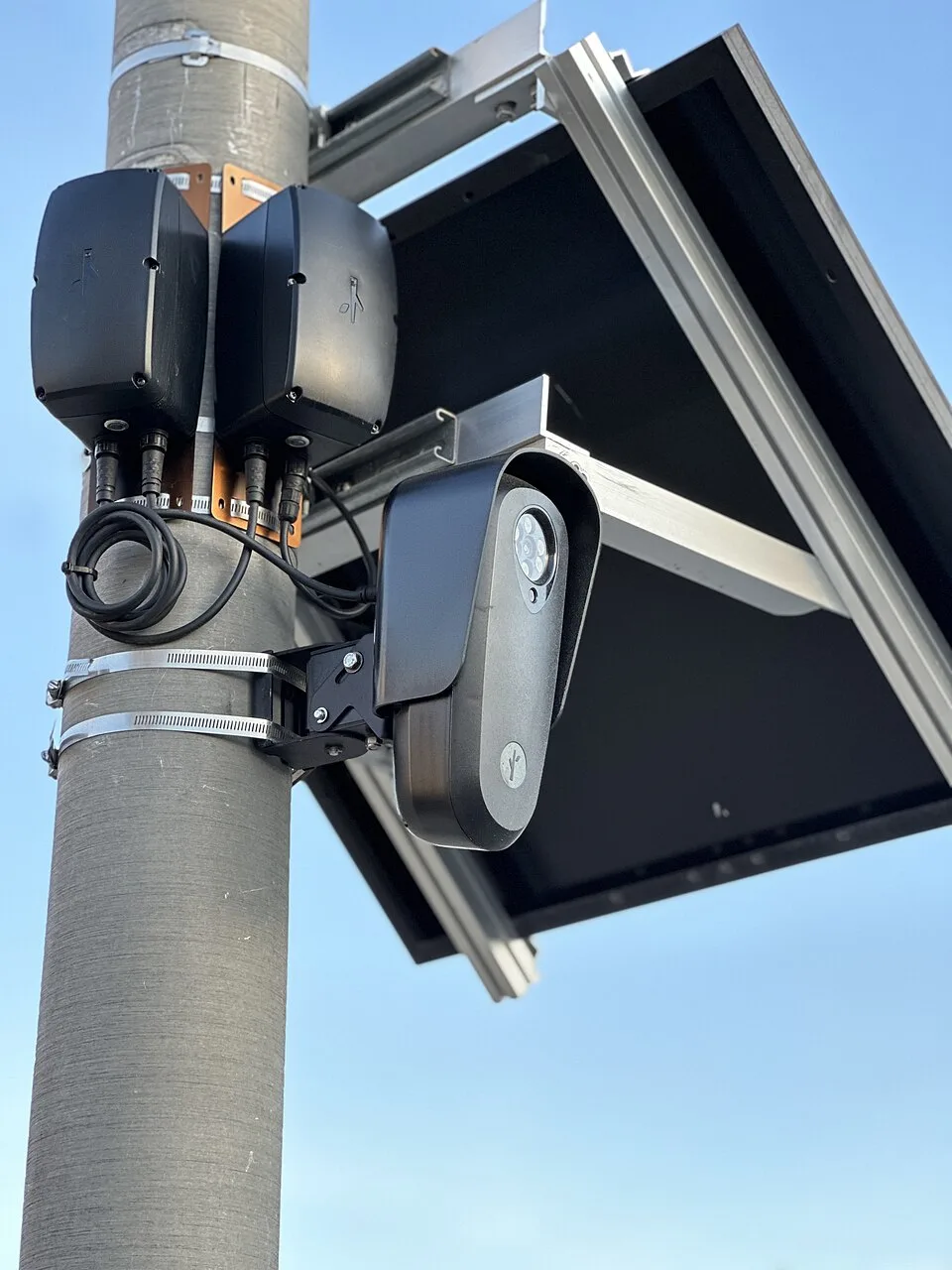
Somewhere between electing people to fix the economy and electing people to fix healthcare, America has apparently decided that its real midterm priority is the network of license plate readers bolted to telephone poles across every suburb in the country. Flock Safety cameras, the AI-powered surveillance tools that quietly became ubiquitous in American cities and towns over the last several years, have exploded into a genuine campaign issue in 2026. Axios reports that candidates are now sprinting to out-oppose each other on the technology, and if you think that's going to be a nuanced policy debate, you have not been paying attention to American politics.
What Flock Cameras Actually Are (Since Congress Clearly Needs a Refresher)
Flock Safety cameras are fixed license plate readers that use AI to capture and store data on every vehicle that passes by. They're sold primarily to law enforcement agencies and homeowners associations, and according to the company's own numbers, their network spans thousands of communities across the United States. The pitch is simple: help police solve crimes faster by knowing exactly where your car was at any given moment.
The problem, which civil liberties groups have been screaming about for years while everyone else was busy arguing about other things, is that this infrastructure also creates a comprehensive, AI-powered map of where American citizens travel, with whom, and how often. No warrant required for the initial data collection. No opt-out mechanism. Just cameras, everywhere, forever.
For a long time this was mostly a concern for privacy advocates, defense attorneys, and the kinds of people who read the ACLU newsletter. Axios is now reporting that it has become a top midterm boogeyman alongside data centers, which tells you something important: the grassroots anger over AI surveillance has finally reached a volume that politicians can hear over the sound of their own fundraising calls.
The Political Scramble Nobody Saw Coming Six Months Ago
Here is the thing about politicians and technology issues: they tend to ignore them until they can't, and then they panic-sprint toward whatever position generates the most applause at town halls. That sprint is now underway on Flock cameras.
Axios reports that members of Congress and congressional candidates are actively trying to harness the grassroots anger around license plate readers, racing to position themselves as the ones who will Do Something about the country's surveillance infrastructure. The ideological coalition here is genuinely strange. Opposition to pervasive AI surveillance is one of those rare issues where the libertarian right and the civil liberties left can end up in the same room without immediately trying to fight each other.
Whether that produces actual legislation or just a lot of very passionate floor speeches that accomplish nothing is, historically speaking, not a close question. But the fact that it has become a campaign issue at all is a meaningful shift. As Axios frames it, this is a signal of how fast AI has moved from the margins of political conversation toward the center of a national election cycle.
Data Centers Got Here First, and the Pattern Is Already Familiar
Flock cameras are arriving to a party that data centers already started. Axios reports that opposition to building new data centers has become a significant midterm issue on its own, with candidates competing to take the hardest line against facilities that consume enormous amounts of energy and water while employing relatively few people in the communities that host them.
The data center backlash follows a predictable arc. Local communities noticed the facilities were getting approved at a rapid pace, started asking questions about their power draw and environmental footprint, and the anger went viral. Now it is campaign material. The Flock camera issue is following almost exactly the same trajectory, just on a faster timeline.
What both issues share is that they are fundamentally about AI infrastructure, the unglamorous physical layer underneath the chatbots and the generated images and the productivity tools that get the breathless magazine covers. Nobody puts a picture of a server farm on the front of Wired. Nobody makes a documentary about license plate readers mounted on a suburban intersection. But people are now voting on them, which is a genuinely new development in American politics.
The Part Where We Ask What Took So Long
The Flock camera network did not materialize overnight. The company was founded in 2017, and the expansion of its technology into law enforcement contracts has been documented by journalists and researchers for years. The ACLU and other privacy organizations have published detailed analyses of the constitutional implications. Local news outlets have covered individual communities wrestling with whether to adopt the cameras or push back against them.
None of that produced a national political reckoning. What produced a national political reckoning was the issue going viral in enough individual communities simultaneously that the aggregate anger became impossible for candidates to ignore. That is not how thoughtful policy gets made. That is how you get a lot of candidates promising to ban things they only learned about four months ago.
The risk here is real. Surveillance infrastructure this embedded in law enforcement operations does not get unwound with a campaign promise and a floor speech. It requires actual legislative work, actual agency rulemaking, and actual political will sustained past the point where the cameras stop trending on social media. The history of Congress taking on tech regulation does not exactly inspire confidence on that front.
The Dingo Take
You are supposed to believe that the same legislative body that took three years to produce a largely toothless kids' online safety bill is about to seriously reckon with a national AI-powered vehicle surveillance network because it became a midterm issue in August 2026. Sure. Absolutely. Write that down.
The anger driving this is legitimate. A country-spanning network of license plate readers that vacuums up location data on ordinary citizens going about their ordinary lives, with minimal oversight and no meaningful consent mechanism, is exactly the kind of thing that should make people furious. The civil liberties concerns are not hypothetical. They are documented, specific, and serious. The problem is that political systems are very good at absorbing legitimate anger and converting it into symbolic gestures, and the history of AI regulation in the United States is mostly a history of symbolic gestures.
What would actually change things is candidates willing to go past the applause line and into the boring, technical, legally complex work of writing enforceable federal standards for how law enforcement can collect, store, and share automated location data. That's not a great stump speech. It doesn't fit on a yard sign. But it's the difference between a movement and a moment, and right now all we have confirmed is a moment.



Comments