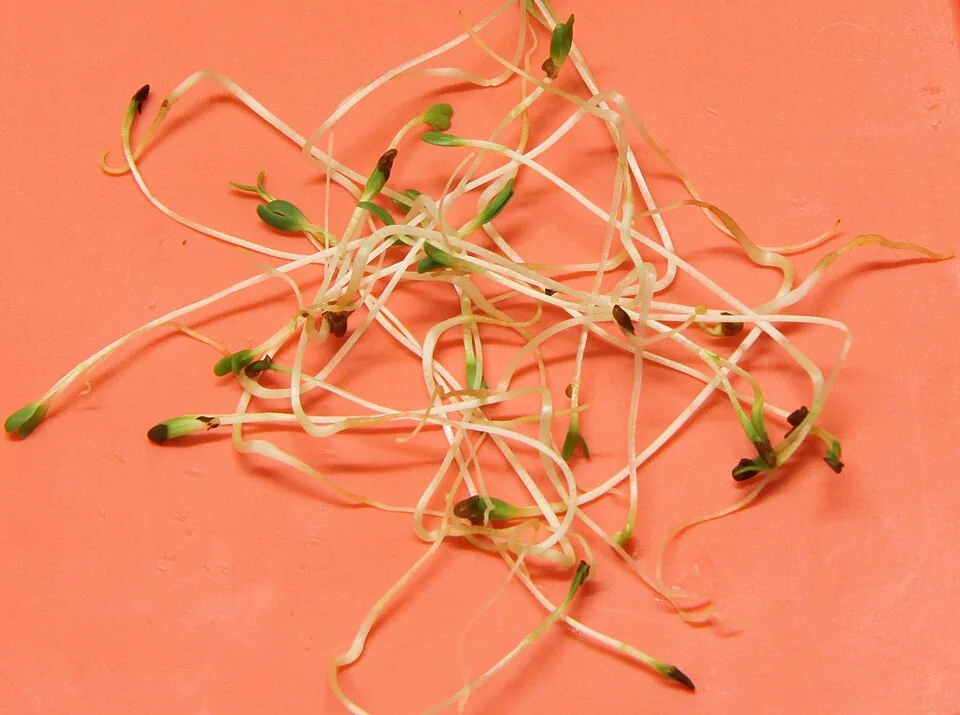
A Minnesota sprout company got a federal warning letter in June 2025 about, among other things, a leaking roof dripping water onto the food it was producing. Fourteen months later, 55 people across 15 states are sick, four are hospitalized, and the CDC is tracking an outbreak involving both salmonella and E. coli simultaneously. Totally unrelated, probably.
What We Know So Far
The CDC confirmed at least 55 cases of food poisoning tied to alfalfa sprouts, spread across Florida, Indiana, Iowa, Kansas, Michigan, Minnesota, Wisconsin, New Hampshire, New York, Pennsylvania, North Carolina, South Carolina, North Dakota, South Dakota, and Washington, according to The Guardian. Four people have been hospitalized.
The FDA says that of 34 sick people who were interviewed, 26 reported eating alfalfa sprouts. Officials traced the contaminated product to Everything Sprouts, a Minnesota-based grower selling under the Calco and Everything Sprouts brand names to grocery stores and restaurants.
The company has issued a voluntary recall of certain lots. Whether those lots are still sitting in someone's refrigerator crisper drawer right now, contributing to a sad but technically health-conscious salad, is a genuinely important question.
Two Germs for the Price of One
Here is something that does not typically happen: this outbreak involves multiple different pathogens at once. The Guardian reports that people are getting sick with both salmonella and different strains of Shiga toxin-producing E. coli, known as STEC. Food poisoning outbreaks usually rally around a single villain. This one brought backup.
STEC is not a fun bug to tangle with. It causes stomach cramps and bloody diarrhea, and in serious cases can trigger acute kidney failure. Salmonella brings its own gift basket: diarrhea, fever, severe vomiting, dehydration, and cramps. Getting either one is terrible. Getting both, or even being unable to tell which one you have, is the kind of thing that makes you reconsider every life choice that led to the sprout-covered grain bowl.
Public health investigators are still working to understand the scope. Outbreak numbers from the CDC tend to be undercounts, since most people who get food poisoning never get tested and never get counted.
About That FDA Warning Letter
Let's talk about the warning letter. In June 2025, the FDA sent Everything Sprouts a formal warning after inspections the previous year turned up several concerns, The Guardian reports. One of those concerns was a leaking roof that was dripping water directly onto bean sprouts and workers' smocks.
A leaking roof. Dripping. Onto the food. This is not an obscure regulatory technicality. This is the kind of problem that a health inspector in any restaurant in America would flag as a critical violation before they'd even finished writing it down.
The FDA issued the letter. Everything Sprouts, apparently, kept sprouting. And now here we are.
The Company's Response, Such As It Is
Everything Sprouts says it has been conducting daily tests since the outbreak began and has, per a statement cited by The Guardian, "not received any positive lab results." The company also said that no illnesses had been reported to them directly.
This is a good time to point out that "we didn't get any positive tests" and "55 people in 15 states got sick and the federal government linked it to our product" are not mutually exclusive statements. Both can be true at the same time. Laboratories miss things. Tests have windows. Contamination is not always evenly distributed across a batch.
The voluntary recall is, at minimum, the right call. The statement is less reassuring than the company probably intends it to be.
What You Should Actually Do Right Now
If you have alfalfa sprouts in your house that came from Everything Sprouts or carry the Calco brand, do not eat them. Throw them out. The recall is voluntary, which in American food safety terms means the company is doing it because the alternative is worse, not because anyone made them.
The CDC and FDA have not issued a blanket warning against all alfalfa sprouts from all producers, but sprouts in general are a known vector for foodborne illness. The way they are grown, warm and wet and in close quarters, is basically an ideal environment for bacteria. This is not a new problem. The FDA has been warning about sprout risks since the 1990s.
If you are immunocompromised, elderly, pregnant, or feeding sprouts to a small child, the federal guidance has been consistent for decades: sprouts carry real risk and the reward, culinarily speaking, is roughly zero.
The Dingo Take
You are supposed to look at this story and conclude that the system basically worked. Company gets inspected, gets a warning letter, eventually issues a recall, outbreak gets identified and publicized. Sure, 55 people got sick first, but that is just how food safety works in a country this big and this complex.
That framing is wrong. The FDA sent a warning letter in June 2025 about a roof leaking onto the food supply. Not a paperwork violation. Not a labeling technicality. A literal structural failure contaminating the production environment. And then, per available reporting, nothing materially changed until the outbreak happened anyway. Warning letters are not the same as enforcement. The FDA has the authority to demand corrections and follow through when companies don't make them. The question of whether they did that here is one that deserves a real answer.
The broader issue is that the American food safety system runs on voluntary compliance, understaffed inspectors, and after-the-fact outbreak detective work. It catches a lot. It also lets a company with a dripping ceiling keep operating for over a year before 55 people in 15 states become the proof that something was wrong. That is not a broken system having a bad week. That is the system working exactly as designed, which is the more unsettling conclusion.




Comments