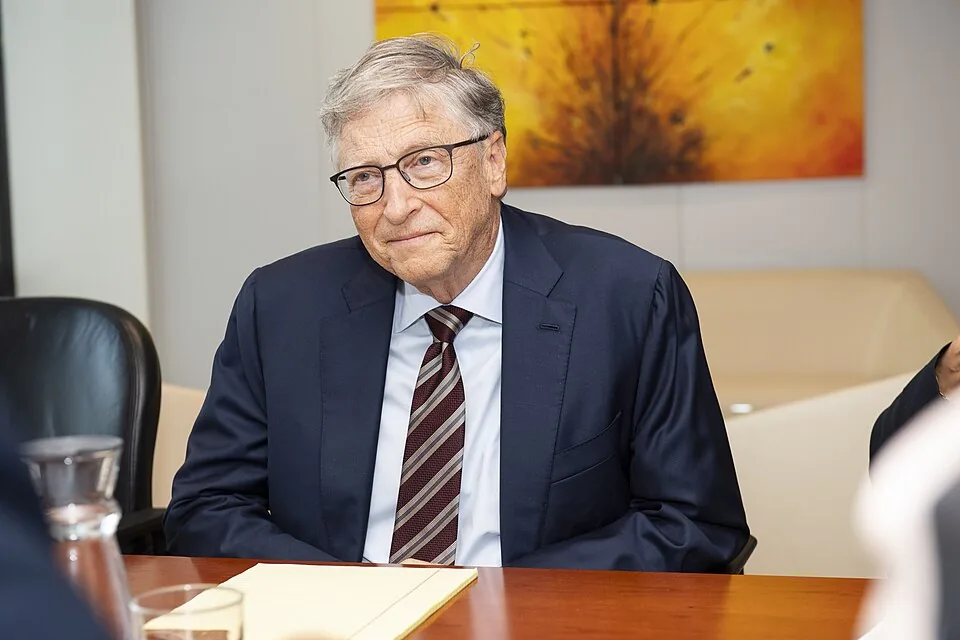
Bill Gates just published a nearly 6,000-word essay arguing that AI will obliterate white-collar jobs in law, medicine, software, and customer service within a decade, not over generations. He also thinks smart robots will be competing with construction workers by 2030. And he's being pretty clear that without serious policy intervention, there will be 'far fewer' jobs than exist today. Sleep well.
The Part Where the Microsoft Guy Says the Quiet Part Loud
Gates published the essay on his personal website Wednesday, and CBS News reports it covers a lot of ground, but the core message is not subtle. AI is advancing at what he calls a 'mind-blowing rate,' moving faster than any previous technological revolution, and leaving society with far less runway to adapt than it had during, say, the industrial revolution or the rise of the internet.
The key threshold Gates is watching for is when AI produces 'nearly error-free work.' Once that happens, he writes, AI 'will be able to function on its own without a human checking in on it, and companies will have every economic incentive to let it.' That's the cliff edge. After that, the economic logic for keeping humans around in a lot of roles basically evaporates.
This is not a guy with a reputation for hysterical doom-saying. Gates is methodical, famously nerdy, and has spent decades thinking about how technology reshapes society. When he writes that AI will hit law, medicine, software, and manufacturing 'rapidly, over the course of a decade rather than a few generations,' that deserves more than a news cycle of attention.
It's Not Just Desk Jobs
Here is where a lot of people tuned out of the AI jobs conversation because they thought it only applied to knowledge workers and coders. Gates is correcting that assumption directly. Physical labor is next.
According to CBS News, Gates argues in the essay that 'smart' robots will begin competing with humans on physical tasks in construction and hospitality by the end of this decade. That is five years from now. The workers who didn't worry because they weld things or pour concrete or clean hotel rooms were never as safe as the conventional wisdom suggested, and Gates is now saying so plainly.
The ripple effects of that are enormous and almost nobody in power is talking about them seriously. Construction alone employs millions of Americans. Hospitality employs millions more. These are not fringe industries. These are the jobs that kept working-class communities economically functional after manufacturing left. If robots start doing those jobs competitively in the next five years, the political and social consequences will make the 2016 Rust Belt story look like a warm-up act.
The Tax System Is Already Helping Robots Win
Gates doesn't just describe the problem. He points to a structural reason it's accelerating that almost never gets discussed in mainstream coverage of AI. The tax code is actively subsidizing the replacement of human workers.
As CBS News reports, Gates lays it out plainly in the essay: hire a human and you pay payroll taxes on their earnings. Buy a robot and you can usually write it off immediately as a business expense. The system, as it currently exists, financially penalizes companies for choosing people over machines. Nobody designed it this way on purpose, but that's the effect, and it's been sitting there unreformed while AI made automation exponentially more attractive.
Gates proposes taxing AI tokens and robots as one possible correction, a mechanism to slow the pace of displacement and give society time to adapt. It's the kind of policy idea that will make libertarian tech bros furious and that mainstream Democrats have been too timid to touch. Whether it's the right answer is a legitimate debate. That we're not having that debate seriously, at scale, in the halls of government right now is genuinely alarming.
The 'Nature Preserve' Idea and Why It Matters
One of the more striking frameworks in Gates's essay, per CBS News, is his argument that some jobs should simply be reserved for humans by policy choice, the same way societies choose to protect land as nature preserves rather than build on it. Caregiving is his primary example.
The analogy is doing real philosophical work here. Gates is acknowledging something that pure market logic struggles to accommodate: that human contact has intrinsic value in certain contexts, and that a society might reasonably decide to protect that value even at an economic cost. That's not a fringe idea. Most people intuitively understand that they want a human being present when they're sick or dying or scared. The question is whether governments will have the will to encode that preference into policy before the market makes the decision for them.
He does note the complexity. Japan, with a shrinking workforce and not enough young people to care for an aging population, might genuinely welcome robotic caregivers as a practical necessity. Context matters. But the broader point stands: these are choices societies can make, not just outcomes they have to accept. The problem is that making those choices requires political will that is currently nowhere in evidence.
Meanwhile, in Washington...
The Trump administration has spent the past year treating AI primarily as a deregulation opportunity and a geopolitical competition with China, with very little public attention to what happens to American workers as the technology scales. There is no serious federal jobs transition program on the table. There is no meaningful AI tax policy under active consideration. The main governing philosophy appears to be 'get out of the way and let the market figure it out.'
That approach might make sense if the market had a good track record of voluntarily softening the blow when entire job categories disappear. It does not. What usually happens is that workers absorb the loss, communities collapse, and politicians eventually capitalize on the anger by blaming immigrants or trade deals. We've seen this movie. It doesn't end well.
Gates is one of the architects of the world that produced this moment. He knows how technology companies think, because he built one. When he writes that companies will have 'every economic incentive' to replace humans once AI is reliable enough, he is not speculating. He is describing how his peers make decisions. That's the part of this essay that should be keeping policymakers up at night.
The Dingo Take
You are supposed to believe that someone will figure this out in time. That the market will create enough new jobs to absorb the disruption, that policymakers will get ahead of it, that this technological revolution will be different from the ones that hollowed out manufacturing towns and never looked back. Bill Gates, who has more insight into how this technology actually works than virtually anyone alive, is telling you that is not a safe assumption.
The essay is not a panic attack. It's a methodical, well-sourced argument from someone who helped build the digital economy, who has spent decades watching technology reshape work, and who is now saying clearly that the pace and scope of what's coming is unlike anything we've handled before. 'Far fewer jobs than exist today.' That is the phrase that should be leading every political debate right now. It is not.
What we have instead is a Congress that barely understands how social media works, an administration ideologically committed to removing guardrails, and a tech industry that has every financial incentive to move fast and let someone else deal with the wreckage. Gates is raising the alarm. The question is whether anyone with actual power is listening, or whether we're going to have this conversation properly only after the jobs are already gone.


Comments