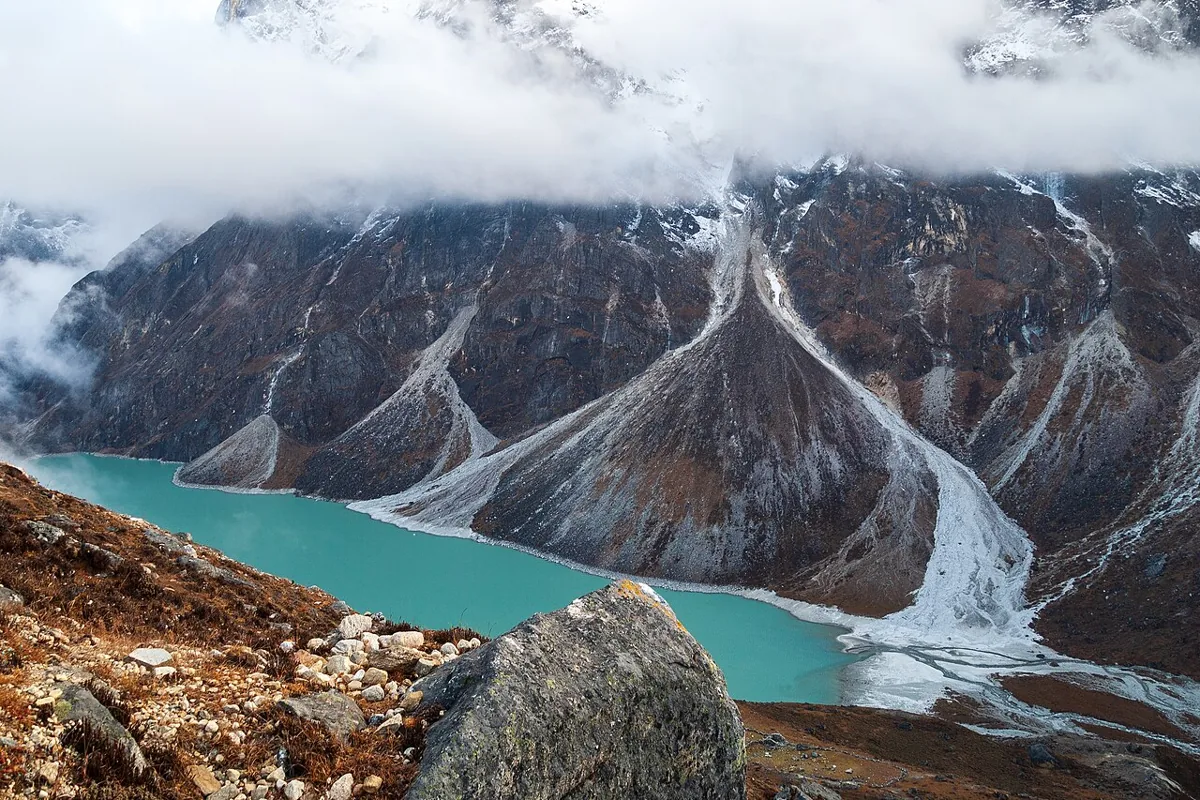
An earthquake cracked a mountain, a landslide dammed a river, and then the Bhote Koshi turned into a wrecking ball. At least 18 people are dead and more than 380 are listed as missing after catastrophic flash flooding tore through Nepal's northern border region on Wednesday, according to CBS News. Among the missing: at least three American nationals.
How a River Becomes a Weapon
Nepal's Foreign Minister Shishir Khanal confirmed that an earthquake triggered a massive landslide, which blocked the Bhote Koshi River in the northern Rasuwa district. When a blocked river finally moves, it does not gently resume. It detonates.
The resulting surge swept through Rasuwa and quickly overwhelmed the neighboring Nuwakot and Dhading districts, according to CBS News. Videos circulating on social media and regional outlets show walls of brown water consuming bridges, tearing apart buildings, and rushing through mountain gorges at a speed that leaves precisely zero time to react.
District administrator Narendra Pariyar, quoted by Reuters, put it with an understatement that deserves some credit for restraint: 'There could be heavy casualties or loss of property.' The word 'could' is doing extraordinary heavy lifting in that sentence.
The Missing: 291 Foreigners, 3 of Them American
Nepal's Tourism Board, drawing on information from tour companies, confirmed that 291 of those reported missing are foreign nationals. CBS News reports that the breakdown includes 142 Indian nationals, 12 British, 17 Malaysian, eight South Korean, four South African, one Australian, one Dutch, and three Americans. The nationalities of another 111 missing people had not yet been confirmed.
Most of the missing foreigners were on organized tourism trips. The Rasuwa district and surrounding areas are popular trekking routes, sitting in the shadow of the Langtang range and close to the Tibetan border. These are the kinds of breathtaking mountain passes that draw adventurous travelers from around the world. On Wednesday, that geography became the problem.
Helicopters could not land in the affected areas of Syapru Besi and Timure, Reuters reports. Nepal's mountainous terrain, with its deep valleys and narrow gorges, is spectacular until it becomes an obstacle to the people trying to reach the people who need saving.
Infrastructure in Ruins
The Nepal Electricity Authority confirmed that six major hydropower and transmission facilities were damaged in the flooding, according to CBS News. That is not a minor footnote. Nepal depends heavily on hydropower, and the Bhote Koshi corridor in particular hosts a string of run-of-river plants built to harness exactly the kind of powerful mountain water flows that just turned catastrophic.
Bridges gone. Roads gone. Power infrastructure damaged. The physical connective tissue of this region has been shredded at precisely the moment rescue teams need it most. Nepal Police spokesman Abi Narayan Kafle told AFP: 'We do not exactly know the extent of damage, but the flood is big, and it could have damaged many settlements.' All resources have been deployed, and people along the riverside have been urged to relocate to higher ground.
The Government Response
Nepali President Ramachandra Paudel said he was 'extremely saddened' by the loss of life and property, and called on the government, political parties, agencies, and the general public to ramp up rescue and relief efforts, CBS News reports. Prime Minister Balen Shah posted on social media that coordination with medical teams, scouts, and the Red Cross was underway.
India, watching its northern border states nervously, ordered local authorities in regions adjacent to Nepal to go on high alert. When a disaster of this scale hits a mountain river system, the water does not stop at the border.
The international response will matter. Nepal is not a wealthy country, and flooding events of this magnitude, especially ones that wipe out power infrastructure and cut off valley communities, can spiral into secondary crises fast. The death toll of 18, as of Wednesday, is almost certainly not the final number.
This Is Not a Freak Event
Nepal sits at the intersection of the Indian and Eurasian tectonic plates, which is why the Himalayas exist and why Nepal gets earthquakes. It also sits in the path of the South Asian monsoon, which means every year, roughly June through September, the country absorbs enormous volumes of rainfall. Landslides and floods kill people in Nepal every single monsoon season.
The combination of seismic activity and monsoon hydrology is a recurring catastrophe engine. A 2021 flood event in the same general river corridor killed dozens. The 2015 earthquake killed nearly 9,000 people. The specific trigger on Wednesday, an earthquake causing a landslide that dammed the river, is a well-documented hazard type in this region, not some bolt from the sky.
That context does not diminish the tragedy. It makes it heavier, because it means this was, to a significant degree, foreseeable. What was also foreseeable: that rescue operations in the deep valleys of northern Rasuwa would be brutally difficult, that helicopter access would be compromised, and that the full picture of who is alive and who is not would take days to assemble.
The Dingo Take
Three hundred and eighty people missing. Three of them American. Eighteen confirmed dead so far, with helicopters that cannot land and roads that no longer exist. You are supposed to read a number like 380 and feel its weight, and then most of us scroll to something else within forty-five seconds. Don't do that today.
The tourists who went missing Wednesday were not doing anything reckless. They were on organized trips, booked through tour companies, hiking one of the most visited mountain corridors in Asia. The Langtang region draws tens of thousands of visitors a year. This is what a compounding natural disaster looks like when it hits a place where the terrain itself becomes the enemy of survival: you go from 'spectacular mountain trek' to 'trapped in a flooding gorge with no helicopter access' faster than anyone's emergency plan accounts for.
The U.S. State Department has a mechanism for this, and American families with relatives in that region should contact them now. CBS News has confirmed three U.S. nationals in the missing count, and that number may change as tour companies and local authorities continue piecing together who was where. The situation is still moving. Pay attention.


Comments