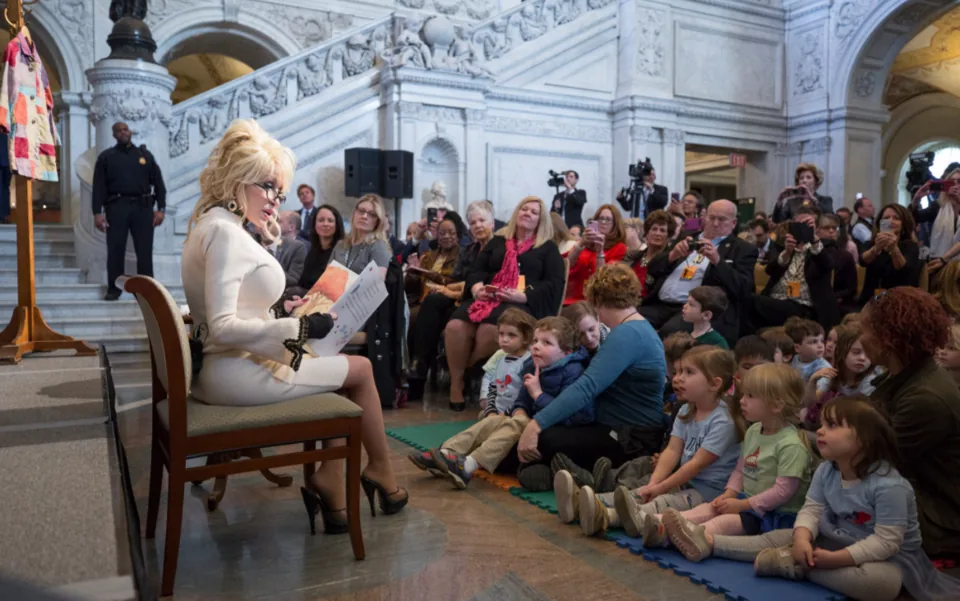
Dolly Parton spent thirty years mailing free books to poor kids every single month, funded it herself, and inspired states to chip in. Then, while she was dying of cancer, Indiana and Missouri decided they'd had enough of that particular socialist nightmare. The woman hadn't even been buried before the consequences of those cuts started hitting the 152,000 children enrolled in Indiana alone.
What the Program Actually Did
Dolly Parton's Imagination Library, founded in 1995 and run through her nonprofit Dollywood Foundation, mailed one free age-appropriate book per month to every enrolled child from birth to age five. No means test. No application maze. No cost to families, regardless of income. Just books, showing up at the door.
According to Newsweek, the program has distributed more than 300 million books total and currently serves more than 3 million registered children across the United States, Canada, Australia, the United Kingdom, and Ireland. Parton started it in Sevier County, Tennessee, because her own father couldn't read or write. She turned that wound into something that reached across the world.
The model was straightforward. The Dollywood Foundation covered administrative costs. Local community partners, schools, libraries, and businesses raised funds for books and postage. In states that chose to participate, including Indiana and Missouri, the state matched half of what local partners raised. The whole thing was set up to be cheap, replicable, and politically painless. It served every child under five who enrolled, rich or poor, red county or blue.
Indiana Pulled the Plug First
Indiana removed state funding from its budget last year, under Republican Governor Mike Braun. At the time, Newsweek reports, the program had more than 125,000 Indiana children enrolled and had previously received a $6 million two-year allocation from Braun's Republican predecessor, Eric Holcomb. Braun's answer was to suggest the state lean on private philanthropy instead.
The current count, per Newsweek, is 152,105 children in Indiana receiving books through the program, representing 37 percent of every child under five in the state. More than 8.9 million books have gone to Indiana kids since 2006. That's a real, measurable infrastructure, built over two decades, that Braun's administration decided wasn't worth a line item.
To his credit, Indiana First Lady Maureen Braun launched a private fundraising campaign to cover the gap. As Indiana Public Radio reported, by March the campaign had reached 90 percent of its two-year fundraising goal. So, to be scrupulously fair: some of the damage may get patched by donor generosity. But "maybe rich people will cover it" is not a policy. It's a prayer dressed up as governance.
Missouri Went From Hero to Villain in One Budget Cycle
Missouri's reversal is particularly galling, because Missouri had done something genuinely impressive just a year before the cuts. In 2024, Newsweek reports, Missouri became the first state to fully fund the Imagination Library, going beyond the 50/50 model and delivering 1.9 million books to children in a single year. Dolly Parton said publicly that it made her happy to think she was giving kids a gift that mattered.
Then Missouri Republican lawmakers cut the program's state funding from roughly $6 million to $2 million for the upcoming fiscal year. The Missouri Department of Elementary and Secondary Education froze new enrollment on July 1. Children already in the system will keep getting books until the money runs out. Kids born after the freeze just don't get in.
The communications director for Missouri's Department of Elementary and Secondary Education, Lucas Bond, told Newsweek this year that the state was "unsure of the future" of the program as a state-funded effort. He said local partnerships "could be a potential in the future with time, funding, and partnerships coordination." Read that sentence again slowly. That's the official answer to what happens to a proven, successful literacy program that the state chose to dismantle.
The Timing Is Almost Too Much to Process
Parton's family announced her death following a brief battle with cancer. The Imagination Library posted to social media that "the work ahead has never felt more meaningful" and confirmed the program would continue. That's the foundation's staff, grieving, promising to carry forward the work of a woman who built something genuinely good, while watching two states quietly walk away from it.
Jeff Conyers, the vice chair and president of the Dollywood Foundation, told Rolling Stone in February that he hoped Governor Braun and the Indiana legislature would restore the state's funding match. "The beauty of the Imagination Library is that it unites us all, regardless of politics, because every child deserves the chance to dream big and succeed," he said. He was being diplomatic. He was also, clearly, not wrong.
The program was, by any honest accounting, one of the least controversial government expenditures imaginable. Free books for babies. Backed by the most universally beloved figure in American music. Proven to work. Cheap to run. The kind of thing politicians used to fight to put their names on.
The Dingo Take
You are supposed to look at Indiana and Missouri cutting this program and see two states making tough fiscal choices in a difficult budget environment. That's the framing. That's what the press releases will say. What you are actually seeing is Republican state governments deciding that a $6 million book program for toddlers is expendable while other priorities are not. In Indiana, the governor's wife had to go hat in hand to private donors to replace what the state budget used to cover. That's not fiscal responsibility. That's outsourcing your obligations to charity and calling it innovation.
The Missouri whiplash is the part that should make your head hurt. One year: first state in the country to fully fund the program, 1.9 million books delivered, Dolly Parton publicly thrilled. Next year: two-thirds of the funding gone, enrollment frozen, official communications offering "time, funding, and partnerships coordination" as a replacement for an actual plan. They found the thing that worked and then stopped doing it. No complicated ideology required to understand that. It's just bad.
Parton is gone now. The program will try to survive her, because the people running it believe in what she built. But here is the actual legacy question no one is asking at the memorial tributes: when a woman spends thirty years proving that mailing books to poor kids works, and states step up to fund it, and then quietly cut it when the politics shift, what does that say about what we actually value? The answer is sitting in a frozen enrollment queue in Missouri, waiting to age out of eligibility before anyone figures out the funding.


Comments