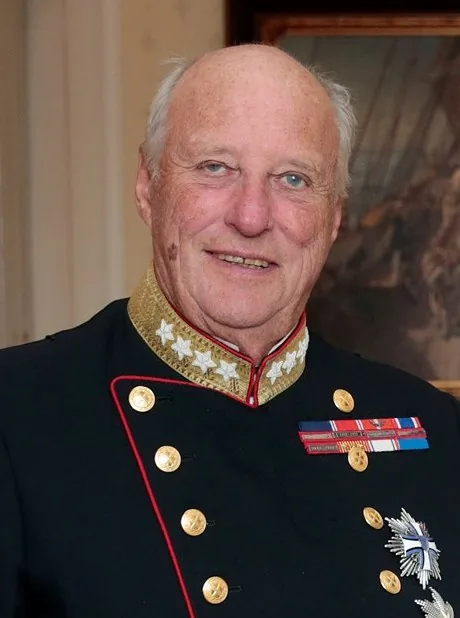
King Harald V of Norway died Friday morning at the National Hospital in Oslo, ending a 35-year reign that began in exile, survived Nazi occupation, and outlasted every other sitting monarch in Europe. He was 89 years old, and he had made absolutely clear he was not going anywhere until his body decided otherwise. His body has now decided.
The King Who Refused to Quit
The Norwegian Royal Palace confirmed Harald died at 6:35 a.m. local time, according to CBS News. His son, Crown Prince Haakon, automatically ascended to the throne as King Haakon VIII.
Harald had watched other European monarchs walk away from their crowns with what can only be described as pointed indifference. When Denmark's Queen Margrethe, his second cousin, abdicated in January 2024, Harald was asked whether he'd consider the same. His answer was essentially: absolutely not. He said the oath he took when he became king in 1991 lasted for life. He meant it literally.
He was hospitalized twice on foreign trips in the years that followed, and still did not abdicate. The man had a point to prove, and he proved it until the end.
A Childhood in the Shadow of Hitler
Harald's biography reads less like a royal profile and more like a World War II thriller. He was 3 years old when Nazi Germany occupied Norway in 1940. His mother grabbed him and his two sisters and fled, first to Sweden and then by boat to the United States, while his father and grandfather went into exile in Britain alongside Norway's government-in-exile.
The Norwegian royals became regular guests at the White House during those years. Harald was 6 years old when he performed his first official royal duty: christening new warplanes at a Norwegian air base in Canada. The kid was doing state functions while most children his age were worried about losing their mittens.
The family returned to Norway in June 1945, shortly after Germany's surrender. His grandfather, Haakon VII, had famously refused to bow to Nazi demands during the occupation, a refusal that made the royal family a symbol of Norwegian resistance and built a reservoir of public goodwill that Harald inherited and never squandered.
The Love Story That Almost Broke the Monarchy
For a king, Harald had an almost suspiciously romantic personal life. European royal families kept pushing eligible noblewomen his way for nearly a decade, and he kept saying no. He was in love with Sonja Haraldsen, his school sweetheart and the daughter of a businessman, which is to say someone with absolutely no royal blood and therefore, by the logic of European monarchies, entirely unsuitable.
His father, King Olav V, reportedly feared the marriage would destabilize Norway's still-young monarchy. Harald waited nine years, wore his father down, and married Sonja on August 29, 1968. CBS News reports that Norwegians greeted the wedding with jubilation. Olav was wrong, Harald was right, and the couple had two children together.
The Norwegian Constitution was updated in 1990 to allow firstborns of any gender to take precedence in succession, though it was not applied retroactively. Their son Haakon therefore took precedence over his older sister, Märtha Louise.
A King Who Actually Had Things to Say
Harald was not a monarch who waved from balconies and left it at that. After the 2011 terrorist attacks by right-wing extremist Anders Behring Breivik, which killed 77 people in bomb and gun attacks across Norway, Harald delivered a memorial speech that the country held onto. "I remain convinced that the belief in freedom is stronger than fear," he said. That line still lands.
In 2016, he gave an unexpected speech explicitly defending LGBTQ+ equality, refugees, and religious pluralism. "Norwegians are girls who love girls, boys who love boys, and girls and boys who love each other," he said, and went on to embrace Norwegians of Muslim, Afghan, Pakistani, and Polish heritage as fully and completely Norwegian. The speech went viral globally. This was a head of state who had figured out that a symbolic role does not have to mean a silent one.
Prime Minister Jonas Gahr Støre said in a statement, according to CBS News: "For more than three decades as monarch, Harald V demonstrated an unwavering faith in the Norwegian people. He helped us to see the best in ourselves and in one another."
The Family Scandals He Outlived
Norway's royal family managed to avoid the operatic disasters that plagued the British Windsors and the Swedish royals for most of Harald's reign, though the final years brought some turbulence. His daughter Märtha Louise gradually stepped back from royal duties after she announced she could communicate with angels and became engaged to an American who identifies as a shaman, which is a sentence that exists in the historical record now.
More seriously, CBS News reports that in early 2026, Harald's daughter-in-law Crown Princess Mette-Marit faced renewed scrutiny over her past connections with convicted sex offender Jeffrey Epstein. She is not accused of any wrongdoing, but the attention was damaging enough that she issued a public apology. Around the same time, her eldest son from a previous relationship, Marius Borg Høiby, was convicted of rape and sentenced to four years in prison. Høiby holds no royal titles.
Harald presided over all of it with the particular stillness of a man who had spent his childhood outrunning the Gestapo. Context is everything.
What He Left Behind
Harald was born in 1937 in Asker, near Oslo, the first Norwegian prince born in the country since King Olav IV in 1370. He reigned during Norway's oil-and-gas-driven economic boom, watched his country become one of the wealthiest and most stable democracies on earth, and spent 35 years as the human symbol of all of it.
Like his father before him, Harald was a serious competitive sailor. King Olav V won Olympic gold in sailing in 1928. Harald represented Norway at several Olympics himself, and in 1987 skippered his yacht to gold at the World Championships. The sea was not a hobby for these people. It was a vocation.
His motto, inherited from both his father and grandfather, was "All for Norway." He adopted it when he took the throne in 1991 and apparently took it at face value. He is survived by his wife, Queen Sonja, his daughter Märtha Louise, and his son, now King Haakon VIII of Norway.
The Dingo Take
There is something genuinely rare about a public figure who says they will do something until they die and then actually does it. Harald took an oath in 1991, watched contemporaries and younger peers abandon theirs, said plainly that his oath lasted for life, and then died on the throne 35 years later. You can disagree with the institution of monarchy on principle, which is a reasonable position to hold, and still recognize that this particular man operated with a consistency that most elected officials never manage for a single term.
His 2016 speech alone deserves more attention than it got outside Scandinavia. A reigning European monarch, using his platform to explicitly name and embrace gay Norwegians, Muslim Norwegians, immigrant Norwegians, atheist Norwegians, and tell them they are all equally Norwegian. In 2016. While elected leaders in much of the Western world were busy discovering that xenophobia was a viable electoral strategy. The bar should not be that low, but he cleared it while others were digging underneath it.
Norway now has King Haakon VIII, and the continuity is tidy enough. But Harald V was an unusual figure: a symbolic leader who understood that symbols can do real work if you're willing to put something behind them. He survived Nazi occupation as a toddler, waited nine years to marry the woman he loved, and then spent three and a half decades being surprisingly decent in public. Worse legacies exist. Far worse ones, as a quick scan of the current news cycle will confirm.



Comments