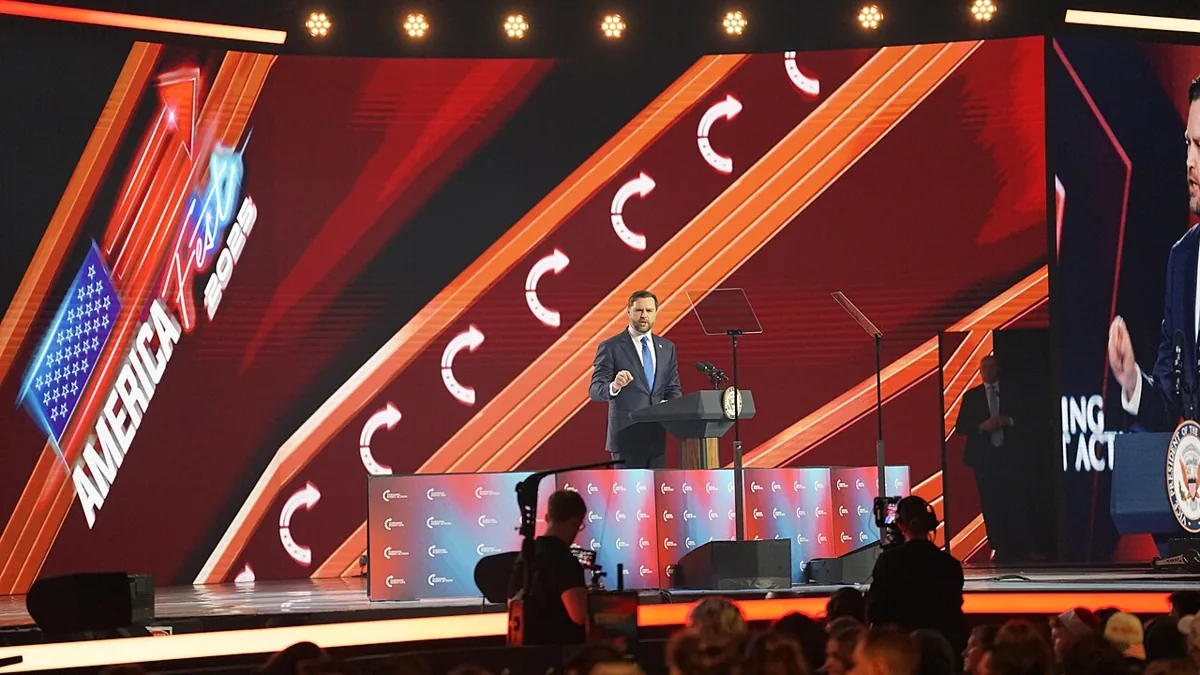
The Vice President of the United States sat down for an hour-long interview this week and told a 22-year-old podcaster that he is personally fine with triggering a biblical apocalypse. JD Vance, second in line to the presidency, said he's focused on 'doing as much of God's work as possible' and that 'if that leads to the end times, OK.' The man has access to nuclear codes.
What He Actually Said, Because You Need to Hear It
According to The New Republic, Vance sat down with Bryce Crawford, a 22-year-old evangelical podcaster with a YouTube channel featuring videos like 'Preaching the Gospel in the Hood,' and gave him over an hour of his time. The resulting interview, released Monday, included the Vice President musing openly about whether we are living in the end times.
'Do I think we are in the end times? I don't know,' Vance said, before adding, in what is apparently a separate and totally fine thought, that he would 'not be shocked if the Antichrist was walking among us.' He declined to name names. Generous of him.
Then came the kicker. Vance said he's concentrated on doing 'God's work' and shrugged that 'if that leads to the end times, OK.' Just like that. OK. As if he were talking about a flight delay or a restaurant being closed. Apocalypse? Sure, fine, whatever.
A Quick Refresher on What the 'End Times' Actually Means
In case the guy with his finger near the button is being a little casual about this, let's be specific. The Christian end times, as The New Republic lays out, refer to a period involving widespread wars, earthquakes, a false prophet, and seven years of unprecedented human suffering known as the Great Tribulation, capped off by Armageddon itself. It ends with a final judgment by God.
This is not a metaphor Vance is deploying loosely. This is the literal theological framework he was discussing, in a sit-down interview, as the sitting Vice President of the United States. He was asked about the end of human civilization and his answer was essentially: not my problem, probably fine.
Vance did note, to his credit, that focusing on the end times 'too much can be very bad' for him spiritually. So he's pacing himself. The apocalypse is a nice thought but he doesn't want to get obsessed about it. A man of discipline.
Meanwhile, Back in the Real World
While Vance was chatting eschatology with a millennial evangelist, The New Republic points out what the administration was otherwise occupied with: aggravating Western alliances, embracing Russia, waging war on Iran, undermining voting rights, and dividing the American public. Just your standard Tuesday for the end-times-adjacent executive branch.
Crawford, the interviewer, is not exactly a neutral figure. Last week he appeared on comedian Howie Mandel's podcast to argue that 'homosexuality isn't love' and that 'truth trumps a feeling' when it comes to transgender identities. This is who the Vice President chose to spend an hour of his schedule with, instead of, say, anyone dealing with the actual consequences of administration policy.
The Crawford interview is a window into something real and important: Vance is not performing religiosity for a political base. He is genuinely, theologically comfortable with the idea that his work in government could contribute to the conditions for the end of the world. That is a sentence about the man who is a heartbeat from the presidency.
The Pattern This Fits Into
This is not the first time Vance has leaned into Christian nationalist framing to explain or justify administration actions. But saying out loud that you are 'OK' with bringing about the apocalypse is a meaningful escalation from the usual 'faith informs my public service' boilerplate that politicians reach for.
The theological tradition Vance is drawing from here matters. There is a strand of American evangelical thought, sometimes called dominionism, that holds that Christians have a duty to take control of secular institutions and steer them toward biblical ends. Some strands of that belief system view the end times not as something to be feared or avoided, but as something to be ushered in. Vance did not say that explicitly. But he did say he would not be shocked to find the Antichrist walking among us, and that apocalypse-as-byproduct of his work is perfectly acceptable to him.
That is a governing philosophy. That is the Vice President's governing philosophy. The United States is a country with thousands of nuclear warheads, an active war in Iran, and a second-in-command who's made his peace with Armageddon.
Nobody Seems Particularly Alarmed and That Is Its Own Story
The interview dropped Monday. By Tuesday the news cycle had largely moved on. That's partly because the Trump administration produces so many genuine emergencies on a daily basis that a Vice President casually endorsing the possibility of biblical apocalypse barely registers as unusual.
That normalization is the actual danger here. A year ago, a sitting Vice President saying he would be 'OK' with triggering the end times would have been a three-day story with congressional reaction, op-eds, and cable panels. Now it's a Tuesday. We've been ground down to the point where 'VP fine with Armageddon' is a news item that competes with everything else on the homepage.
Vance did not ask for follow-up questions from credentialed press. He gave his apocalypse take to a 22-year-old YouTuber. And that, honestly, is the most 2026 sentence imaginable.
The Dingo Take
You are supposed to find this normal. That is what the sheer volume of this administration's behavior demands of you, every single day. You are supposed to read 'VP comfortable with triggering apocalypse' and scroll past it because there's also a war, a constitutional crisis, and Pete Hegseth mocking Canadian teenagers all happening simultaneously. The chaos is the point. The exhaustion is the strategy.
But stop for one second and actually sit with what Vance said. The Vice President of the United States told a YouTube preacher that he would not be surprised to find the Antichrist currently walking the earth, and that if his work in government brings about the biblical end of human civilization, that's acceptable to him. He is not a fringe figure saying this. He is the number two official in the executive branch of the most powerful government on the planet, one with a nuclear arsenal and active military engagements. 'OK' with the apocalypse. His words.
The question that doesn't get asked enough is what policy looks like when the person making it has decided that the destruction of the world order might be theologically fine. What does that do to long-term thinking? To alliances? To the question of whether institutions are worth preserving at all? Vance has, politely and with a shrug, told us exactly how he sees his job. We should probably take him at his word.


Comments