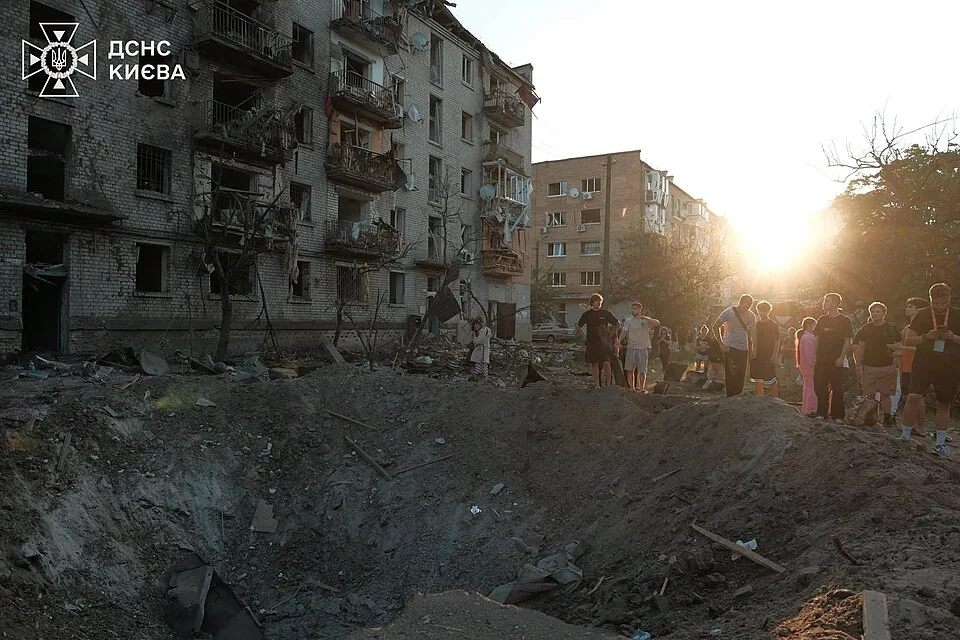
A Russian strike on a warehouse west of Kyiv this weekend killed more than 38 people, making it the single deadliest attack of 2026 in a war that has now ground through its fourth year. A warehouse. Thirty-eight people. Gone over a weekend that most of the world spent not paying attention. NBC News is reporting that Richard Engel is back on the ground in Ukraine as the violence escalates to a grim new benchmark.
What Actually Happened This Weekend
According to NBC News, the strike hit a warehouse located west of Kyiv. The death toll stands at more than 38 people, which makes it the deadliest single attack on Ukrainian soil so far this year. The details beyond that are still coming in, which is part of why Engel is there.
West of Kyiv. That matters. Early in the war, Kyiv was under direct assault and the world watched. Then Russia pulled back, the front lines settled into the east and south, and a lot of people filed Ukraine under 'ongoing situation' and moved on. A strike this far west is a reminder that 'ongoing situation' is doing a lot of heavy lifting as a phrase.
A War That Keeps Hitting New Lows
We are in September 2026. Russia's full-scale invasion of Ukraine began in February 2022. That is four and a half years of this. Four and a half years of strikes, counteroffensives, mobilizations, drone attacks on apartment buildings, and Western aid packages that come with enough conditions attached to fill a mortgage agreement.
The fact that a single strike killing 38 people is notable enough to mark as the worst of the year is itself the story. Not because 38 deaths are somehow routine, but because the cadence of this war has become so relentless that it takes a number like that to cut through. That is what sustained attrition does to the way we measure horror.
Engel on the Ground While the World Moves On
NBC News reports that Richard Engel is currently in Ukraine to cover the escalating conflict, and will be hosting a subscriber Q&A answering reader questions from the ground this week. Engel has covered more war than most people have covered in their dreams, and his presence there signals that someone at NBC still considers this a story that needs a veteran correspondent standing in it.
That sounds like a low bar, and it is. But glance at the cable news chyrons on any given night and count how many minutes Ukraine gets compared to whatever domestic political circus is currently on fire. The ratio is not flattering. The war did not slow down because the coverage did.
What 38 People in a Warehouse Means
A warehouse is not a military installation. It is a building where things are stored, where workers move goods, where people do ordinary economic labor. Russia striking a warehouse west of Kyiv and killing 38 people is not a surgical strike on a military target. It is what it looks like.
International humanitarian law has a lot to say about the deliberate targeting of civilian infrastructure. The International Criminal Court has already issued an arrest warrant for Vladimir Putin over the deportation of Ukrainian children. The legal architecture exists. The accountability, as with so many things in geopolitics, remains somewhere between 'pending' and 'don't hold your breath.'
Where Things Stand Heading Into Fall
Four-plus years in, the broad strokes of this war are familiar: Ukraine has Western weapons and Western money but not unconditional Western commitment; Russia has more bodies than it has compunctions about spending them; the front lines move in kilometers that cost thousands of lives each; and every few months something happens that reminds the world this is still very much happening.
This weekend was one of those moments. Thirty-eight people dead in a single strike, the worst of 2026, west of the capital. Whether it shifts anything diplomatically, militarily, or in terms of international attention is a separate question. History suggests the answer is 'probably not much.' History is a real buzzkill.
The Dingo Take
Thirty-eight people killed in a single strike and it lands in the news cycle like a stone dropping into a lake that has already absorbed a thousand stones. The ripples are there. They fade fast. That is the specific cruelty of a protracted war: it trains the audience to need a higher and higher number before the same nerve fires.
Russia has been doing this for four and a half years with remarkable consistency and remarkably little consequence at the strategic level. Sanctions exist. Weapons shipments exist. Strongly worded statements from the G7 exist in quantities that could fill several warehouses, ironically enough. And yet here we are in September 2026 counting bodies west of Kyiv on a Sunday.
Pay attention to what Engel reports this week. Not because a journalist doing a subscriber Q&A is going to change the trajectory of a land war in Europe, but because the least any of us can do is actually look at what is happening. Thirty-eight people went to work or were somewhere near a warehouse, and now they are not. That happened. Do not let the news cycle bury it by Wednesday.




Comments