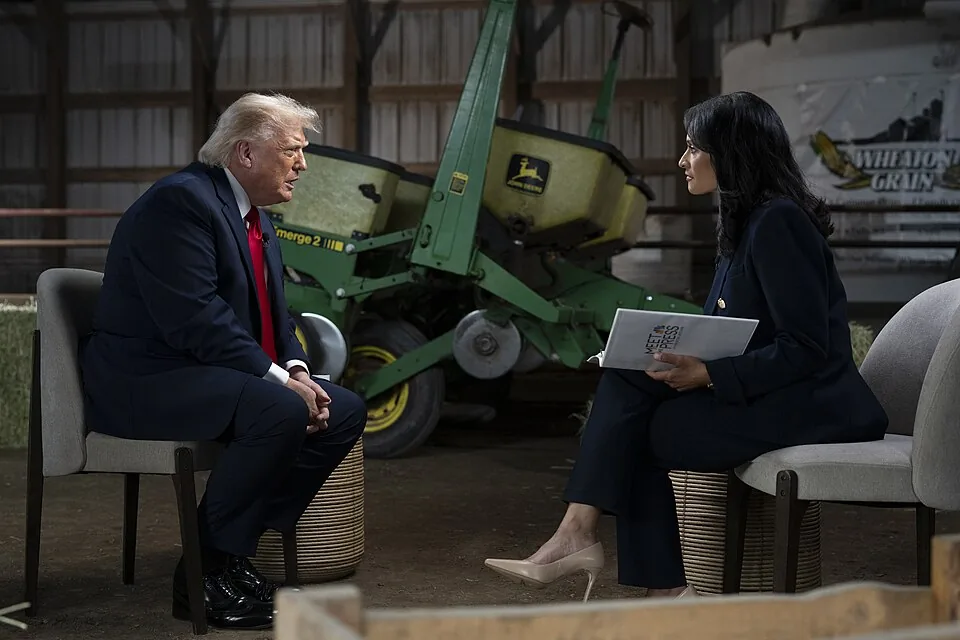
The president of the United States went on Truth Social Sunday to demand that a federal regulator investigate an NBC anchor for accurately describing his primary endorsements as having 'mixed results.' Not fabricated results. Not defamatory results. Mixed results. This is where we are.
The Post That Should Embarrass a Nation
As the Sunday morning talk shows aired, Trump posted that Kristen Welker, host of NBC's Meet the Press, 'will be reported' to the FCC. 'I hope that Chairman Brendan Carr, and the fine people of his Commission, will take this Threat to our Country very seriously,' he wrote. The capital T on 'Threat' is doing a lot of work there.
To be crystal clear about what triggered this: Welker said Trump's primary endorsements yielded mixed results. That is a factual characterization that any competent political journalist might make after reviewing election outcomes. It is not a threat to the country. It is a sentence.
Meet the Attack Dog Who Keeps Coming When Called
FCC Chairman Brendan Carr did not wind up in this position by accident. As the Guardian reports, Carr has spent Trump's presidency doing the dirty work with remarkable consistency. Days after taking office in January 2025, he revived a previously dismissed complaint against CBS over 60 Minutes editing, right as the FCC was weighing CBS license transfers. CBS eventually paid $16 million to settle with Trump. Draw your own conclusions about the sequencing there.
After Jimmy Kimmel made remarks about Charlie Kirk, Carr urged broadcasters to act, telling them 'we can do this the easy way or the hard way.' Even Ted Cruz said that sounded 'right out of Goodfellas.' When Ted Cruz thinks your media intimidation tactics are too mob-like, you have cleared some kind of bar. In March 2026, Carr threatened broadcasters over their coverage of the Iran war after Trump complained on Truth Social. In April, he ordered premature license reviews for Disney's eight ABC-owned stations. Disney is now suing.
NBC is owned by Comcast, which the Guardian notes has long been in Trump's crosshairs. This is not a coincidence. This is a pattern.
The Independence That Isn't
The FCC was created by Congress as an independent agency. That word, independent, used to mean something specific and legally significant. Early in his term, Trump issued an executive order bringing the FCC and other formerly independent agencies under White House supervision. Before any significant action, the agency now needs White House approval. It also, apparently, takes White House orders to initiate action against individual journalists.
In March, Trump fired both Democratic FTC commissioners, positions Congress mandated. When commissioner Rebecca Slaughter sued, the Supreme Court sided with the president. The message was received everywhere, including at the FCC.
The Guardian also reports that the FCC currently has two Republicans and one Democrat, Anna Gomez, because Trump simply won't appoint the second Democrat required to reach the statutory five-member commission. Trump has nominated another Republican. The fear, not unreasonable given everything above, is that once confirmed, Gomez gets fired and her voice disappears entirely while the agency still technically maintains quorum.
What Carr Used to Believe Before He Forgot
Here is an irony that deserves its own paragraph. In 2019, Brendan Carr, then a sitting FCC commissioner, stated firmly: 'The FCC does not have a roving mandate to police speech in the name of the public interest.' That was Carr's own position, on the record, less than a decade ago.
Tom Wheeler, who chaired the FCC from 2013 to 2017 and wrote the Guardian piece this reporting draws on, notes that Carr's own words should be his answer to what Trump is demanding now. Wheeler says he 'almost feels sorry' for Carr, which is very generous of him. The rest of us do not feel sorry for Carr. Carr picked up the phone every single time.
The First Amendment Does Not Have a Trump Exception
Let's spell out the actual constitutional issue here, because it keeps getting buried under the procedural outrage. A sitting president is directing a federal regulatory agency to investigate a journalist for making an accurate statement about his electoral performance. That is not a gray area. The First Amendment exists specifically to prevent this kind of government pressure on the press.
Wheeler puts it plainly: Trump wants the FCC to control what broadcasters say, while he controls what the FCC can do. That is a closed loop. That is state control of media dressed up in administrative language and executed through license threats and settlement pressure and premature reviews and social media posts that function as executive orders because, increasingly, they are.
The Dingo Take
You are supposed to believe this is normal regulatory activity. A federal agency responding to a president's social media posts about a Sunday news host's word choice. Eighteen months of threatened license reviews, coerced settlements, and 'easy way or hard way' warnings later, and we're still having debates about whether this crosses a line. The line is a memory.
What CBS's $16 million settlement proved, what every Disney lawsuit and every Carr threat has demonstrated, is that the mechanism works. Broadcasters got the message. Some have softened. Some have settled. Some have preemptively changed their coverage. You don't need to actually revoke a license if the threat of revocation is enough to make journalists think twice before saying 'mixed results' on a Sunday morning. That's the whole game.
Brendan Carr knows exactly what he's doing. He said in 2019 that the FCC has no mandate to police speech. He has spent the last eighteen months doing precisely that. At some point, 'I was just following orders from Truth Social' stops being an explanation and becomes the verdict.



Comments