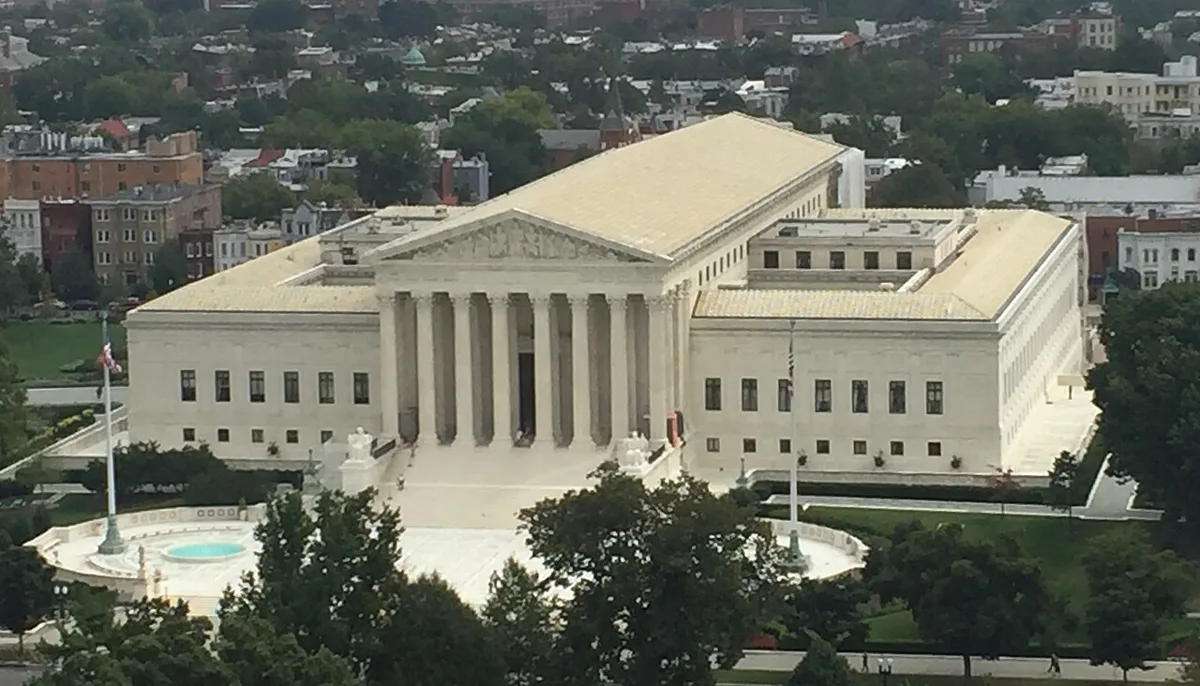
On Wednesday, House Republicans tried to permanently lock in the Supreme Court that Donald Trump built, by amending the Constitution to freeze it at nine seats forever. It failed, 212 to 206. And the way it failed tells you almost everything you need to know about where the Democratic Party is right now.
What Republicans Actually Tried to Do
The resolution came from Rep. Andy Biggs, R-Ariz., and it was straightforward in the way that only truly audacious power grabs can be. His joint resolution would have amended the Constitution to read: "The Supreme Court of the United States shall be composed of nine justices consisting of one chief justice and eight associate justices." Simple. Clean. Permanent.
Biggs defended it on the House floor with the kind of logic that sounds reasonable until you think about it for four seconds. "It fixes the number of justices at nine permanently, not because nine is a magic number, but because a fixed court cannot be expanded by whoever happens to win the next election," he said. Which is one way to describe it. Another way: Republicans want to constitutionally guarantee that the 6-3 conservative majority they engineered over a decade of norm-breaking stays in place regardless of what voters do next.
Constitutional amendments require two-thirds support in both chambers, then ratification by three-fourths of states. The House vote wasn't close. It died 212-206, with all but one Democrat voting against it.
The History Republicans Are Pretending Doesn't Exist
Here is a fact that Speaker Mike Johnson did not mention when he called nine seats "critically important" and warned against "political palooza": Congress has changed the size of the Supreme Court seven times since 1789. Seven. The Judiciary Act of 1789 set the court at six justices. It shrank and expanded repeatedly over the following century, reaching as high as ten seats, before landing at nine in 1869.
So when Republicans say that permanently locking in nine justices protects some sacred American tradition, what they are actually saying is that the last 157 years of stability should now be constitutionally mandated, in this particular moment, when their party controls the court. The timing is not subtle.
House Democratic Whip Katherine Clark's office put it plainly in a memo to members ahead of the vote, noting that this Republican majority has "already surrendered Congressional war powers, Congressional taxing and tariff powers, and Congressional spending powers to President Trump" and would now permanently give away the power to set court size that Article I explicitly vests in Congress. Rep. Jamie Raskin of Maryland, the top Democrat on the House Judiciary Committee, called it exactly what it is: "Trump's followers in Congress now seek to freeze into place the political court that MAGA built, for decades to come."
The Messaging Game Behind the Vote
To be fair to Republicans, they were not primarily trying to pass this amendment. They knew they couldn't. Constitutional amendments need two-thirds of both chambers, and they don't have it. This was a messaging vote, one of several this week designed to tie Democrats to the Democratic Socialists of America ahead of the 2026 midterms. The day before, the House passed a resolution condemning socialism "in all its forms."
The DSA's platform does include replacing the Supreme Court with a judiciary subordinate to Congress, which is genuinely a radical position. But the gap between "DSA wants to abolish the court" and "mainstream Democrats want to add four seats" is large enough to drive a truck through, and Republicans are betting voters won't look closely. Mike Johnson told reporters Tuesday that Democrats are being "taken over" by "the Democrat Socialists of America, the communist socialists." CBS News reported that. It happened. A Speaker of the House said that out loud in 2026.
The campaign arm spokesperson Mike Marinella contributed: "Give House Democrats an ounce of power, and they'll use every bit of it to fundamentally transform America into an unrecognizable socialist hellscape." So yes, the messaging strategy is very much online.
Court Expansion Is No Longer a Fringe Position
Here is what Republicans may have underestimated: the vote didn't embarrass Democrats. It energized them. The nearly unanimous Democratic "no" vote reflects a party that has shifted meaningfully on court expansion, driven by a 6-3 conservative majority that overturned Roe v. Wade, weakened the Voting Rights Act, and handed Trump broad immunity for official acts.
Jim Clyburn, D-S.C., the former House majority whip and one of the most institutionalist figures in the Democratic Party, went on NBC News' Meet the Press on Sunday and endorsed expanding the court to 13 seats. "A baker's dozen would be a good number," he said. That is not a quote from a DSA member. That is one of the most establishment Democrats alive.
Former Vice President Kamala Harris said this summer that the party should "revisit the point of expanding the court to 13 justices," according to NBC News. Josh Orton, president of the progressive group Demand Justice, told NBC News that what was once fringe is now mainstream. "People understand this is now an emergency," he said. "They see the Roberts majority as more corrupt, more friendly to corporate power and to the Trump administration, and more anti-democratic."
One Democrat broke ranks: Rep. Don Davis of North Carolina voted with Republicans. Rep. Kevin Kiley, the California independent who caucuses with Republicans, voted against it.
What Comes Next
The short answer is: this fight moves to 2028. Orton told NBC News that Demand Justice intends to "continue building the case for major Supreme Court reform through the 2028 election cycle" and that court expansion needs to happen "in the first two years of the next Democratic administration."
Republicans, meanwhile, will keep running this play. Tying Democrats to court-packing, socialism, and radicalism is the midterm strategy. They will take the 212-206 vote and turn it into attack ads. That part is a given.
What is different now compared to, say, 2021, when Democrats mostly ran away from court expansion, is that the party is not scrambling to distance itself. Clark's argument against the amendment was not "we don't want to expand the court." It was "you don't get to take this power away from Congress." That is a different posture entirely.
The Dingo Take
Republicans spent this week trying to use the Constitution as a receipt, a document locking in every advantage they have accumulated since 2016 as permanent and untouchable. That is what this amendment was. Not a principled stand for judicial stability. A preservation order on a court built through Mitch McConnell's unprecedented blockade of Merrick Garland, three Trump appointments, and a 6-3 majority that has spent years handing wins to corporate interests, gutting reproductive rights, and building a legal moat around the Trump presidency.
And they lost. Because they needed two-thirds and couldn't get there, but also because Democrats, for once, didn't run from the fight. Watch the framing closely: Clark's argument wasn't defensive. It was "you do not get to strip Congress of a power the framers gave us so you can freeze your court in amber." Raskin called it what it was on the House floor. Even Clyburn, a man whose whole career has been built on institutional caution, went on national television and said add four seats.
The Roberts court may have miscalculated how much rope it was burning through with each overreach. Roe. Voting rights. Presidential immunity. Every 6-3 decision that would have been unthinkable fifteen years ago is another Democrat who no longer needs to be convinced that the court is a political institution that should be treated like one. Republicans are counting on voters being more scared of "court packing" than angry about what that court has actually done. That bet may not age well.





Comments