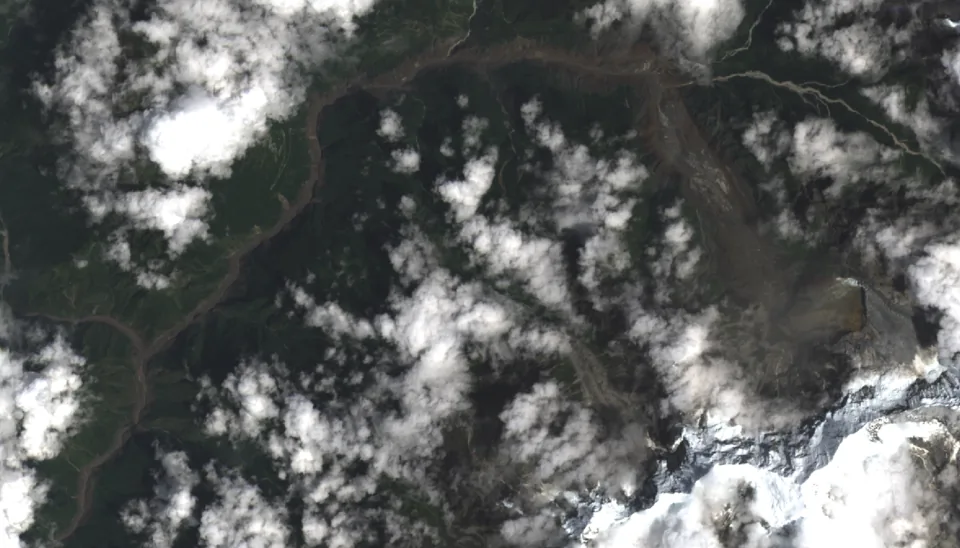
A week after a wall of ice, water, and rock erased entire communities in Nepal, more than 1,200 people are confirmed dead and more than 4,000 are still missing. Morgues are overwhelmed. Bodies have been washed so far downstream they are no longer recognizable as people. So families are gathering at one of the holiest sites in Asia to burn small figures made of grass, because that is the only thing left to burn.
What Actually Happened
The disaster struck last week with the particular cruelty that glacial events deliver: fast, total, and indiscriminate. A torrent of ice, rock, and water tore through Nepal, killing more than 1,200 people and swallowing thousands more into thick mud and debris. According to NBC News, many of the missing are believed to be buried in that mud, unreachable, possibly unrecoverable.
The scale broke the systems designed to handle death. Morgues are overwhelmed with unidentified remains. Bodies washed far downstream have been rendered unrecognizable. The people tasked with managing this catastrophe are doing so under conditions that make the most basic human decency, confirming who is dead, confirming where they are, nearly impossible to deliver.
A week out, hope of finding survivors has largely evaporated. Search efforts continue, but everyone involved understands what they are searching for now.
The Grief That Has No Body to Hold
In Hindu tradition, cremation is not a preference. It is a requirement, a sacred rite that sends the dead properly into what comes next. Denying it is not just a logistical failure. It is a spiritual wound. And right now, thousands of Nepali families are sitting with exactly that wound, waiting for remains that may never come.
So on Wednesday, mourners gathered at Pashupatinath Temple in Kathmandu, one of the most revered Hindu pilgrimage sites in all of Asia. On the banks of the Bagmati River, they did what they could. They built miniature funeral pyres and burned effigies made of kusa grass, also called darbha, a plant with deep roots in Hindu ritual practice. The small stick figures were wrapped in orange cloth, rubbed in paste, and covered in garlands of orange flowers.
NBC News reports that some relatives, overwhelmed by the moment, collapsed into the arms of the people standing next to them. Nepali service members in military fatigues stood along the temple steps holding rifles, providing military honors. The setting was ancient and formal and completely inadequate to the size of the grief, which is to say it was exactly what grief looks like when a civilization tries to hold something too large to hold.
Mass Burials Without Permission, and the Fury That Followed
Here is where the disaster compounds itself. Authorities have been conducting mass burials of unidentified remains, citing the public health necessity of preventing disease spread. That reasoning is legitimate. The execution has been another matter entirely.
According to NBC News, some families of the missing have expressed real frustration that these mass burials are being carried out without their consent. For families who practice Hinduism, burying a loved one rather than cremating them is not a small thing. It is a violation of everything they believe about how the dead should be treated. Being told it happened without your knowledge, to someone you have not yet confirmed is actually dead, is a specific kind of horror.
Local officials say they have taken DNA samples and photographs of corpses to assist with later identification. They say that bodies identified after a mass burial could theoretically be exhumed and handed back to families. Whether that process will actually function at the scale required, across thousands of cases, in the aftermath of a disaster that has already broken every system it has touched, is a question nobody is answering confidently.
A Number That Keeps Moving
Over 1,200 confirmed dead. Over 4,000 missing. Those numbers have the clinical flatness of disaster statistics, which is exactly what makes them dangerous to just read past. Each one of those four thousand missing people is a family holding a grass effigy and trying to find some way to say goodbye to someone whose body the mountain took.
Nepal is no stranger to natural catastrophe. It sits in one of the most geologically active and climatically precarious regions on earth. But the scale of this event is extraordinary even by those standards. The combination of glacial melt dynamics and extreme weather has produced a disaster that overwhelmed not just infrastructure but the basic human capacity to account for the dead.
The international response is ongoing. But in the immediate term, what NBC News is documenting at Pashupatinath Temple is what the response looks like at the human level: people standing by a river, burning grass, because the mountain kept everything else.
The Dingo Take
You are supposed to look at a number like 4,000 missing and feel the full weight of it. Most of us will not. It is too large. The brain does what it does with large numbers and files them somewhere abstract, somewhere that does not hurt. The image of a parent clutching a small grass figure wrapped in orange cloth because there is nothing else to hold, that is the thing that cuts through. That is the specific detail that makes this real.
The mass burial controversy deserves more attention than it will probably get. Authorities facing a public health emergency made a call. That call, however defensible on disease-prevention grounds, stripped families of their agency over the most sacred moment in their religious lives, without asking. The promise that DNA samples might allow for future identification and exhumation is the kind of assurance that sounds reasonable in a press briefing and falls apart under the weight of four thousand cases, an overwhelmed system, and time. It may work. It may not. The families have no choice but to wait and find out.
Nepal is going to need sustained international attention and resources long after this story stops trending. Glacial disasters of this scale do not produce clean endings where the missing are found and the grieving get closure. What they produce is exactly this: ceremonies at ancient temples, grass burning on miniature pyres, and a silence where answers should be.




Comments