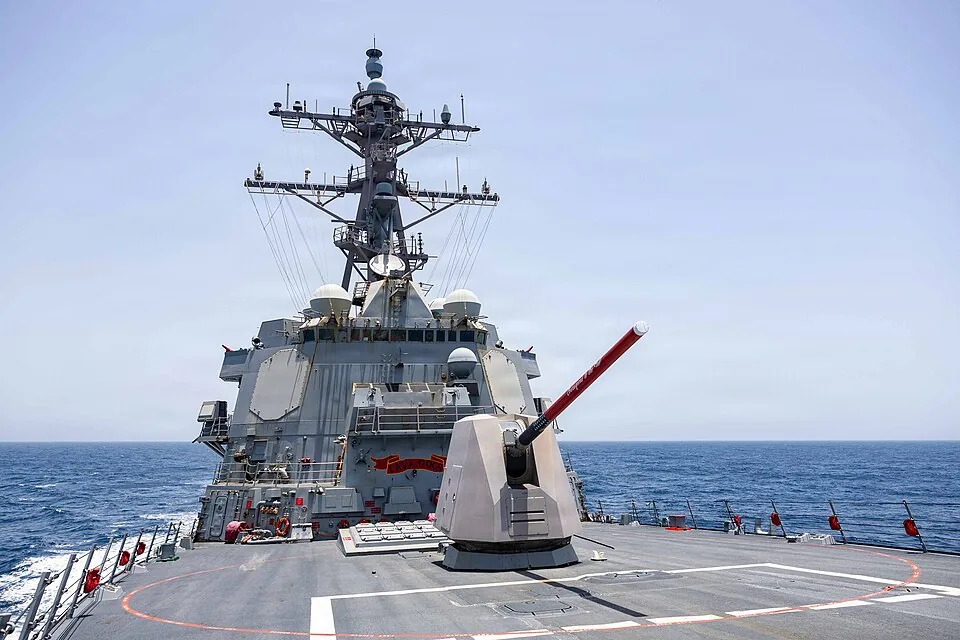
Iran's Revolutionary Guard Corps fired ballistic missiles at a US aircraft carrier and a guided-missile destroyer in the Persian Gulf on Saturday. Both ships evaded the strikes. Every single Iranian missile missed. The US responded by destroying three of Iran's oil tankers, and Donald Trump is calling the whole thing 'small potatoes.'
What Actually Happened Out There
According to US Central Command, Iran's Revolutionary Guard Corps launched multiple ballistic missiles at two US Navy warships, an aircraft carrier and a guided-missile destroyer. Both ships evaded the attacks. No American personnel were injured. The missiles, fired by a military force that the Trump administration has been at war with for months now, hit nothing.
The US did not return the favor in kind. It returned it with interest. CENTCOM announced that American forces struck three Iranian oil tankers in retaliation. The M/T Downy, operating off the coast of Kharg Island, and the M/T Stark 1, near Jask, were both permanently disabled. A third vessel, the M/T Kylo, which was unladen at the time, was completely destroyed in the Gulf of Oman. CENTCOM said the crew was directed to abandon ship before American forces struck it in multiple locations.
Iranian state media, specifically Fars news agency, reported explosions near Kharg Island, one of Iran's major oil export hubs, with a correspondent confirming blasts in the area. SNN, another Iranian outlet, reported that an Iranian tanker had been targeted by the US near the island. That would be the understatement of the Persian Gulf.
The Admiral's Message Was Not Subtle
CENTCOM commander Admiral Brad Cooper released a statement Saturday that read less like a military communique and more like a note left on someone's windshield after a parking dispute. "Let the message to the IRGC be clear," Cooper said. "If you shoot at two of our ships, we will impose an even higher economic cost — taking out three of yours. We will not hesitate to defend American forces, and if necessary, destroy Iran's limited and exposed oil fleet."
The US also released video of all three strikes on social media. Because we are living in a timeline where the US military posts combat footage of warships being destroyed like highlight reels. NBC News reports that CENTCOM confirmed the retaliatory strike in a formal statement Saturday morning.
This is the logic now operating in the Persian Gulf: you fire missiles at us, we sink your economy's circulatory system. Whether that logic leads somewhere stable is a question nobody in this administration seems particularly interested in answering.
'Small Potatoes,' Says the President of the Country at War
Donald Trump, surveying a conflict in which Iran just fired ballistic missiles at US Navy warships, called the situation "small potatoes." This is the President of the United States. The country currently engaged in active military operations against a nuclear-adjacent state in the Middle East.
Trump also weighed in on the semantic debate that apparently occupies his administration. His vice president said Thursday that the situation should not be called a war. Trump, asked about this, defended him by agreeing. "A lot of people don't call it a war," Trump said, according to CBS News. "I call it a military conflict." The distinction being, presumably, that wars have consequences people have to think about.
The US and Israel launched their initial strikes against Iran's nuclear sites in June 2025, which the IAEA board had just found Iran in noncompliance with its nonproliferation obligations for the first time in 20 years. That was over a year ago. Since then, Iran has been firing on US warships and the president is debating what word to use for it.
The UN Angle, Which Will Almost Certainly Go Nowhere
While missiles were flying over the Gulf, diplomats in Vienna were working on a different front. The Associated Press reports that the United States, Britain, France, and Germany have drafted a resolution for the IAEA Board of Governors that would refer Iran to the UN Security Council for failure to comply with its nuclear nonproliferation obligations. The draft was also reported earlier by Reuters.
Under the Nuclear Non-Proliferation Treaty, Iran is legally required to declare all nuclear material and activities and allow IAEA inspectors to verify none of it is being diverted for weapons use. The resolution, if formally submitted and passed, would kick the issue up to the Security Council, which has the power to impose legally binding sanctions or asset freezes.
Here is the catch, and it is a big one: Russia and China both hold veto power on the Security Council and both are Iranian allies. Diplomats quoted by the AP acknowledge that specific punitive measures from the UN are unlikely for exactly this reason. The resolution is still being negotiated and hasn't been formally submitted. Once it is, it goes to a vote at next week's IAEA Board of Governors meeting in Vienna. It will be a busy week.
A $5 Billion Arms Sale and $5.85 Diesel for the Rest of Us
On Friday, the State Department approved a $5 billion sale of bombs, guidance kits, and other military equipment to Saudi Arabia, CBS News reports. Saudi Arabia has been repeatedly struck by Iranian forces and Houthi rebels since the US-Israeli war against Iran began, and the State Department framed the sale as improving Saudi Arabia's "airborne defense capability to counter current and future regional threats." The department also notified Congress of the sale.
For American civilians not buying guided munitions this holiday weekend, the picture looks different. CBS News reports that diesel hit a record $5.85 a gallon on Friday, and AAA is predicting that Labor Day weekend travelers will face the highest fuel prices ever recorded over a holiday. Gas prices surged in the lead-up to the weekend, a direct consequence of a conflict in a region that still produces a substantial share of the world's oil.
That's the full picture on Labor Day weekend 2026: a $5 billion weapons deal for an ally, record diesel prices for everyone at home, three Iranian oil tankers on the bottom of the Persian Gulf, and a president who would like you to know this is all very small potatoes.
The Dingo Take
Iran fired ballistic missiles at a US aircraft carrier and missed. Stop and sit with that sentence for a second. The Revolutionary Guard Corps, executing a military strike against the most powerful naval force on earth, fired ballistic missiles at a carrier group and came up empty. And the White House's response to this moment is to argue about vocabulary.
The 'is it a war' debate is not just silly, it is a tell. When an administration refuses to name the thing it is doing, it is because naming the thing creates accountability for the thing. Wars have costs. Wars require authorization. Wars produce body bags and blown budgets and hard questions from constituents filling up their trucks at $5.85 a gallon diesel. Military conflicts, on the other hand, are just sort of vibes you can manage the messaging around. If you're squinting at the terminology while Iran is shooting ballistic missiles at aircraft carriers, something has gone badly sideways in how this government is processing reality.
And the UN referral is fine, sure, draft the resolution, go through the motions. Russia and China will veto whatever punitive measure makes it that far and everyone involved knows it. That process exists right now mostly as documentation for historians. The actual story is happening in the Persian Gulf, where the US and Iran are actively sinking each other's ships, record fuel prices are hitting American families ahead of a holiday weekend, and the president is calling it small potatoes. It is not small potatoes. It has never been small potatoes. The potatoes are enormous and on fire.




Comments