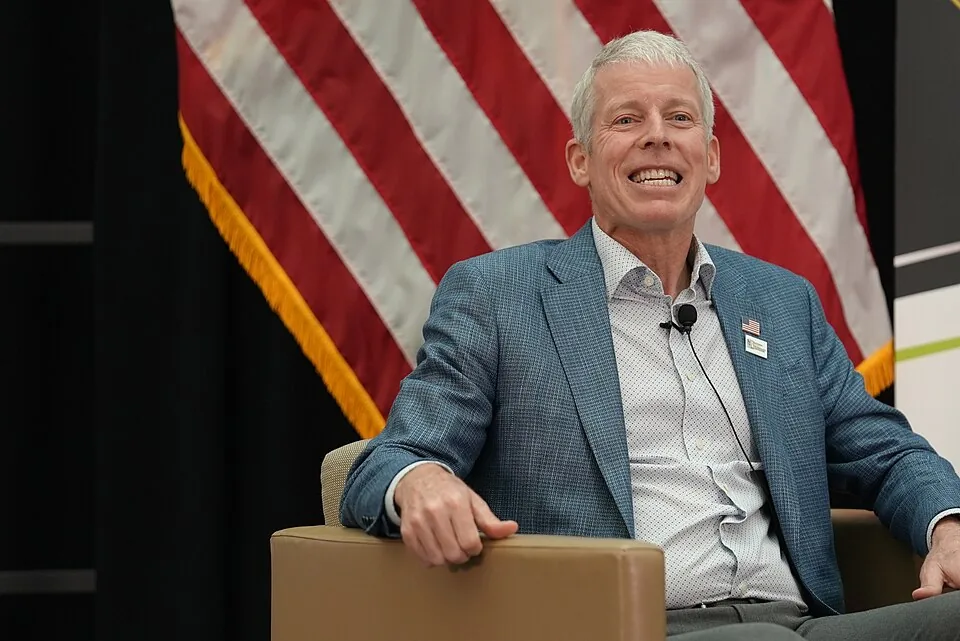
Diesel fuel hit a record $5.89 a gallon this week, gas prices are at their highest ever for a Labor Day weekend, and the war with Iran is still very much on. So naturally, Energy Secretary Chris Wright went on CBS News Sunday morning to explain that the real problem is seventeen years of Democratic energy policy. That's the pitch. That's what they're going with.
The Most Expensive Labor Day Drive in American History
According to CBS News, Americans heading out for the last unofficial weekend of summer are doing so at pump prices that have never been this high for this particular holiday. Gasoline is near $90 a barrel of crude. Diesel, which moves basically every product in the country by truck or train, just broke its own record at $5.89 a gallon.
Wright, appearing on Face the Nation from Denver on September 6th, offered what you might call a moderately optimistic non-promise. Peak summer driving demand is over, he said, and the Trump administration recently tweaked regulations to let American refiners squeeze more gasoline and diesel out of their existing equipment. 'Prices headed downward is not an unreasonable expectation,' he told host Margaret Brennan. That is the kind of sentence a man says when he is not willing to actually predict anything.
Brennan asked the obvious follow-up: is an export ban on diesel on the table? Wright would not rule it out but pivoted immediately to the administration's preferred answer for everything. Grow supply. More production. Drill more. Alaska. Gulf of America. Venezuela. The list goes on. The prices, for now, do not go down.
Why Is Diesel So Expensive? Russia, Apparently, But Also Democrats
To his credit, Wright did offer a substantive explanation for the diesel crunch. Russian refineries, he told Brennan, have suffered significant damage over the course of the Ukraine war. Russia used to be a meaningful diesel exporter. Now they export none and have actually become a net importer of gasoline. That removed a major chunk of global refining capacity from the market, and the whole world is feeling it.
Brennan pointed out, not unreasonably, that one way to avoid this problem would have been for Russia to not invade Ukraine in the first place. Wright acknowledged this with the energy of a man who had already moved on. He then pivoted to blaming seventeen years of Democratic energy policy for shutting down refineries and coal plants, summarizing their entire approach in two words: 'expensive energy.'
This is a fun bit of messaging that requires you to forget that the Trump administration has been in office since January 2025 and that diesel prices apparently kept climbing on their watch. Wright is the Energy Secretary. He has been the Energy Secretary. But the Democrats closed the refineries, so.
The Iran Situation, Which Is Also Not Great
The Iran war, which has been a significant driver of elevated oil prices, is not winding down in any obvious way. CBS News reported that U.S. forces struck Iranian oil tankers just two days before this broadcast. Wright, who had apparently suggested earlier that morning on another network that the U.S. might have to wait for a 'new regime' in Tehran before any nuclear deal gets done, was asked by Brennan whether Americans should brace for military strikes becoming the new normal.
His answer was that the U.S. is 'always open for a deal' but that the primary military mission right now is economic strangulation: blocking all Iranian crude exports, cutting off their revenue, and hoping the pressure produces either a policy change or a government change. 'Their current strategy is slowly failing for them,' Wright said. Whether that is true is difficult to assess from the outside. What is clear is that oil is $90 a barrel and the Strait of Hormuz remains very much relevant to global energy markets, despite Treasury Secretary Bessent having previously suggested it would be 'irrelevant in two years.'
Wright was asked directly how you get from $90 crude back to the $50 range. His answer: Venezuelan production is up 50% since the U.S. got involved, Alaska is being 'unleashed,' and the Gulf of America has enormous reserves being tapped. Every month, production is growing, he said. Twice. Production is, apparently, growing every month. The prices have not received this memo.
The Venezuela Deal That Nobody Is Calling Complicated
One of the more striking developments buried inside the Labor Day price crisis is that the United States has struck a significant oil deal with Venezuela, and Energy Secretary Wright just got back from Caracas. CBS News reported that Wright described the deal as 'zero cost to American taxpayers' while delivering 'massive amounts of discounted oil' plus ownership interests in Venezuelan production.
Brennan pressed him on the obvious tension here: Venezuela's government is unelected, widely considered illegitimate, and has not committed to holding elections that the U.S. claims to care about. How do you build investor confidence on a foundation like that? The transcript cuts off before Wright's full answer, which is either a technical glitch or a metaphor.
What is not in dispute is that the administration that ran for office on energy dominance and American independence is now deeply invested in Venezuelan oil output as a key piece of its price relief strategy. This is not necessarily wrong on the merits. It is, however, a fascinating thing to have to explain to the voter who bought the 'energy independence' bumper sticker.
Meanwhile, the Fourth-Ranking Republican in the House Supports Anyone With an R Behind Their Name
Sharing the Face the Nation stage this Sunday was Michigan Congresswoman Lisa McClain, chair of the House Republican Conference and one of the more powerful Republicans currently in Washington. She is helping organize the GOP's first-ever midterm convention in Dallas, which is designed to fire up the base ahead of elections that, per CBS's own polling, Republicans are looking at with some anxiety. Trump's approval rating currently sits at 39%.
Charlie Cook of the Cook Political Report told CBS he thinks Republicans should 'brace themselves' for outcomes ranging from 'bad' to 'really bad' to 'truly horrible.' Senator Kevin Cramer of North Dakota told the network that farm country is in 'serious trouble' for Trump. McClain responded to this by listing trade deals and the death tax repeal and saying Michigan farmers love the Canada tariffs, actually, because Canada has had a 250% tariff on American dairy since the 1990s. Brennan noted that figure is on a sliding scale and only kicks in at certain thresholds. McClain kept going.
Then Brennan brought up the National Taxpayers Union Foundation's finding that Trump's tariffs have cost Michigan $23 billion since January 2025, which works out to $5,619 per Michigan household. Canada is set to retaliate with new tariffs Tuesday targeting aluminum, dairy, steel, and appliances, all major Michigan industries. McClain said she trusts Trump won't hurt Americans long-term. Then Brennan asked about the National Republican Congressional Committee spending nearly half a million dollars to support Ohio Republican Max Miller, who has been accused of domestic abuse by two former partners. McClain's answer: 'I support anybody with an R behind their name.' That is a quote. That is the whole answer.
The Dingo Take
You are supposed to believe that record diesel prices, a shooting war with Iran, and a trade fight with Canada that is costing Michigan families $5,600 a year are all going fine, actually, because the president is leveling the playing field and production is growing every month. Chris Wright went on national television on Labor Day weekend, with diesel at $5.89 a gallon, and spent his airtime blaming Democrats who have not controlled any branch of government in a year and a half. The party that has run the executive branch since January 2025 would like you to know that the executive branch's problems are someone else's fault.
The Venezuela thing deserves more attention than it is getting. The administration that turned 'energy dominance' into a campaign religion is now counting on output from an unelected authoritarian government in Caracas to help bring American fuel prices down. Maybe it works. Maybe the deal is actually as good as Wright says. But the ideological gymnastics required to get there, from 'drill here, drill now, America first' to 'we're invested in Venezuelan state oil production,' are impressive even by this administration's standards.
As for Lisa McClain saying she supports anyone with an R behind their name, including a congressman facing domestic abuse accusations from two separate former partners: that is the midterm message. That is what the convention in Dallas is built on. Not policy. Not results. Just the letter. Cook Political Report says it could be bad, really bad, or truly horrible. At 39% approval with diesel nearly six bucks a gallon and Canada about to retaliate on Tuesday, 'truly horrible' is doing a lot of work as a floor.



Comments