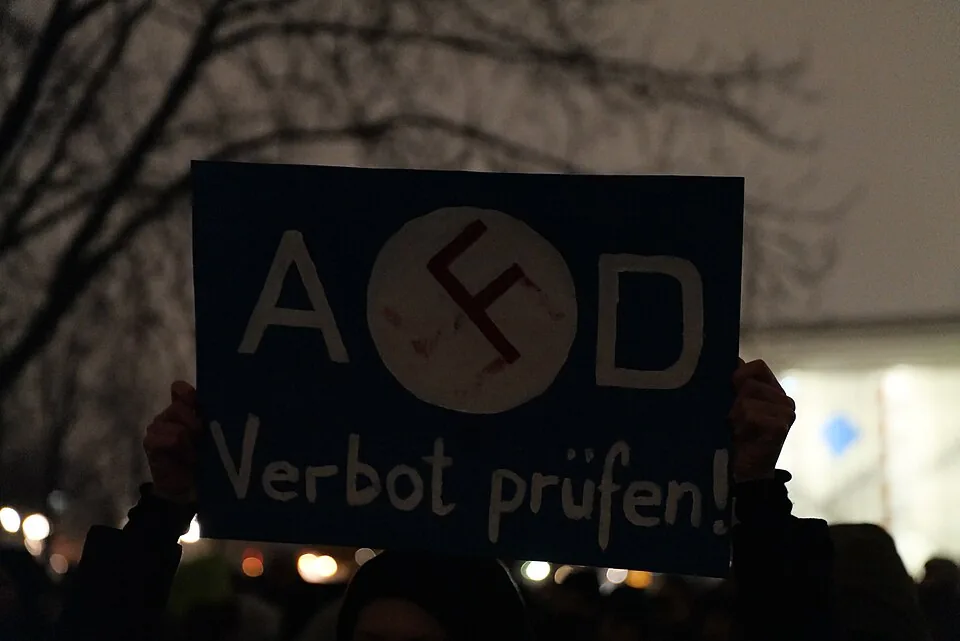
Germany's far-right Alternative für Deutschland just won roughly 44% of the vote in the eastern state of Saxony-Anhalt, more than doubling its 2021 result, while the country's mainstream conservative party essentially got cut in half. If the AfD manages to form a government here, it will be the first time a far-right party has controlled a German state government since World War II. Let that sentence sit with you for a moment.
The Numbers Are Not a Typo
According to exit polls released Sunday by German public broadcasters ARD and ZDF, the AfD is on course to win between 44.1% and 44.5% of the vote in Saxony-Anhalt. The CDU, the party of Chancellor Friedrich Merz, is projected at 18.5%. That is not a close race. That is a demolition.
In the 2021 regional election, the AfD pulled 20.8%. So in five years, they doubled their support while the CDU's share was cut roughly in half. Whatever the CDU thought its strategy was, it did not work. AfD federal leader Alice Weidel went on public broadcaster ZDF to twist the knife, telling viewers that Merz's conservatives will "never win another election." Hyperbole, maybe. But the math right now is not arguing with her.
AfD candidate Ulrich Siegmund, the 35-year-old face of the Saxony-Anhalt campaign, said after the results came in that "we have written history." He then thanked Chancellor Merz directly, saying the CDU leader had been "a very good campaigner for us." That is the kind of burn that does not need a comeback.
Meet the Man in the White Polo Shirt
Siegmund is not the AfD of five years ago. NPR describes him as a former marketing man with a "friendly image but a radical platform" — immaculate side parting, flawless smile, starched white dress shirts. The kind of guy who could sell you a timeshare and a mass deportation policy in the same afternoon without breaking a sweat.
His platform includes mass deportations of migrants, changes to immigration and education policy, restructuring the regional public broadcaster, and closer ties with Russia. Oh, and closer ties with the MAGA movement in the United States. Because apparently the international far-right networking scene is thriving.
The smile never cracks, NPR notes, even when he's talking about the hardest-right immigration positions in contemporary European politics. That is not a reassuring detail. A politician who can discuss mass deportation with the relaxed warmth of someone describing a weekend hiking trip is a very specific and very dangerous kind of politician.
What 'First Time Since World War II' Actually Means
NPR is clear about what a Saxony-Anhalt government under the AfD would represent: the first time in postwar German history that the far-right has controlled a state government. Germany built its entire postwar political architecture specifically to prevent this outcome. The constitution, the electoral system, the memory infrastructure of remembrance culture — all of it was designed with one eye permanently on 1933.
And yet here we are. The AfD has been formally classified as right-wing extremist by domestic intelligence authorities in several German states. That classification carries legal weight in Germany. It is not a political smear from opponents. It is a finding from the security services of a country that knows, better than almost any other, what right-wing extremism looks like when it gets its hands on a government.
Whether the AfD can actually assemble a parliamentary majority remains unclear, as NPR notes. The party may win the most votes without winning enough seats to govern alone, and every mainstream party has so far refused to enter a coalition with them. That firewall has held. The question is whether it keeps holding when one party is sitting at 44%.
This Is Not an Eastern German Problem Anymore
The AfD's strength in eastern Germany is not new. The former East, with its specific post-reunification economic grievances and its complicated relationship with West German institutions, has been fertile ground for the party for years. The easy framing has always been to treat it as a regional anomaly, a protest vote from a part of the country still processing the trauma of reunification.
That framing is now officially dead. As NPR reports, the AfD is also polling first at the federal level. Alice Weidel did not claim Saxony-Anhalt as a local win. She called it a preview. "We are going to see explosive growth across all of East Germany," she said, "and at the federal level, too."
When a party classified as extremist by its own country's intelligence services is leading national polls and just won 44% of a state election, describing it as a regional phenomenon is not analysis. It is wishful thinking dressed up as context.
The Dingo Take
You are supposed to look at 44% for a party that domestic intelligence has classified as right-wing extremist and find some reassuring angle. Some caveat about coalition math, some note about how the firewall has held before, some reminder that winning a plurality is not the same as forming a government. All of that is technically true. None of it is actually reassuring.
The AfD doubled its vote share in five years. The mainstream conservative party that was supposed to be the responsible center-right alternative got cut in half. A 35-year-old former marketing guy who campaigns on mass deportations with a smile is now talking about writing history, and he is not wrong. The architecture Germany spent eighty years building to prevent exactly this outcome is being stress-tested in real time, and the stress is winning.
The MAGA connection Siegmund's party is openly courting is not a footnote. This is the same international movement that has been systematically working to normalize far-right politics across democracies for a decade, and it is working. Germany is not America, and Saxony-Anhalt is not Berlin. But nobody who watched 2016 and said "that could never spread" gets to feel smug about anything right now.





Comments