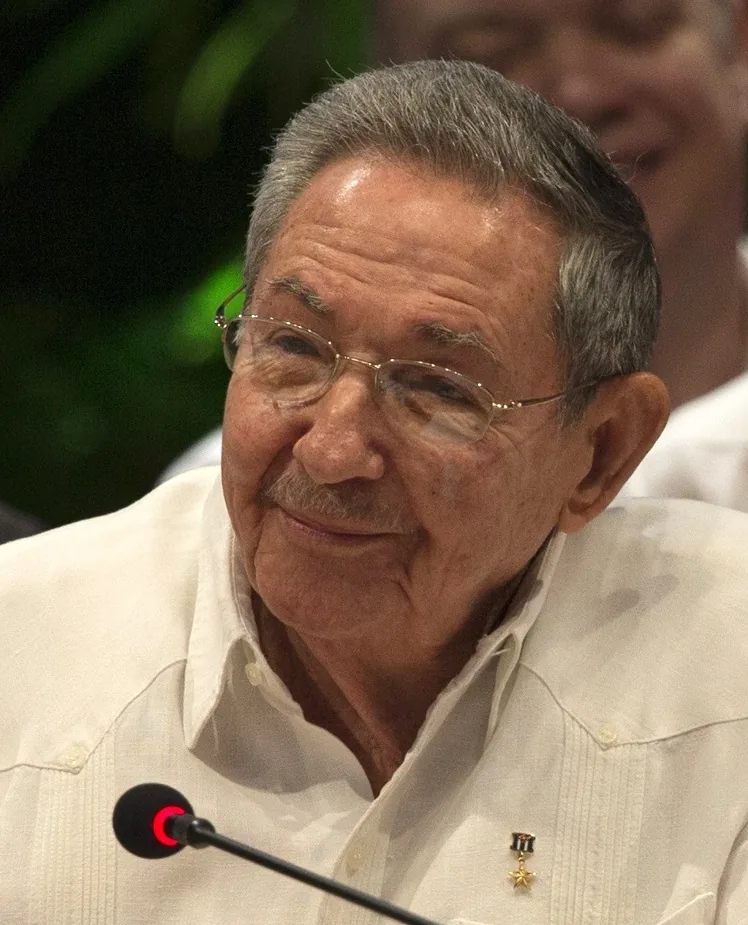
Everyone spent last week writing Raúl Castro's obituary, and he responded by putting on his dress uniform and sitting in the front row of a military ceremony. The 95-year-old former Cuban president made his first public appearance since hospitalization rumors sent South Florida into a frenzy, and Cuban state television made absolutely sure you saw every second of it.
The Comeback Nobody Ordered
According to CBS News, Cuban state television aired more than ten minutes of footage Saturday night showing Castro in his olive-green military uniform, walking alongside high-ranking officials, standing up to receive a commemorative certificate, and greeting attendees. Ten full minutes. That is not a health update. That is a statement.
The event celebrated the 65th anniversary of the Personal Security Directorate, the army branch responsible for protecting Cuba's top leaders. Castro was flanked by his bodyguard and his grandson, Raúl Guillermo Rodríguez Castro. Cuban President Miguel Díaz-Canel posted photos on X the next morning, writing that it was "an honor" to participate alongside the Army General. The subtext could not be louder if they had used a megaphone.
How Bad Were the Rumors?
Bad enough that Castro's alleged illness made serious waves in Miami before Havana said a single word about it. CBS News reports the story originated with Diario Las Américas, a Miami-based Spanish-language newspaper citing a source described as close to Castro inside Cuba. The Cuban government did not confirm the illness. They also did not deny it. Classic.
Castro had already been conspicuously absent from a July rally marking the anniversary of the Cuban revolution, CBS News notes, his first absence from that event in decades. That absence, more than any rumor, is what started the clock ticking. When a 95-year-old authoritarian who hasn't held formal office since 2021 skips the revolution's biggest birthday party, people notice.
The Grandson Is Doing Diplomacy Now
Buried in Saturday's broadcast was a detail that deserves more attention than it's getting. CBS News reports that state television noted Castro's grandson, Raúl Guillermo Rodríguez Castro, participated earlier this year in talks with the United States. Talks that have since stalled, while American sanctions have increased.
Both governments have acknowledged the conversations happened. Neither has released an agenda or any details. The U.S. imposed an oil and financial blockade on Cuba in January, and those sanctions have tightened considerably since. The grandson's diplomatic role is apparently real, and apparently ongoing, even if the talks themselves are currently going nowhere.
The Blockade Is Grinding Cuba Into Dust
Whatever you think of the Castro family's 60-plus years of authoritarian rule, and there is plenty to think, the humanitarian situation in Cuba right now is genuinely brutal. CBS News reports the U.S. energy blockade has worsened a five-year crisis and caused blackouts lasting over 30 hours. Thirty hours without power is not an inconvenience. It is a public health emergency.
The blockade strategy being used by the Trump administration is maximum pressure applied to a population that is already living through severe scarcity of food, medicine, and fuel. Whether you believe this approach will produce political change or simply cause suffering is, at this point, an empirical question. Five years of crisis plus eight months of blockade have produced stalled talks and longer blackouts. Draw your own conclusions.
Oh, and the U.S. Also Charged Him With Murder
In June, CBS News reports, the U.S. Department of Justice filed murder charges against Castro in connection with the 1996 downing of two small planes belonging to Brothers to the Rescue, an anti-Castro organization. The aircraft had entered Cuban airspace as part of a campaign pushing for political change on the island. Four people were killed.
Filing murder charges against a 95-year-old former head of state who lives in a country the U.S. has no extradition treaty with is, legally speaking, mostly a gesture. A significant one, politically. But a gesture. Castro is not going to stand trial in a Miami courtroom. What the charges do is cement his status as a sanctioned, criminally indicted figure while he's still alive to see it, which is presumably the point.
The Dingo Take
You are supposed to look at ten minutes of Cuban state television showing a 95-year-old man accepting a certificate and think "he seems fine." Maybe he is. Maybe this was the most elaborate wellness check in Caribbean history, staged specifically because exile communities in Florida were already planning celebrations. The Cuban government has never once in its existence done anything that wasn't calculated, and airing a ten-minute highlight reel of Raúl Castro upright and in uniform one week after hospitalization rumors broke is not a coincidence. It is a production.
What makes this genuinely complicated is that the geopolitical situation around Cuba keeps moving regardless of whether Castro is healthy, dying, or somewhere in between. His grandson is apparently the new back-channel diplomat. The talks with Washington are frozen. The blockade is causing 30-hour blackouts for ordinary Cubans who have no vote, no say, and no ability to fix any of this. The Trump administration is applying maximum economic pressure to a civilian population to produce a political outcome while simultaneously charging a 95-year-old with 1996 crimes it knows it can't prosecute. It is simultaneously maximally aggressive and operationally pointless.
Raúl Castro has outlived every prediction, every sanctions regime, and apparently every serious illness. He'll probably outlive the current diplomatic freeze too. The people actually suffering through this standoff are the ones who didn't get ten minutes on state television last Saturday night.



Comments