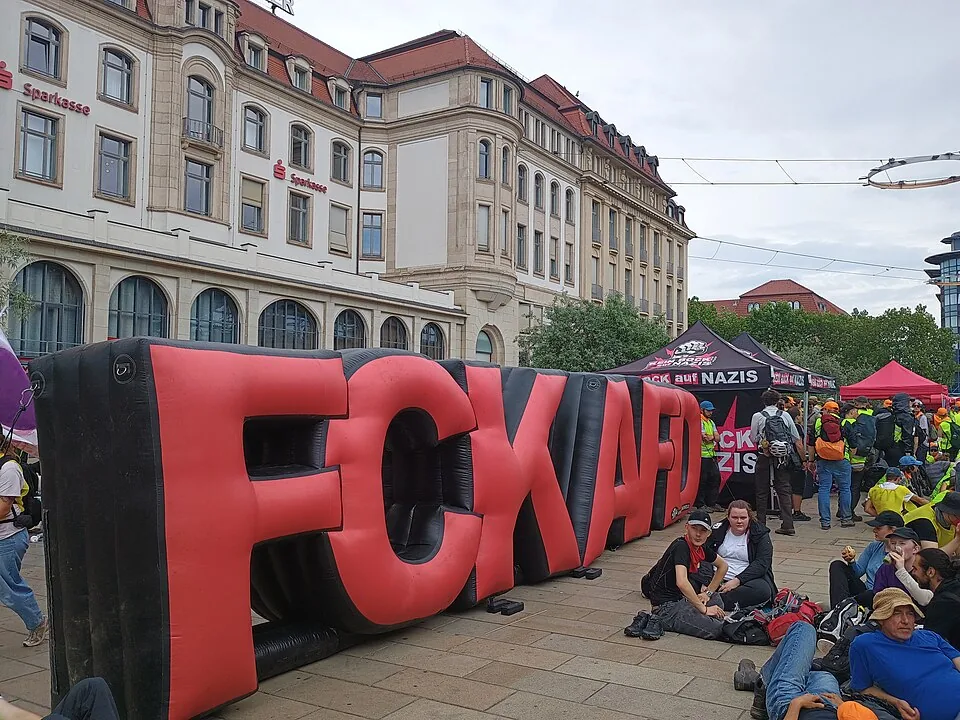
Germany, the country that spent the better part of the twentieth century as the world's cautionary tale about what happens when you hand power to nationalist extremists, has gone ahead and handed power to nationalist extremists. The far-right party won a landslide victory, according to NPR's morning news brief on September 7th. Let that sentence sit with you for a moment.
What Actually Happened
NPR is reporting that Germany's far-right party secured a landslide victory in national elections. Not a narrow squeaker. Not a hung parliament where they scraped into a coalition through backroom dealing. A landslide. The kind of result that suggests this isn't a fluke or a protest vote or a bad polling night. This is where a significant chunk of the German electorate has decided it wants to go.
The party in question has spent years positioning itself as the outlet for German voters who feel left behind, ignored, or actively threatened by immigration, economic disruption, and the general churn of modern life. Sound familiar? It should. This is the same playbook that's been run successfully in Hungary, Italy, France, the Netherlands, Sweden, and, of course, the United States. The script barely changes. Only the accents do.
How We Got Here
Germany has been under sustained political and economic pressure for years. The energy crisis that followed Russia's invasion of Ukraine gutted German industry in ways the country is still recovering from. Inflation hammered ordinary households. Migration became a flashpoint after a series of high-profile violent crimes that the far right weaponized with extraordinary efficiency, regardless of context or statistical reality.
The mainstream parties, the center-left SPD and the center-right CDU/CSU, spent much of the last several years fighting each other more effectively than they fought the actual crises facing German voters. Coalition governments collapsed. Chancellors came and went. And into that vacuum of competent, coherent leadership, the far right walked with a simple message: everyone else has failed you, and we will not. It is a lie, historically speaking. But it is a very effective lie when the alternative is a governing coalition that can't keep the lights on.
There is also the east-west divide to reckon with. The former East Germany has been a hotbed of far-right support for years, driven by genuine economic grievance, demographic hollowing, and a complicated relationship with the post-reunification order that left many eastern communities feeling like second-class citizens in their own country. But this result suggests the support has spread well beyond those traditional strongholds.
Why the Rest of the World Should Care
Germany is not a small country having a bad election cycle. It is the largest economy in Europe, the anchor of the European Union, and historically the country whose political stability has been treated as non-negotiable for the entire Western liberal project. When Germany catches a cold, as they say, Europe gets pneumonia.
A far-right German government would reshape European Union politics overnight. Think about what that means in practical terms: migration policy, climate commitments, support for Ukraine, the future of NATO burden-sharing, the basic question of whether the EU functions as a unified bloc or fractures into competing nationalist interests. All of it becomes suddenly, dramatically negotiable in ways it hasn't been since the bloc was founded.
And if you think this is someone else's problem, consider that a more nationalist Germany would be operating in the same geopolitical moment as a Trump administration in Washington that has already shown its preference for bilateral deals over multilateral institutions. The two most powerful economies in the Western alliance both lurching toward nationalist governments at the same time is not a coincidence you can just shrug off.
The International Far-Right Feedback Loop
There is a pattern here that deserves more attention than it typically gets. These movements don't operate in isolation. They watch each other, learn from each other, and celebrate each other's victories in ways that mainstream political parties almost never do across borders. When Viktor Orban wins in Hungary, Marine Le Pen studies it. When Trump wins in America, every far-right party in Europe gets a jolt of momentum and a new template for messaging.
And the victories reinforce each other politically and psychologically. Voters who were skeptical start to think: well, it worked over there. Maybe it's not so extreme. Maybe it's just common sense that everyone else is suddenly seeing. The Overton window doesn't just shift in one country. It shifts across all of them simultaneously, because these movements are coordinated, funded through overlapping networks, and operating from a shared ideological playbook even when they pretend otherwise.
Germany's result is the latest data point in a trend line that has been pointing in one direction for about a decade. Dismissing each individual result as a local anomaly, a one-off response to a specific crisis, a thing that can't happen here, is how you end up very surprised, very often.
Meanwhile, Back in Miami and Kyiv
The Germany story broke on the same morning NPR was also reporting on five people killed in a cargo plane crash at Miami International Airport and Trump's top envoys heading to Ukraine in hopes of restarting peace talks. Three enormous stories landing simultaneously, which is its own kind of commentary on the moment we're living through.
The Ukraine angle is worth watching closely. Trump's envoys showing up in Kyiv to restart peace negotiations comes after months of the administration making clear it does not see continued support for Ukraine as an American interest. What those talks actually look like, who's being asked to give up what, and whether Kyiv has any real leverage in negotiations where one of the mediators has spent two years questioning whether Ukraine deserves to exist as a sovereign state, these are questions that don't have reassuring answers yet.
A newly elected far-right German government with its own complicated relationship with Russia policy enters that picture at a genuinely dangerous moment. Timing, as they say, is everything.
The Dingo Take
You are supposed to believe that each of these far-right victories is a isolated event. A local reaction to local conditions. Something that can be explained away by a specific economic crisis or a specific scandal or a specific migration surge that won't repeat elsewhere. Germany has a complicated history, people say. Eastern voters have legitimate grievances, analysts explain carefully. And yes, all of that is true. None of it changes what just happened.
What just happened is that the country most responsible for establishing, after catastrophic and murderous trial and error, that aggressive ethnic nationalism leads somewhere everyone agrees was monstrous, has voted for aggressive ethnic nationalism in a landslide. Not because German voters have forgotten their history. But because enough of them have decided that their present frustrations outweigh it. That is not a footnote. That is the whole story.
The liberal democratic order that the post-World War II world was built to protect doesn't collapse in one dramatic moment. It goes piece by piece, election by election, each one explained away as a local quirk until one day you look up and the pieces are mostly gone. Germany just took a very large piece. Pay attention.





Comments