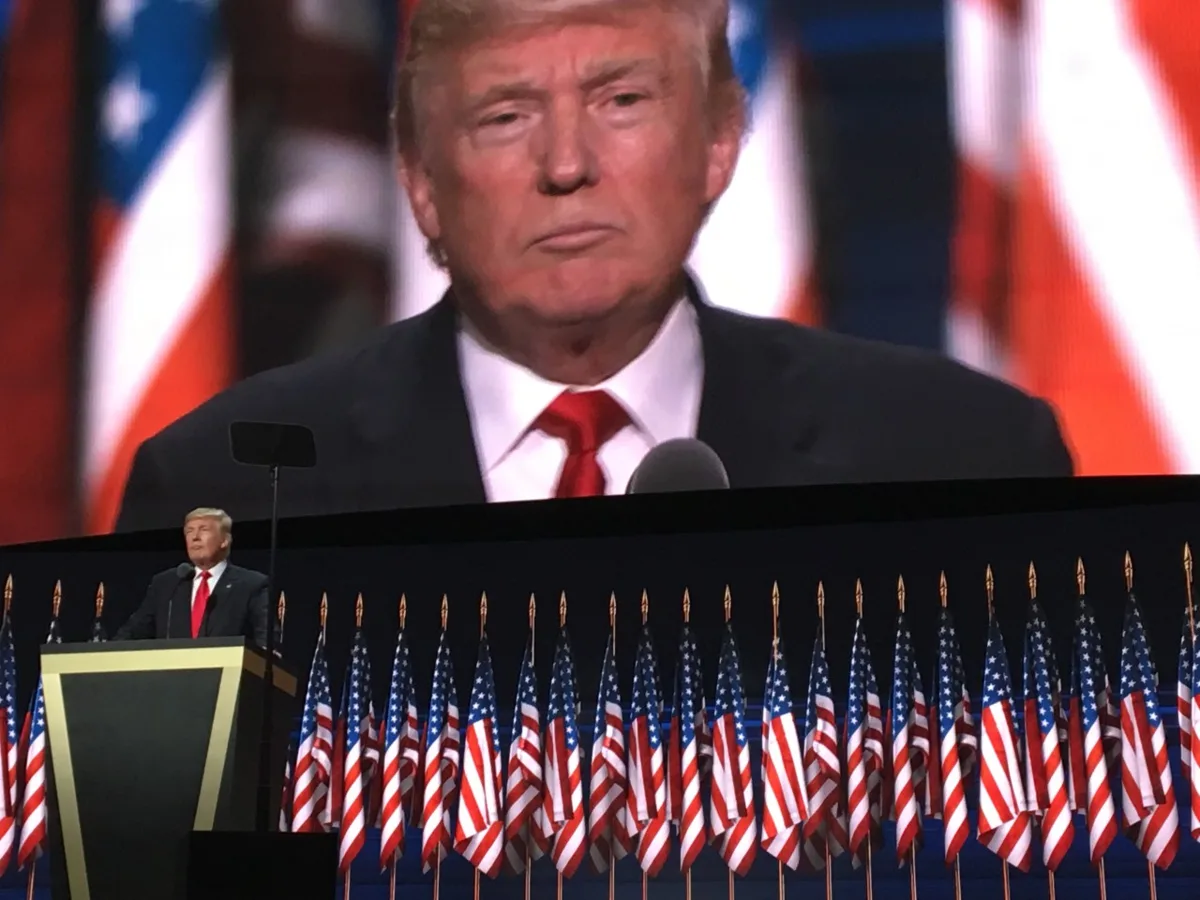
Donald Trump is sitting on $403 million in Super PAC money with midterm elections approaching, and according to multiple reports, his plan is to spend it on the one candidate he's always believed in most: himself. His approval rating is rotting in the mid-30s, Republican candidates in competitive districts are quietly begging his staff to keep him away, and the strategy his own team has landed on is essentially a Donald Trump promotional tour. This is fine. Everything is fine.
The Number That Should Terrify Every Republican Strategist
As of July 31, MAGA Inc had more than $400 million in cash reserves, more than any major party committee on either side of the aisle, according to The Guardian. That is an almost incomprehensible amount of political money. It could define races, lock in ad time, shape narratives across dozens of competitive districts before voters have made up their minds.
Instead, almost none of it has moved. Trump has spent the summer sitting on the pile like a very angry dragon who also wants you to know how big the pile is.
The Guardian reports that in early August, Trump told advisers the strategy for the midterms should mirror what Democrats are already doing: make the election about him. Karl Rove, who helped architect two Bush presidential victories and knows something about electoral math, immediately pointed out in the Wall Street Journal that this is a catastrophically stupid idea, given that Trump's approval rating is currently mired in the mid-30s.
Karl Rove Is Screaming Into a Very Large, Gold-Plated Void
Rove's Wall Street Journal warning was not subtle. He wrote that Trump "is never disciplined," that he'll have no script, and that his unfiltered rally appearances will produce a constant stream of comments that Republican candidates will spend their entire campaigns either defending or desperately distancing themselves from. The Guardian quotes Rove saying the narrative "won't be on anything positive about them or the GOP."
Rove and other Republican operatives are urging Trump to use the $403 million to actually support Republican candidates. You know, the traditional purpose of a campaign war chest. They are, as Robert Reich writes in The Guardian, yelling into the wind of Trump's ballroom-sized ego.
For what it's worth, Trump's team has already burned through about $1 million on the first wave of midterm ads through the non-profit arm of his operation, Securing American Greatness. The Guardian reports those ads feature video clips of Trump talking about tax cuts in his domestic legislation and lower egg and prescription drug prices. It is, structurally, an ad about Donald Trump. The candidates whose seats are actually on the line are largely decorative.
Republican Candidates Are Quietly Saying Please, God, No
Here is where it gets genuinely funny in a way that makes you want to lie down on the floor. Fox News White House correspondent Peter Doocy is reporting whispers of "a ton of Trump travel in October, possibly as much as a Trump rally a day" in competitive states and districts, according to The Guardian. A rally a day. In October. In swing districts.
Politico is reporting that some battleground Republicans have already told Trump's staff they would prefer he not visit their districts at all ahead of November. Four Republican operatives involved in those conversations confirmed this. One senior Republican, operating in a district Trump won by double digits, told Politico bluntly: "We've told them he cannot come. Candidly, he would not be helpful here."
Read that again. A district Trump won by double digits. They still don't want him there. Republican pollsters, meanwhile, have been quietly advising candidates in tight races to limit how often they even mention his name. The man who demanded absolute loyalty from his entire party is now the person his own party is trying to bury under talking points about local infrastructure.
What the Money Is Actually For
Reich lays out the most plausible theory in The Guardian, and it is not a flattering one for anyone hoping the Republican Party functions as an organization with collective goals. Trump's calculation, Reich argues, is essentially this: if he puts Super PAC money behind candidates and they lose, he looks bad. So better not to bet on them at all. Better to spend the money making Donald Trump look like Donald Trump wants to look.
There's also the 2028 angle. Reich floats the possibility that some of this cash is being preserved to discipline Republicans in future primary cycles, rewarding loyalty and punishing deviation. He concludes that theory is limited by the fact that Trump is already "practically a lame duck." Which is a sentence that would have been unthinkable a year ago and is now just Tuesday.
What we are left with is a $403 million pile of political money that may, functionally, exist to make one man feel better about his approval ratings. That's not a campaign strategy. That's a very expensive therapy substitute.
The Dingo Take
You are supposed to believe that a political party with hundreds of millions of dollars available, facing a genuinely competitive midterm environment, is being held back from spending that money by strategic caution and careful timing. You are supposed to believe the delay is intentional, the plan is sound, and the rallies will help. Look at the actual evidence and tell me that story holds together.
Trump's approval ratings are historically bad. His own party's operatives are asking him not to show up. His first ads are biographical clips about himself. Karl Rove is writing Wall Street Journal op-eds begging him to act like a normal political actor, which is roughly equivalent to asking water to stop being wet. The most powerful Republican in the country has $403 million and the strategic instincts of someone who has never once in his life considered what another person might need.
Republicans built this. They fed the ego, excused the behavior, and handed one man complete control of their party's money and message. Now they're stuck whispering to staffers that please, if it's not too much trouble, maybe don't send him to our district. They don't get to be surprised. The only people who should be surprised are the ones who thought a man who has never prioritized anyone but himself was going to start doing it now, with $403 million on the table and a brand in desperate need of repair.



Comments