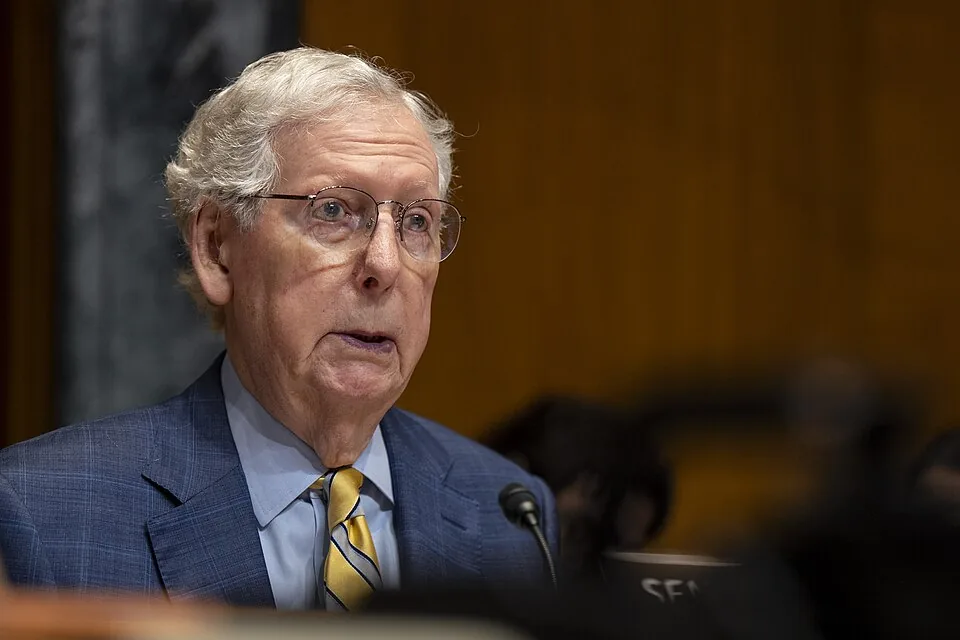
Mitch McConnell's office spent weeks unable to tell reporters anything more concrete than that they 'hoped' he'd make it back to the Senate this week. He did not make it back Monday. His aides are now pointing to Wednesday, which, if you're keeping score, is not this week's first two days.
The Senate Came Back. McConnell Didn't.
The chamber returned from August recess on Monday afternoon, senators filed in, the gavel came down, and one very famous Kentucky Republican was nowhere to be found. According to The Independent, McConnell remained absent as the Senate gaveled back into session, with his office offering no clearer guidance than that they hoped he might return at some point during the week.
Politico reports that aides eventually told Senate GOP leadership he would be back for votes on Wednesday. So the 84-year-old Senate veteran, fresh off a hospitalization that stretched into weeks at a rehab center, will apparently ease back in by skipping roughly half the week. A gentle re-entry. A soft landing. A man taking his time.
His office did not respond to The Independent's request for his schedule Monday. That tracks. His office has been playing information keep-away since June.
Months of Mystery, One Word: Pneumonia
McConnell was first hospitalized in June. What followed, as The Independent reports, was a slow, aggravating trickle of information that satisfied essentially nobody. His office released statements. His office released photos. His office released a statement from McConnell himself saying he would maintain 'an intensive regimen of physical therapy from home' during the state work period. The word 'pneumonia' eventually surfaced as the official explanation.
Kentucky's Democratic Governor Andy Beshear spent weeks calling on McConnell to release a video statement confirming he could actually do his job. He was rebuffed. Not ignored, not delayed. Rebuffed. The senator's team actively pushed back on the entirely reasonable request that a sitting U.S. senator demonstrate he remains capable of being a sitting U.S. senator.
What filled the information vacuum, as it always does, was garbage. The Independent notes that conspiracy theories flooded X and eventually seeped into mainstream culture, amplified by late-night jokes on The Daily Show and elsewhere. When you refuse to tell people what's happening, people will decide for themselves. This is not a new lesson.
Meanwhile, Congress Has a Body Count
This is not solely a McConnell story, which is the part that should genuinely disturb you. The Independent's reporting situates his absence within a much broader pattern of elderly lawmakers visibly struggling to function in the jobs they refuse to vacate.
Sen. Lindsey Graham died earlier this year at 71. Rep. David Scott died in April at 80, following multiple reported episodes of disoriented behavior on Capitol Hill. Before his hospitalization, McConnell himself was captured on C-SPAN sitting largely silent on the Senate floor for around six hours during a stretch of debate. Journalists covering Congress have reported members of both parties appearing confused at hearings, at press conferences, and wandering the hallways of the Capitol complex.
This is the legislative body making decisions about war, healthcare, economic policy, and the basic functioning of the federal government. The people doing that work include, apparently, a significant number who cannot reliably tell you what day it is.
A Crypto Vote, a Missing Senator, and a Clock Running Out
The timing of McConnell's absence carries some actual legislative consequence. The Senate is scheduled Tuesday to vote on the Clarity Act, a cryptocurrency regulation bill that would require federal officials to place crypto assets into a blind trust or divest entirely. McConnell will miss that vote.
The Senate has three weeks in Washington before it leaves again ahead of the midterm elections. The House departs at the end of this week. As The Independent notes, that makes meaningful legislative progress on anything genuinely difficult. The window is narrow. The schedule is brutal. And one of the chamber's most influential Republicans is, at minimum, working a four-day week.
McConnell's team has not explained what Wednesday's return will look like in practice, what his workload will be, or how his physical condition affects his capacity to function at full speed. These seem like reasonable things for voters in Kentucky, and frankly everyone else, to know.
The Dingo Take
You are supposed to believe this is a normal situation. A senator is hospitalized for weeks, his own aides cannot tell reporters whether he will show up to work on any given day, the governor of his home state has to publicly beg for proof of life on camera, and the official response from his office is silence followed by a written statement promising physical therapy. Normal. Fine. Moving on.
It is not normal. What is actually happening here is that a powerful man's staff is running interference to protect his tenure while the voters he represents have no reliable information about whether he can do his job. That is a structural failure dressed up as a health matter. And it is happening across both parties, in both chambers, repeatedly, because there are no mechanisms to stop it and no political incentives to create them. The age debate cost Joe Biden the Democratic nomination. It has so far cost Mitch McConnell precisely nothing.
Two senators and a House member have died this year. McConnell spent the summer in a hospital and a rehab facility and still couldn't tell anyone when he was coming back. The Senate is currently scheduled to legislate for three weeks before leaving town again. At some point, the darkly funny part stops being funny and starts just being dark.



Comments