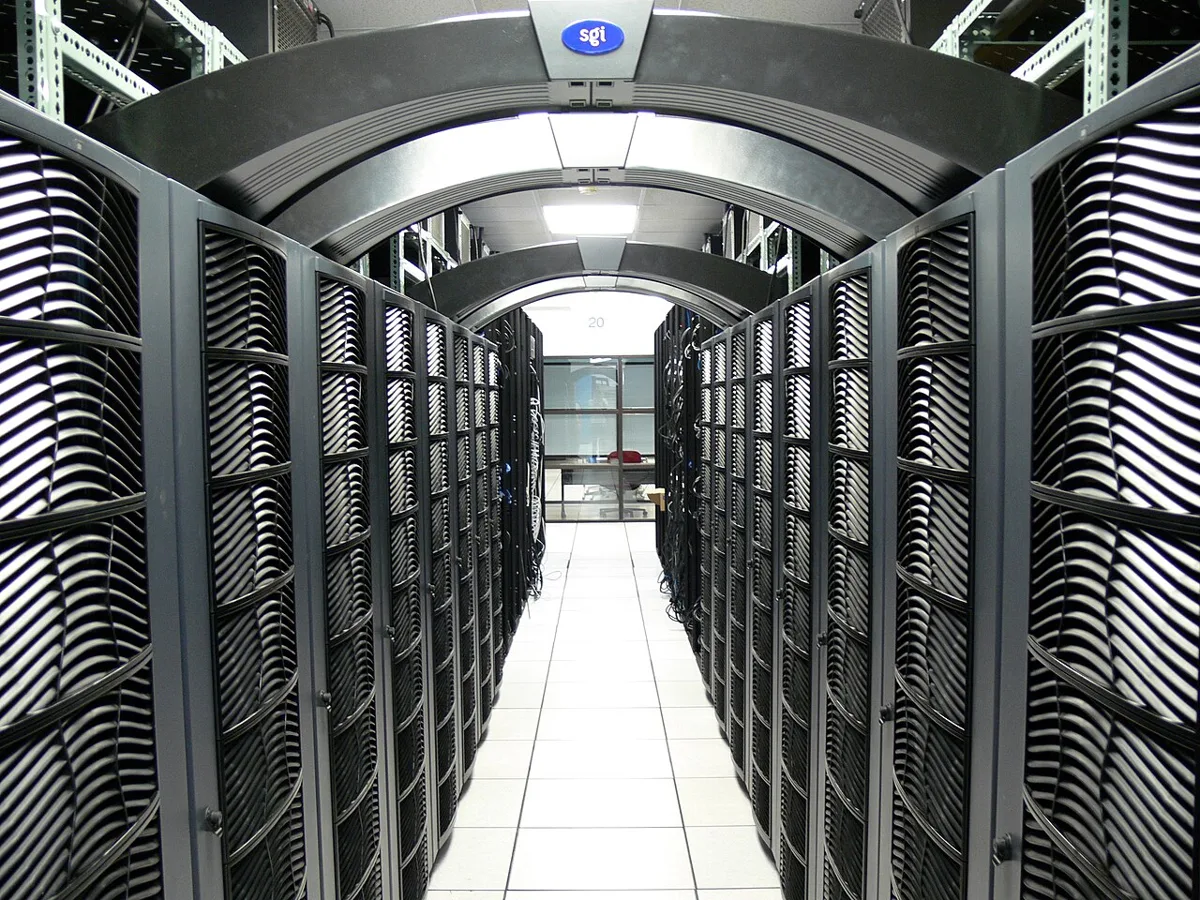
Donald Trump would like you to know that if your community doesn't want a massive, water-guzzling, electricity-sucking data center built near your home, you are going to end up backwards and poor. This week he doubled down on that message, rejecting any calls to slow the AI infrastructure buildout. Congress, meanwhile, is fracturing in every direction at once, which is about the only thing it does reliably anymore.
The Presidential Sales Pitch Nobody Asked For
Trump's position here is about as subtle as a server farm humming at full capacity at two in the morning. According to Fox News Digital, he has repeatedly warned that communities pushing back on data center development will fall behind economically, framing opposition as basically choosing poverty on purpose.
Rep. Ro Khanna of California was not moved by this argument. 'Trump has failed to deliver for the forgotten American, so he's just grasping at straws,' Khanna told Fox News Digital. That is a remarkably clean line, and he is not wrong. The same administration that has spent years telling working-class communities it has their back is now telling those same communities to shut up and take the server farm.
Rep. Yassamin Ansari of Arizona went one step further and suggested that if Trump loves data centers so much, he should welcome one into his own backyard. Which, honestly, fair point. Mar-a-Lago is in Florida. Florida has land. Florida has sunshine. Let's talk.
What Data Centers Actually Do to a Community
Here is what the boosterism tends to leave out. Data centers consume staggering amounts of water for cooling and draw enormous loads from local power grids. Fox News Digital reports that multiple states have raised serious concerns about electricity costs, water consumption, and the pace of development in residential and semi-rural areas.
Rep. Haley Stevens of Michigan put it plainly: 'It baffles me that we are just not guaranteeing, for average ratepayers, low utility bills.' She is talking about a scenario where tech giants build out AI infrastructure on the cheap, local power grids strain under the load, and ordinary households end up absorbing the cost through higher bills. That is not a hypothetical. That is already happening in communities across the country.
Rep. Jonathan Jackson of Illinois framed it as a wealth distribution problem, telling Fox News Digital that 'the wealth has gone into the tech sector, and they are unregulated, unbridled and not very philanthropic.' Unregulated and unbridled is doing a lot of work in that sentence, and it is accurate.
Khanna's Bill Would Keep Data Centers 2,500 Feet Away From Your Kids' School
Khanna has introduced what he is calling a Data Center Bill of Rights. According to Fox News Digital, the legislation would ban data centers within 2,500 feet of homes, schools, child care facilities, hospitals, and nursing homes, and give local communities real authority over siting decisions. That is not a radical position. That is the kind of zoning conversation most localities have about a Walmart.
The fact that we have reached a moment where Congress has to write a bill asserting that maybe you should not put a massive industrial facility next to an elementary school tells you something about how fast this industry has moved and how thoroughly regulators have lagged behind it.
The Republican Split Is Real, and It Is Getting Louder
Fox News Digital's reporting makes clear that this is not a clean partisan divide, which makes it more interesting and more complicated. Some Republicans are fully on board with the Trump vision. Rep. Rich McCormick of Georgia said communities should be 'fighting over' data centers for the tax revenue and infrastructure benefits they bring. 'If you don't want one, I think you're missing out,' he told Fox News Digital.
But Rep. Nancy Mace of South Carolina broke with that line, backing AI investment on national security grounds while opposing residential siting. 'We've got to stay ahead of China with AI, and data centers are a part of that,' she said. 'But you don't put them in somebody's backyard.' That is a more defensible position, and notably it lines up with what most local community groups are actually asking for.
Rep. Ralph Norman, also of South Carolina, took a federalist off-ramp, arguing that the 10th Amendment means states and communities should decide for themselves. Which is a fine principle, right up until the federal government starts leaning on those same communities to approve projects for national AI competitiveness reasons. You cannot simultaneously invoke states' rights and threaten towns with economic backwardness for using them.
Arizona Is Running Out of Water While the Servers Run Hot
Arizona deserves particular attention here because the situation there is not abstract. The state is in a long-term water crisis. The Colorado River, which Arizona depends on heavily, has been shrinking for decades. And data centers, particularly in hot climates, use enormous volumes of water for cooling.
Ansari's call for a pause in Arizona's data center expansion until the state can assess long-term water and ratepayer impacts is not anti-technology hysteria. It is basic governance. Fox News Digital reports she described Trump's enthusiasm for the facilities as 'out of touch' with what 'the vast majority' of Americans want. Whether that polling holds is a separate question, but the underlying concern about water in a desert state with a dwindling supply is not a fringe position. It is hydrology.
The Dingo Take
You are supposed to believe that the choice here is between embracing data centers unconditionally or getting left behind by China and history. That is the frame the Trump administration is selling. It is also nonsense. No serious person is arguing that the United States should not build AI infrastructure. The argument is about who pays for it, where it goes, and whether the communities hosting these facilities get anything out of the deal besides higher electricity bills and noise complaints. Those are not anti-progress questions. They are the only questions worth asking.
What is actually happening is that a massively profitable industry is pushing to build as fast as possible with as little friction as possible, and the federal government is running interference for them by threatening communities that slow-walk permits. The power bills go up, the water table goes down, and the quarterly earnings reports look great. Then Trump shows up and tells the locals they should be grateful. Classic.
The congressional fracturing Fox News Digital documented is the most honest thing in this whole story. Even Republicans who support the AI buildout are struggling to defend putting industrial-scale facilities in residential neighborhoods. That is not a complicated ethical problem. The fact that it requires a federal bill to establish that data centers should not be built next to schools is a perfect illustration of how thoroughly the industry has outrun any coherent regulatory framework, and how thoroughly the current administration is fine with that.




Comments