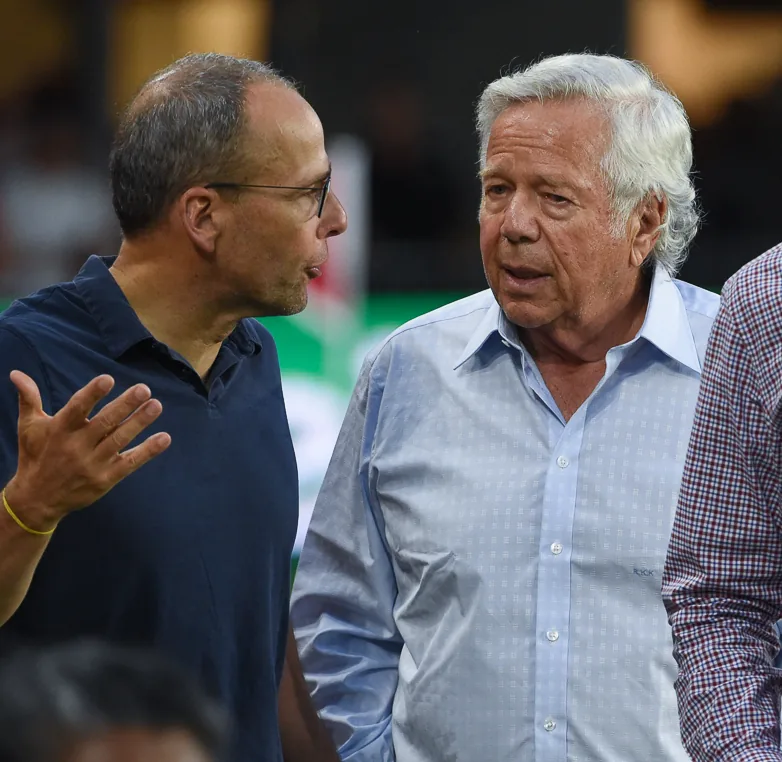
Robert Kraft spent thirty years building a reputation as the NFL owner who actually gave a damn — flying planes to Parkland kids, springing Meek Mill from prison, loaning his jet to fetch masks from China during a pandemic. Then he banned a rapper from his stadium for having opinions about Gaza, and now all that carefully curated goodwill is sitting in a dumpster fire behind Gillette Stadium. According to The Guardian, Kraft didn't just block Macklemore from the Ed Sheeran date at his own venue — Macklemore says Kraft appeared to pressure other NFL owners to freeze him out of most of Sheeran's other stadium stops too.
What Kraft Actually Did
Ed Sheeran is on a stadium tour. Macklemore was booked as a supporting act. Simple enough. Then Robert Kraft, owner of the New England Patriots and landlord of Gillette Stadium, pulled the plug on Macklemore's appearance at his venue, citing what he described as Macklemore's "recent actions" and "a broader history of antisemitic rhetoric and imagery."
Macklemore's camp tells a different story. The rapper says Kraft didn't stop at his own house — he allegedly worked the phones with other NFL owners to get Macklemore bounced from most of the other stadium dates on the tour. As The Guardian reports, this has left Sheeran's opening act lineup in tatters, with multiple other performers resigning from the tour in solidarity with Macklemore.
Kraft's antisemitism claim leans heavily on a 2013 incident in which Macklemore wore a wig, fake beard, and hooked nose at a Seattle concert. Critics called it an anti-Semitic caricature. Macklemore apologized. That was thirteen years ago. The "recent actions" Kraft referenced? The rapper's vocal support for Palestinians.
The Good Guy Myth, Shattered
This is the part that stings, because Kraft really did work to be different. The Guardian runs through the tape and it's genuinely impressive. He supported Patriots players Devin and Jason McCourty in their criminal justice reform advocacy. He helped get Meek Mill released from prison. After Parkland, he loaned the team plane to students heading to Washington to protest gun violence. When Trump was telling people to inject bleach and calling COVID a hoax, Kraft sent his private jet to China to haul N-95 masks back to the United States.
The man cultivated a specific image: the owner who got it, who understood that power comes with responsibility, who could sit across from rappers and activists and not look like a complete fraud. He made bipartisan political donations. He fought his stadium battle with Massachusetts politicians without taking public money. He was, by NFL owner standards, aggressively reasonable.
And now here he is, doing the exact thing that Roger Goodell went on a Zoom call in 2020 to apologize for. Using ownership power to silence a performer whose political views he finds inconvenient. The Guardian draws the line direct and clean: this is what the league did to Colin Kaepernick, and Kraft — who spent years performing sympathy for Kaepernick's situation — is now running the same play.
The Kaepernick Echo Is Impossible to Ignore
Colin Kaepernick knelt during the national anthem to protest police killing Black people without consequence. The NFL collectively destroyed his career for it. Years later, Goodell admitted on camera that the league had been wrong. Kraft nodded along, supported the McCourty brothers, showed up to all the right moments.
Now Kaepernick himself, according to The Guardian, says the same tactics of collusion used against him are being deployed against Macklemore. An owner banning a performer. That owner allegedly coordinating with other owners. A coordinated freeze-out dressed up in the language of community protection.
The politics have shifted but the machinery is identical. Kaepernick said cops were killing people and getting paid leave for it. Macklemore says Palestinians are dying and it matters. Both of those statements are factually defensible. Both cost them stages. One cost a quarterback his entire career.
The Antisemitism Cover
Let's take Kraft's stated reason seriously for a moment, because the 2013 costume incident is real and it was genuinely bad. Macklemore wore something that read as an anti-Semitic caricature in public. He apologized. Whether you find that apology sufficient is a legitimate discussion.
What is harder to take seriously is using a thirteen-year-old incident as the primary justification for a 2026 ban, when the "recent actions" driving the actual decision are clearly about Palestine. Dressing political retaliation in the language of fighting antisemitism is a move that, as The Guardian notes, has become normalized under Trump — a president who has his own complicated relationship with actual antisemitism while deploying the accusation as a political cudgel against critics of Israeli government policy.
Kraft has every legal right to decide who performs at his stadium. Nobody is disputing that. The question is why he's doing it, and the timing makes the answer pretty obvious.
Sheeran Doesn't Escape Clean Either
Ed Sheeran is not coming out of this looking great. His opening acts are quitting the tour in solidarity with Macklemore, which means Sheeran is watching his own tour become a referendum on whether he'll push back against the owner calling the shots at his venue. So far, he has not pushed very hard.
The Guardian's Howard Bryant puts it bluntly: one of the two men in this story looks like a dictator, and the other looks like a wimp. It's not a flattering binary, but it's the one Sheeran built for himself by not doing more to stand behind his own opening act.
These stadium shows exist because Sheeran fills seats. He has leverage here. Whether he chooses to use it is a choice, and choosing not to use it is also a choice.
The Dingo Take
You are supposed to believe that Robert Kraft banned Macklemore to protect the Jewish community. A man who spent three decades building goodwill with activists, rappers, and reform advocates now wants you to think his concern is a 2013 Halloween costume. Come on. His own statement gives it away — "recent actions" is the tell. The recent action is Palestine. The costume is the legal cover.
This is how the blacklisting of politically inconvenient artists works in 2026. You don't say "shut up about Gaza." You find something else — something old, something that sounds protective rather than punitive — and you staple it to the front of the decision. The NFL did a version of this with Kaepernick for years, endlessly shifting the justification while the result stayed the same: the guy with the wrong politics doesn't get the stage.
Kraft spent years being the owner who was better than this. Now we know he was just waiting for the cause he actually cared about enough to stop pretending. Every billionaire has one. His was this. The plane flights and the prison releases and the Parkland kids were real — and they were also, it turns out, part of a personal brand that had a limit. He found it. So did we.

Comments